Langstroth and top-bar hives serve different operating models. Langstroth hives use standardized, removable frames in stacked boxes, making them better suited to inspection, colony division, comb reuse, mechanized extraction, and commercial throughput. Top-bar hives use a horizontal box with individual bars and free-hanging comb, reducing heavy lifting and often allowing gentler inspections, but requiring more careful handling and more manual harvesting.
Choose Langstroth for modularity, scalable honey production, and equipment compatibility; choose top-bar for simpler horizontal management, lower lifting demands, and a lower-disturbance approach where manual harvesting is acceptable.
How the Hive Structures Differ
Langstroth: A vertical, modular system
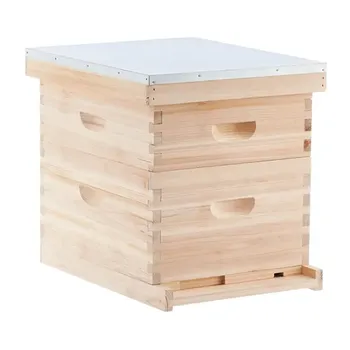
A Langstroth hive consists of stackable boxes, removable frames, supers, bottom boards, and covers. The colony expands vertically as additional boxes are added.
Each frame provides a four-sided support structure for the comb. Foundation may also guide the bees’ comb construction and promote consistent spacing.
Top-bar: A horizontal, single-box system
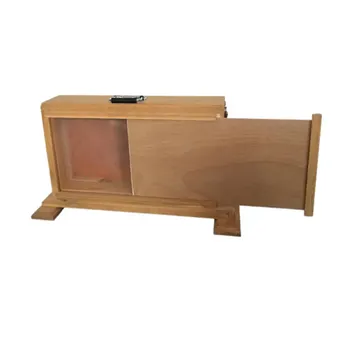
A top-bar hive is a long horizontal trough fitted with individual bars across the top. Bees build comb downward from each bar without the support of a complete wooden frame.
The hive’s inward-sloping walls help reduce comb attachment to the sides. Because the hive is generally shorter and wider, inspections can be performed by moving bars one at a time rather than lifting stacked boxes.
The structural consequence
Langstroth architecture prioritizes standardization and mechanical support. Top-bar architecture prioritizes horizontal access, simple construction, and natural comb building.
That difference affects nearly every management task: inspection, expansion, transport, harvest, repair, and equipment purchasing.
Operational Differences in Apiary Management
Inspection and colony disturbance
Langstroth frames can be removed individually for detailed inspection, brood assessment, queen checks, disease monitoring, and colony division. However, lifting and removing frames can disturb the colony more than a careful top-bar inspection.
Top-bar inspections typically involve sliding bars apart sequentially. This avoids lifting heavy supers and can reduce disruption when performed carefully.
The advantage is not absolute: top-bar comb is more vulnerable to crushing, tearing, or sudden movement, so rough handling can still cause significant disturbance.
Expansion and swarm management
Langstroth colonies can be expanded by adding boxes or supers as the population and nectar flow increase. Standardized frames also simplify splitting colonies, exchanging resources, and reusing drawn comb.
Top-bar colonies expand horizontally by adding more bars. This avoids vertical lifting, but it requires closer attention to comb alignment and available space.
For operators managing many colonies, Langstroth’s modular expansion is usually easier to standardize across sites and teams.
Comb reuse and colony cycles
Langstroth frames allow drawn comb to be removed, stored, redistributed, and reused. Reusing established comb can reduce the colony’s need to produce new wax and help accelerate brood or honey production.
Top-bar comb can sometimes be retained and managed across inspections, but it is less robust and is commonly cut during harvest or when damaged. Rebuilding comb therefore becomes a more significant part of the colony’s work and the beekeeper’s operating cycle.
The primary reference’s suggestion that bees necessarily build entirely new comb during every top-bar inspection should be treated cautiously. The practical issue is that top-bar comb is less reusable and less mechanically secure, not that every inspection automatically requires complete reconstruction.
Heavy lifting and physical labor
Langstroth management involves lifting boxes that may become heavy with honey. This creates higher physical demands during inspections, migration, supering, and harvest.
Top-bar hives reduce the need to lift stacked boxes. Bars are handled individually, which can be valuable for small operations, older beekeepers, or apiaries where ergonomic considerations are important.
This benefit can be offset by slower manual manipulation and more delicate comb handling.
Honey Yield and Harvesting Efficiency
Langstroth supports higher processing throughput
Langstroth frames provide stable comb that can be uncapped and placed into centrifugal honey extractors. Standardized supers and frames also support organized transport, staging, and batch processing.
For commercial apiaries, this enables faster harvesting, greater labor productivity, and easier integration with uncapping machines, extractors, pallets, and processing lines.
Top-bar harvesting is more manual
Top-bar comb lacks the full frame support required for standard centrifugal extraction. Harvesting generally involves crush-and-strain methods, pressing, or specialized manual techniques.
These methods can preserve a natural-comb product, but they usually require more hands-on labor and provide lower processing throughput.
Top-bar honey is not inherently higher quality simply because the hive causes less disturbance. Quality depends on factors such as nectar source, moisture content, ripeness, hygiene, storage, and extraction practices.
Wax-to-honey trade-off
When bees must produce substantial new comb, they divert resources toward wax production rather than liquid honey storage. This can contribute to lower recoverable honey yields compared with a Langstroth system that reuses established frames.
The difference is influenced by management, climate, forage availability, colony strength, and whether top-bar comb is retained or harvested. It should be treated as an operational tendency rather than a fixed yield guarantee.
Equipment Compatibility and Supply Chain Implications
Langstroth offers ecosystem compatibility
Langstroth equipment is widely standardized across commercial beekeeping supply chains. Interchangeable frames, boxes, supers, bottom boards, and related components simplify purchasing and replacement.
This standardization also supports compatibility with:
- Motorized and centrifugal extractors
- Uncapping equipment
- Standard transport pallets
- Frame storage systems
- Colony splitting and transfer equipment
- Common replacement woodenware
For distributors and wholesalers, this creates a broad, repeatable product ecosystem rather than a single-hive sale.
Top-bar equipment is more specialized
Top-bar hives are structurally simpler and can have lower initial equipment requirements. However, their bars, hive dimensions, comb supports, and harvesting tools are less compatible with conventional Langstroth infrastructure.
An operation adopting top-bar hives may therefore need dedicated harvesting, storage, transport, and repair procedures.
Product portfolio considerations
A supplier serving commercial apiaries should generally treat Langstroth equipment as the core standardized offering. Top-bar products are better positioned as a complementary category for small-scale, educational, natural-comb, artisanal, or low-lifting applications.
The strongest supply model supports both systems while clearly separating compatible accessories, replacement parts, and harvesting tools.
Structural Durability and Repair
Langstroth comb is better supported
The four-sided Langstroth frame protects comb during inspection, transport, and extraction. If comb becomes detached, it can often be secured back into the frame temporarily with suitable supports such as rubber bands.
This makes Langstroth equipment more forgiving during routine handling and commercial transport.
Top-bar comb is more fragile
Top-bar comb hangs from a single bar and lacks side and bottom reinforcement. It can break when the hive is tilted, when bars are moved abruptly, or during hot weather when wax softens.
Once broken, free-hanging comb can be difficult to reattach reliably. This increases the need for careful handling, stable hive placement, and operator training.
Durability of the hive body is not the same as comb durability
Top-bar hive bodies can be simple and durable, but that does not make the unsupported comb equally durable. Purchasing decisions should distinguish between the longevity of the wooden structure and the vulnerability of the biological product inside it.
Understanding the Trade-offs
Langstroth’s main trade-offs
Langstroth systems provide higher scalability, better comb stability, and superior harvesting efficiency. Their disadvantages include heavier lifting, more components, greater reliance on standardized equipment, and potentially more colony disturbance during frame removal.
They also demand consistent management of boxes, frames, spacing, and seasonal expansion.
Top-bar’s main trade-offs
Top-bar systems offer lower lifting demands, simple horizontal access, and a natural-comb operating model. Their limitations include fragile comb, slower inspections when precise manipulation is required, more manual harvesting, lower compatibility with industrial extraction, and potentially lower recoverable honey output.
They are often most effective when the apiary values simplicity and artisanal handling over maximum throughput.
Common purchasing mistake: comparing only initial cost
Top-bar equipment may appear less expensive at the hive level. However, total operating cost also includes labor, harvesting tools, comb losses, training, transport, storage, and compatibility with existing processing infrastructure.
Langstroth equipment may require a larger initial investment, but its standardization can reduce friction as the apiary expands.
Common management mistake: mixing systems without planning
Operating both hive types can broaden an apiary’s product offering, but it also creates separate workflows for inspection, replacement parts, harvest, storage, and staff training.
A mixed system is practical when the apiary deliberately assigns each hive type to a clear purpose rather than treating them as interchangeable.
Making the Right Choice for Your Apiary
The correct decision depends on the apiary’s production model, labor capacity, processing equipment, and customer requirements.
- If your primary focus is commercial honey volume: Choose Langstroth hives for modular expansion, reusable framed comb, standardized handling, and centrifugal extraction compatibility.
- If your primary focus is processing efficiency: Choose Langstroth equipment so harvesting can integrate with uncapping machinery, extractors, transport systems, and standardized replacement parts.
- If your primary focus is lower lifting demands: Choose top-bar hives because bars can be managed individually without routinely lifting heavy stacked boxes.
- If your primary focus is natural-comb or artisanal honey: Choose top-bar hives, provided the operation accepts manual cutting, pressing, or crush-and-strain harvesting.
- If your primary focus is flexible distribution and resale: Stock Langstroth as the broad-compatibility platform and offer top-bar hives as a specialized complementary range.
- If your primary focus is rapid order fulfillment: Standardize commonly used Langstroth components while maintaining clear specifications for top-bar dimensions and dedicated accessories.
The best hive is the one whose structure matches the apiary’s labor model, harvest process, and growth plans.
Summary Table:
| Feature | Langstroth Hive | Top-Bar Hive |
|---|---|---|
| Structure | Stackable boxes with removable frames | Horizontal box with individual bars |
| Comb Support | Four-sided frame provides sturdy support | Free-hanging comb from top bar, more fragile |
| Inspection | Frames removed individually; heavier lifting | Bars slid apart; less lifting but delicate handling |
| Expansion | Vertical by adding boxes; standardized | Horizontal by adding bars; requires careful alignment |
| Comb Reuse | High: frames can be reused | Low: comb often cut or damaged during harvest |
| Honey Extraction | Compatible with centrifugal extractors | Requires crush-and-strain or press methods |
| Labor & Ergonomics | More heavy lifting; efficient processing | Less lifting; manual processing |
| Scalability | High for commercial operations | Limited for high-throughput operations |
| Equipment Compatibility | Standardized with broad ecosystem | Specialized; less compatible with existing infrastructure |
Streamline your apiary operations with the right hive system. At HONESTBEE, we provide a full spectrum of beekeeping equipment, machinery, and consumables, including Langstroth and top-bar components. Our expertise and fast fulfillment ensure you can scale efficiently, whether you're a commercial apiary or distributor. Contact us today to discuss your needs and discover how we can support your success — get in touch.
Related Products
- High-Performance Langstroth Bee Hives for Global Professional Beekeeping
- Australian Langstroth Beehive Boxes for Beekeeping Wholesales
- Professional Observation Hive: The Ultimate Portable Solution for Beekeeping Education, Exhibitions, and Colony Displays
- Langstroth Honey Bee Box Hive Boxes for Different Depths
- Solid Bottom Board Australian Pine Wood Langstroth Bottom Board for Wholesale
People Also Ask
- What are the structural and yield differences between traditional primitive beehives and modern standard wooden hives (such as Langstroth hives) for commercial honey producers? Discover why modern hives boost yield and efficiency.
- Why is the adoption of modern movable-frame hives, such as Langstroth hives, advantageous over traditional hive equipment for commercial apiaries? Key Benefits for Scalable Beekeeping
- How does transitioning to modern hives boost honey yield? Increase production and product quality for your commercial apiary
- How do Langstroth and Dadant standard beehives compare regarding brood chamber management and component compatibility? Find the Perfect Fit for Your Apiary
- Why are Langstroth hives the standard in commercial beekeeping? Optimize Production and Varroa Research Efficiency