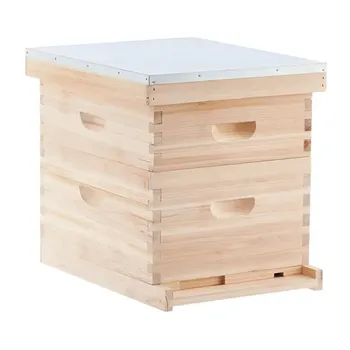
Langstroth hives are widely preferred because they combine standardized dimensions, removable frames, and modular expansion. These features allow commercial beekeepers to move frames between colonies, inspect colonies without destroying comb, add honey supers as production increases, and use centrifugal extractors and other equipment designed around Langstroth frames.
The central advantage of the Langstroth system is interoperability: standardized hive parts reduce operational friction from the apiary through harvesting, maintenance, replacement sourcing, and honey processing.
Why Langstroth Hives Fit Commercial Production
Standardized components simplify scaling
Langstroth equipment is built around commonly recognized components such as deep brood boxes, medium or shallow honey supers, and removable frames. This creates a repeatable system across colonies and apiary locations.
Commercial operators can expand capacity by stacking additional supers rather than rebuilding or replacing the entire hive. That vertical, modular configuration supports predictable workflows during inspections, honey flows, and harvest periods.
Removable frames preserve the colony’s working structure
The Langstroth design uses movable frames positioned according to bee-space principles. Bees build comb on the frames, allowing beekeepers to remove individual units for inspection, treatment, or harvesting.
Because the comb can generally be returned to the hive, colonies do not need to rebuild their entire nest after every harvest. This can reduce disruption and help maintain production continuity, provided the frames are handled correctly.
Colonies are easier to inspect and manage
A technician can examine brood patterns, food stores, queen performance, pests, and disease indicators frame by frame. This is substantially more practical for commercial monitoring than inspecting a fixed or irregular comb structure.
The same access also supports timely intervention. Beekeepers can identify problems, replace damaged frames, redistribute resources, or manage colonies without dismantling the whole hive.
Why Equipment Compatibility Matters
Standard frames integrate with extraction machinery
Commercial honey processing commonly relies on centrifugal extractors. These machines are designed to accept frames in specific dimensions and configurations, allowing honey to be removed while preserving the comb.
Langstroth-compatible frames therefore connect the hive directly to downstream processing equipment. That compatibility reduces manual extraction work and makes higher-volume harvesting more feasible.
Replacement parts are easier to source
A standardized system gives distributors, wholesalers, and beekeepers access to a broader supply network for boxes, frames, foundation, covers, bottom boards, and related components.
This matters operationally when equipment is damaged, expanded, or lost. Operators can often replace individual parts instead of commissioning custom components or converting an entire apiary to a different design.
Equipment can be shared across colonies
Frames and supers can be moved between colonies when management conditions require it. For example, a beekeeper may redistribute food stores, add space to a strong colony, or organize equipment before extraction.
This interchangeability improves utilization of inventory. It also enables commercial operations to standardize tools, storage systems, transport methods, and processing lines around one hive format.
How Langstroth Design Supports Productivity
Honey can be harvested without destroying the comb
With appropriate management, honey-filled frames can be removed, extracted, and returned to the colony. Bees can then reuse the existing comb rather than constructing all new comb before resuming storage.
That does not guarantee higher yields in every environment. However, preserving comb and reducing reconstruction work can improve operational efficiency, particularly across repeated production cycles.
Supers provide controlled expansion
Beekeepers can add honey supers as colonies grow or nectar availability increases. This gives colonies additional storage space while allowing operators to manage brood and honey areas separately.
The result is a more predictable production model than designs that require cutting, crushing, or otherwise dismantling comb during harvest.
Standardization improves labor planning
Commercial beekeeping depends on repeatable tasks: inspections, frame movement, supering, transport, extraction, cleaning, and storage. Uniform hive components make these tasks easier to train, schedule, and perform across many colonies.
For a distributor or B2B reseller, this also supports a broader product ecosystem rather than a one-off hive sale. Customers may require compatible frames, boxes, foundations, tools, extractors, and replacement parts over the life of the operation.
Why Alternatives Can Be More Labor-Intensive at Scale
Top-Bar hives use less standardized comb geometry
Top-bar hives generally rely on bees building comb from individual bars rather than standardized removable frames. This can work well for particular beekeeping philosophies and management styles.
However, irregular comb is less readily compatible with standard centrifugal extractors. Harvesting may require more manual handling, and equipment sharing between colonies or apiaries is less straightforward.
Warré and fixed-comb designs prioritize different goals
Warré hives and traditional fixed-comb or log hives may emphasize naturalistic management, simplicity, or low equipment dependence. Their designs are not inherently unsuitable for beekeeping.
Their limitation for industrial operations is system compatibility. Nonstandard box dimensions, fixed or semi-fixed comb, and different harvesting methods can make mechanized processing, replacement sourcing, and high-volume workflows more difficult.
Alternative designs may still serve niche markets
The commercial advantage of Langstroth hives should not be confused with universal superiority. Top-bar, Warré, and other designs may be appropriate where low capital cost, minimal equipment, local materials, or specific husbandry preferences are more important than high-throughput processing.
The right comparison depends on the operating model, not simply on the hive’s popularity.
Understanding the Trade-offs
Standardization is not absolute
“Langstroth-compatible” does not always mean that every component will fit every other component perfectly. Box depths, frame lengths, frame widths, foundation types, and manufacturer tolerances can vary.
Buyers should confirm critical dimensions before combining equipment or purchasing extraction machinery. Product specifications and compatibility information are essential parts of reliable commercial supply.
Commercial efficiency requires more equipment
Langstroth hives support mechanized workflows, but those workflows require investment in extractors, uncapping equipment, transport systems, storage, protective gear, and replacement inventory.
The hive itself is only one part of the production system. Its value increases when the surrounding equipment and operating procedures are standardized as well.
Movable frames require careful handling
Frames can be inspected and exchanged, but rough handling can damage comb, stress colonies, or spread pests and disease between colonies. Interchangeability must therefore be paired with sound sanitation and biosecurity practices.
Standardization improves control; it does not eliminate the need for competent management.
What This Means for Commercial Supply
One-stop sourcing reduces operational friction
A complete Langstroth product range allows customers to source compatible hive bodies, frames, supers, covers, bottom boards, foundations, and harvesting accessories through one supply channel.
For distributors and resellers, this creates opportunities to serve both initial setup and recurring replenishment needs. It also reduces the risk that customers will assemble systems from incompatible parts.
Fast fulfillment has practical value
Beekeeping demand is seasonal and time-sensitive. Delays in supplying supers, frames, or replacement components can affect colony management and harvesting schedules.
Responsive service, accurate product matching, efficient order fulfillment, and rapid delivery are therefore operational advantages—not merely purchasing conveniences.
Technical support strengthens compatibility decisions
Customers often need help selecting the correct depth, frame format, quantity, or accessory combination. Professional guidance can prevent costly mismatches between hive components and extraction equipment.
For B2B buyers, product expertise is especially valuable when consolidating purchases for multiple apiaries or serving beekeepers using different Langstroth configurations.
How to Apply This to Your Project
The best choice depends on whether the priority is scalable production, low-equipment management, or a particular beekeeping philosophy.
- If your primary focus is commercial honey volume: Use a standardized Langstroth system with removable frames and compatible centrifugal extraction equipment to support repeatable, high-throughput harvesting.
- If your primary focus is equipment sourcing and resale: Build a coordinated portfolio of compatible boxes, frames, supers, foundations, tools, and processing equipment, supported by accurate specifications and rapid fulfillment.
- If your primary focus is flexible apiary management: Choose a consistent Langstroth configuration across colonies so frames, supers, and replacement parts can be shared efficiently.
- If your primary focus is low capital investment or naturalistic management: Evaluate Top-Bar or Warré designs, accepting that harvesting and equipment integration may be more manual.
Langstroth hives remain the commercial standard because their modular parts, movable frames, and equipment compatibility turn beekeeping into a more repeatable and scalable production system.
Summary Table:
| Feature | Langstroth Hive | Alternative Designs (Top-Bar, Warré) |
|---|---|---|
| Frame Standardization | Yes, standardized frames | Less standardized, irregular comb |
| Equipment Compatibility | High, fits extractors and accessories | Low, manual extraction often needed |
| Scalability | Modular supers allow easy expansion | Limited, less flexible |
| Inspection & Management | Easy frame-level access | More difficult, disruptive |
| Harvest Efficiency | Preserves comb, high throughput | Destroys comb, labor-intensive |
| Replacement Parts | Widely available | Limited availability |
| Suitability | Commercial production, B2B supply | Niche, low-capital or naturalistic use |
Looking to optimize your commercial apiary with Langstroth equipment? HONESTBEE offers a full range of hives, frames, supers, and processing machinery to boost your productivity. Our one-stop sourcing, competitive pricing, OEM/ODM support, and rapid delivery ensure you get reliable supply and maximize your profit margins. Contact us today to discuss your bulk orders and experience our dedicated service!
Related Products
- High-Performance Langstroth Bee Hives for Global Professional Beekeeping
- Australian Langstroth Beehive Boxes for Beekeeping Wholesales
- Professional Observation Hive: The Ultimate Portable Solution for Beekeeping Education, Exhibitions, and Colony Displays
- Langstroth Honey Bee Box Hive Boxes for Different Depths
- Solid Bottom Board Australian Pine Wood Langstroth Bottom Board for Wholesale
People Also Ask
- 8-Frame vs 10-Frame Langstroth Hives: Which Is Right for Your Beekeeping?
- What structural differences should commercial apiary operators consider when selecting between Langstroth hives and Top Bar hives for standardized honey production? Langstroth for standardized honey production
- How do Langstroth hives compare to Top Bar hives for beekeeping? Choose the Best for Your Apiary
- Why is the adoption of modern movable-frame hives, such as Langstroth hives, advantageous over traditional hive equipment for commercial apiaries? Key Benefits for Scalable Beekeeping
- What are the structural and yield differences between traditional primitive beehives and modern standard wooden hives (such as Langstroth hives) for commercial honey producers? Discover why modern hives boost yield and efficiency.