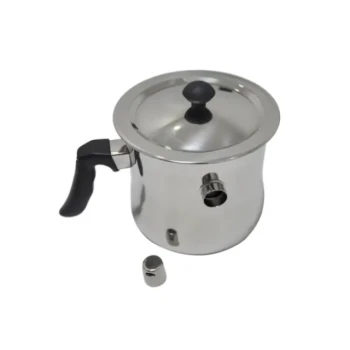
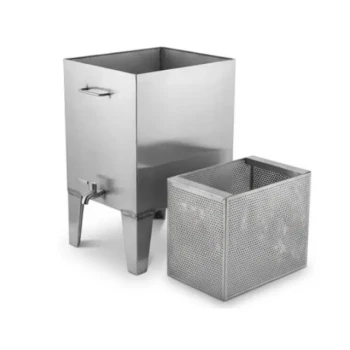
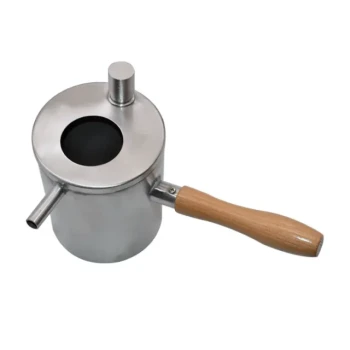
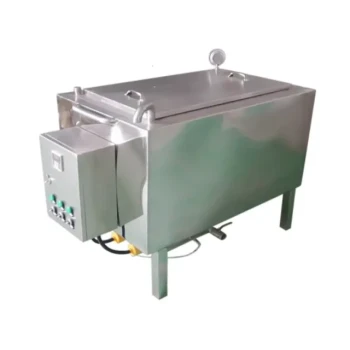
The primary role of a double jacket pan in preparing artificial queen cells is to facilitate the melting of beeswax through a gentle, indirect water bath heating method. Instead of applying heat directly to the wax, this vessel circulates hot water around an inner container to raise the temperature of the beeswax uniformly and gradually.
Core Takeaway Direct heat can rapidly degrade the complex chemical structure of beeswax. The double jacket pan acts as a thermal buffer, ensuring the wax melts without charring or oxidizing, which is critical for creating queen cells that are both structurally sound and biologically acceptable to the colony.
The Mechanism of Controlled Heating
Water Bath Technology
The double jacket pan functions on the principle of a water bath. The space between the outer and inner walls is filled with water, which acts as the heat transfer medium.
Uniform Temperature Distribution
Because water boils at a specific temperature, it caps the maximum heat applied to the inner vessel. This ensures the beeswax melts uniformly rather than creating hot spots that occur with direct flame contact.
Preserving Beeswax Integrity
Preventing Physical Degradation
Beeswax is sensitive to high temperatures. If heated too aggressively, it undergoes physical property changes that can ruin its texture. The double jacket pan prevents this degradation, preserving the wax's natural state.
Minimizing Oxidation
Excessive heat accelerates oxidation, which can alter the chemical composition of the wax. By utilizing a controlled heating technique, the pan significantly reduces the risk of excessive oxidation, maintaining the wax's chemical purity.
Avoiding Charring
Direct contact with high-temperature heat sources often leads to charring or burning. The insulating layer of water in a double jacket pan eliminates this risk, ensuring the material remains clean and usable.
Impact on Molding and Acceptance
Ensuring Appropriate Fluidity
To mold effective queen cells, the wax must be liquid enough to coat the mold but viscous enough to hold its shape. This pan maintains the appropriate fluidity, allowing for the creation of a high-quality matrix for the cells.
Palatability for the Colony
For Apis cerana colonies to accept artificial queen cells, the material must smell and taste natural. By preventing burning and chemical changes, the double jacket pan preserves the palatability of the wax, ensuring the bees do not reject the introduced cells.
Common Pitfalls to Avoid
Over-reliance on Equipment
While the pan regulates heat better than a standard pot, it does not automate the process. You must still monitor the water levels within the jacket to prevent the system from drying out and losing its thermal buffering capability.
Ignoring Temperature Thresholds
Even with a water bath, keeping wax molten for too long can eventually degrade it. The pan allows for precision, but the operator must still act efficiently once the melting point is reached.
Making the Right Choice for Your Project
To ensure the success of your Apis cerana queen rearing, apply the following guidelines:
- If your primary focus is acceptance rates: Use the double jacket pan to prevent charring, ensuring the wax retains the natural scent and taste the bees require.
- If your primary focus is structural integrity: rely on the uniform heating to prevent oxidation, which keeps the wax from becoming brittle or chemically unstable.
By prioritizing the quality of your base material through controlled heating, you lay the foundation for a successful and productive queen rearing cycle.
Summary Table:
| Feature | Benefit of Double Jacket Pan | Impact on Queen Cell Quality |
|---|---|---|
| Heating Method | Indirect Water Bath | Prevents charring and chemical degradation |
| Temperature Control | Uniform & Capped Heat | Maintains optimal fluidity for precise molding |
| Material Purity | Minimized Oxidation | Preserves natural scent for colony acceptance |
| Structural Stability | Gradual Melting | Prevents brittleness in the beeswax matrix |
| Risk Management | No Hot Spots | Eliminates physical property changes in wax |
Elevate Your Queen Rearing Success with HONESTBEE
Quality beekeeping starts with the right equipment. At HONESTBEE, we specialize in supporting commercial apiaries and distributors with a comprehensive range of professional tools. Whether you need specialized double jacket pans for wax processing, advanced honey-filling machines, or durable hive-making equipment, we provide the industrial-grade solutions your business demands.
Why partner with HONESTBEE?
- Wholesale Excellence: Full spectrum of beekeeping machinery and essential consumables.
- Industry Expertise: Solutions tailored for the unique needs of Apis cerana and large-scale operations.
- Comprehensive Portfolio: From specialized hardware to honey-themed cultural merchandise.
Ready to scale your production? Contact us today to discuss our wholesale offerings and discover how we can help your apiary thrive.
References
- Ustadi Ustadi, Djati Batoro. The Difference Queen Cup Materials on the Acceptance Grafted Larvae and Wing Morphometrics in <i>Apis cerana</i> Queen Rearing. DOI: 10.2991/absr.k.220401.051
This article is also based on technical information from HonestBee Knowledge Base .
Related Products
- Beeswax Melter for Candle Making Honey Bee Wax Melter
- Steam Beeswax Melter Wax Warmer for Wax Processing
- Solar Beeswax Melter Easy Solar Wax Melter for Beeswax
- Professional Stainless Steel Wax Melter for Beekeeping and Crafts
- Electric Commercial Beeswax Melter for Factory Use
People Also Ask
- What is the best way to melt beeswax? Safely Preserve Quality with Indirect Heat
- What is the best way to melt beeswax? Use a Solar Wax Melter for Simple, Pure Results
- What types of beeswax melters are available for beekeepers? Choose the Right One for Your Operation
- What safety precautions should be taken when melting beeswax? A Guide to Flammable Wax Handling
- What types of beeswax melters are available for different scales of beekeeping? Solar vs. Electric Melters Compared