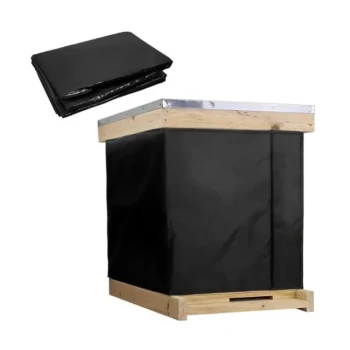
Beehive insulation serves as a fundamental thermal support system designed to assist the colony in regulating its internal environment. Its primary role is to act as a buffer against external weather conditions that threaten the colony's survival or reduce its productivity. By stabilizing internal temperatures, insulation allows the bees to conserve energy that would otherwise be spent on heating or cooling the hive.
While a standard hive provides a basic controlled environment, insulation acts as a critical "hardware guarantee." It ensures the colony can efficiently maintain the stable internal climate necessary for larval development, even when external weather becomes hostile.
The Critical Importance of Thermoregulation
The Target Temperature
The biological imperative of a honey bee colony is to maintain a constant internal temperature of approximately 37 degrees Celsius.
This specific thermal consistency is not merely a preference; it is a requirement for the survival of the colony and the proper development of larvae.
The Hive as a Controlled Environment
A beehive functions as a "controlled dark space" that simulates a natural cavity.
The physical structure of the hive, including its insulation, is the hardware foundation that makes this simulation possible. Without adequate thermal retention, the colony struggles to maintain the equilibrium required for biological success across varying climatic conditions.
Structural Design and Efficiency
Mimicking Natural Biology
Standardized industrial beehives are engineered to mimic the natural biological structures bees create in the wild.
These hives incorporate precise frame spacing and structural reinforcements. Insulation complements this design by ensuring that the "engineered improvements" function correctly without being compromised by external temperature swings.
Enhancing Productivity
When insulation effectively manages thermal loss or gain, the colony’s energy can be redirected.
Instead of exhausting resources on thermoregulation, the colony can focus on productivity. This stability supports the overall health index of the colony and ensures that the standardized environment remains conducive to efficient production.
Understanding the Role of Monitoring
Insulation is Not "Set and Forget"
While insulation provides passive protection, modern management relies on active verification.
It is critical to integrate temperature and humidity sensors to monitor the actual conditions inside the insulated space. These sensors allow beekeepers to detect abnormal fluctuations that insulation alone cannot fix.
Context is Key
Insulation helps, but it does not replace the need for standardized data and tracking.
Automated management systems should track human interventions and environmental changes to analyze how specific management models—including insulation strategies—impact colony health.
Making the Right Choice for Your Colony
Effective colony management requires balancing physical protections with data-driven insights.
- If your primary focus is Larval Survival: Prioritize insulation that helps the colony rigidly maintain the critical 37°C internal temperature threshold.
- If your primary focus is Modern Management: Combine insulation with environmental sensors to gain a comprehensive understanding of how weather impacts your specific hive configuration.
By viewing insulation as a vital component of the hive's hardware, you provide the stability your bees need to thrive in an unpredictable environment.
Summary Table:
| Key Feature | Role in Colony Management | Impact on Productivity |
|---|---|---|
| Thermal Buffering | Acts as a hardware guarantee against external weather extremes. | Reduces energy expenditure on heating/cooling. |
| Target Temp Control | Maintains the critical 37°C required for larval health. | Increases survival rates of the next generation. |
| Structural Mimicry | Replicates natural biological cavities within industrial hives. | Enhances biological success and hive stability. |
| System Integration | Complements temperature/humidity sensors for data tracking. | Enables precise, modern management interventions. |
Maximize Your Colony Productivity with HONESTBEE
As a commercial apiary or distributor, providing the right hardware is essential for large-scale success. HONESTBEE specializes in a comprehensive wholesale offering, supplying everything from advanced hive-making and honey-filling machinery to high-quality beekeeping tools and essential consumables.
Whether you are looking to optimize larval survival through superior insulation materials or expand your operations with professional-grade equipment, we are here to support your growth. Our portfolio even extends to honey-themed cultural merchandise to help you build your brand.
Ready to elevate your beekeeping business? Contact us today to discuss how our wholesale solutions can provide the stability and efficiency your bees—and your business—deserve.
Related Products
- Professional Insulated Plastic Bee Hives
- Professional Insulated Winter Hive Wrap for Beekeeping
- Inner Beehive Cover for Beekeeping Bee Hive Inner Cover
- Stainless Steel Round Beehive Air Vents for Ventilation
- Metal Hive Feet Bee Hive Stand for Ant Protection
People Also Ask
- What are the advantages of plastic bee hives? Boost Efficiency & Durability for Your Apiary
- Are plastic bee hives any good? Unlock Durability & Efficiency for Your Apiary
- How do plastic bee hives compare to wooden hives in handling? Reduce Strain & Boost Efficiency
- Are plastic bee hives good? Durable, Low-Maintenance Hives for Modern Apiaries
- What are the disadvantages of plastic beehives? Key Operational and Environmental Risks Exposed