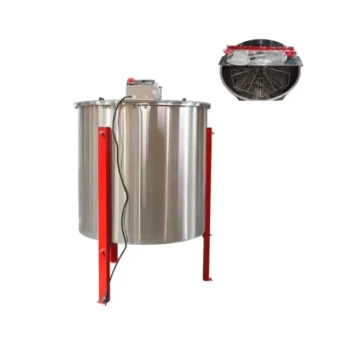
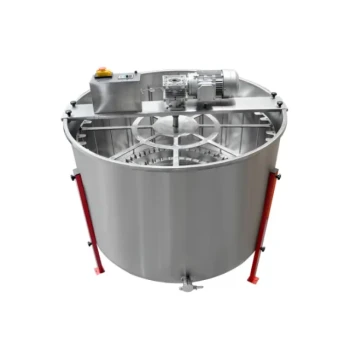
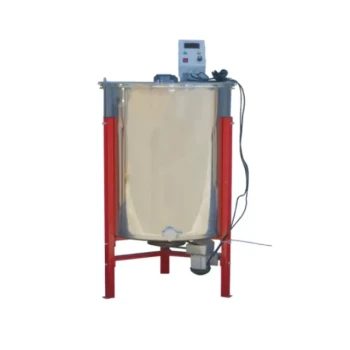
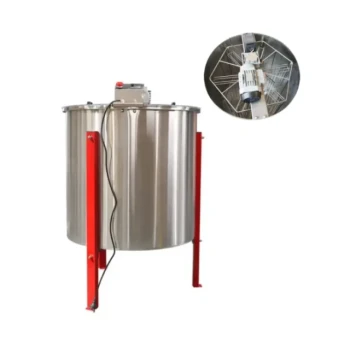
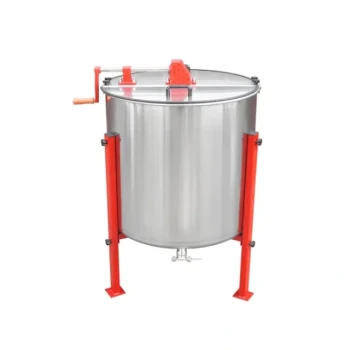
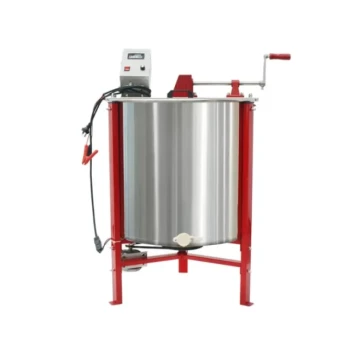
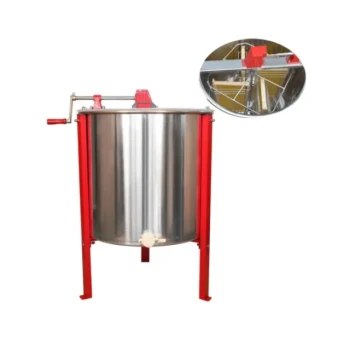
The industrial honey extractor serves as a vital physical integrator for large-scale apiary surveys, enabling the collection of pooled samples that reflect the health status of an entire operation. By combining honey from multiple hives during a unified end-of-season harvest, this equipment transforms individual hive outputs into a single, representative dataset.
Core Takeaway An industrial extractor allows for the efficient assessment of apiary-wide health by creating a homogenized "pooled sample." This method drastically reduces diagnostic costs compared to single-hive testing and provides a reliable early warning system for detecting disease risks, such as high spore loads, across a production line.
The Strategic Value of Pooled Sampling
Creating a Representative Aggregate
In large-scale operations, testing every individual hive is often logistically and financially impossible. The industrial extractor addresses this by physically mixing the harvest from numerous colonies.
The resulting pooled sample provides a snapshot of the spore load of the entire apiary or production line. This aggregate data is critical for understanding the general health baseline of the operation without the noise of individual hive variance.
Cost-Efficiency in Disease Monitoring
The primary value of this method is economic leverage in diagnostics. Instead of paying for hundreds of individual assays, a surveyor can analyze a few pooled samples from the extractor.
This approach offers comprehensive early warning capabilities. It identifies the presence of pathogens or disease risks across the operation, allowing beekeepers to trigger more granular investigation only when a specific pool flags a problem.
Ensuring Sample Purity
Unlike manual squeezing methods, which can introduce impurities, industrial centrifugal extractors maintain the honey's integrity.
This mechanized process ensures that samples collected for evaluating bioactive components—such as antioxidant and antibacterial potential—remain pure and truly representative of the source material.
Operational Efficiency and Mechanics
The Role of Centrifugal Force
Industrial extractors utilize high-speed centrifugal force to separate mature honey from the frame.
This method effectively clears the honeycomb without destroying its physical structure. This allows for high-throughput processing essential for export-oriented models or large-scale surveys.
Preserving Resources for Future Cycles
A secondary benefit of this extraction method is the preservation of the wax comb. Because the structure is not crushed, frames can be returned to the hive immediately.
This recycling allows bees to focus energy on honey production rather than secreting wax to rebuild combs, significantly improving the turnover rate and yield of the subsequent production cycle.
Understanding the Trade-offs
While industrial extraction is superior for efficiency and general disease screening, it is not without limitations regarding botanical profiling.
Potential Loss of Pollen Diversity
Mechanized centrifugal extraction is highly efficient, but research suggests it may influence the overall pollen richness of the final product.
Manual extraction methods tend to preserve a higher diversity of pollen. If the goal of your survey is to analyze detailed botanical information or produce functional honey where pollen diversity is the key metric, industrial pooling may obscure specific floral markers found in manual samples.
Making the Right Choice for Your Goal
To maximize the value of your apiary survey, align your extraction method with your specific data requirements.
- If your primary focus is disease monitoring: Rely on industrial pooled samples to detect apiary-wide spore loads and pathogen risks at a fraction of the cost of individual testing.
- If your primary focus is production efficiency: Use centrifugal extraction to maximize yield and recycle combs, reducing the energy burden on your bee colonies.
- If your primary focus is botanical diversity: Consider that industrial centrifugation might slightly reduce pollen richness compared to manual methods, potentially impacting detailed floral profiling.
Ultimately, the industrial extractor is the most effective tool for transforming a logistical challenge into a manageable, cost-effective data stream for large-scale health assessment.
Summary Table:
| Feature | Value in Large-Scale Surveys | Operational Benefit |
|---|---|---|
| Sample Pooling | Creates a homogenized aggregate of the entire apiary | Reduces individual hive diagnostic costs |
| Disease Detection | Identifies spore loads and pathogen risks early | Enables proactive apiary-wide health management |
| Centrifugal Force | Separates honey while preserving comb structure | Allows for rapid frame recycling and higher yields |
| Sample Purity | Minimizes external contamination during extraction | Ensures accurate analysis of bioactive components |
Scale Your Apiary Operations with HONESTBEE
At HONESTBEE, we specialize in empowering commercial apiaries and distributors with the heavy-duty machinery required for global-standard honey production. Whether you need high-capacity industrial honey extractors for health surveys or advanced honey-filling machines for your production line, we provide the full spectrum of beekeeping tools and hardware.
Our value to your business:
- Comprehensive Wholesale Range: From specialized hive-making machinery to essential industry consumables.
- Strategic Efficiency: Equipment designed to maximize yield and minimize diagnostic overhead.
- Industry Expertise: Catering specifically to the needs of large-scale beekeeping professionals.
Ready to enhance your production efficiency and monitoring accuracy? Contact us today to discuss your wholesale equipment needs!
References
- Michael W. Zabrodski, Elemir Simko. Comparison of individual hive and apiary-level sample types for spores of Paenibacillus larvae in Saskatchewan honey bee operations. DOI: 10.1371/journal.pone.0263602
This article is also based on technical information from HonestBee Knowledge Base .
Related Products
- HONESTBEE 72 Frame Industrial Electric Honey Extractor for Beekeeping
- Commercial Electric 12 Frame Honey Extractor Spinner Motorized Honey Extractor
- 32 Frame Commercial Electric Honey Extractor for Beekeeping and Honey Production
- Commercial 48-Frame Stainless Steel Honey Extractor
- 8-Frame Electric Self-Reversing Honey Extractor Spinner for Commercial Honey Extraction Equipment
People Also Ask
- What is the importance of balancing honeycomb frames within a honey extractor? Ensure Stability and Protect Machinery
- How is honey separated from the frames after they are uncapped? Efficient Extraction Methods for High Yields
- What are the main benefits of using a honey extractor? Maximize Yields and Protect Your Honeycomb
- What are the recommended methods for removing honey from the honeycomb? Top Extraction Techniques for Maximum Efficiency
- How do manual honey extractors compare to electric honey extractors? Choosing the Right Tool for Your Apiary Growth