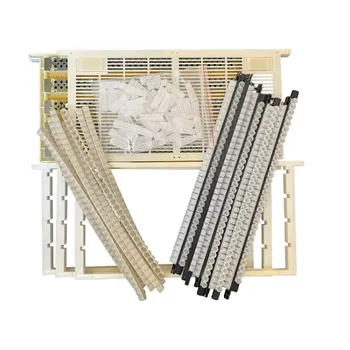
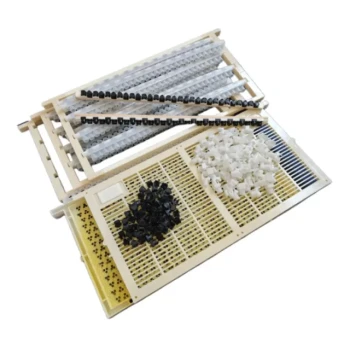
To expand an apiary into royal jelly and propolis production, you need more than standard honey-harvesting equipment. Royal jelly operations require movable-comb hives, queen-rearing frames, artificial queen cell cups, grafting or non-grafting larval transfer tools, and hygienic suction extraction equipment. Propolis production requires hive-mounted collection traps, followed by suitable cleaning, refining, low-temperature handling, and packaging equipment.
The core requirement is a coordinated collection-and-processing system. Royal jelly depends on precise queen-cell management and rapid cold preservation, while propolis depends on efficient hive collection and contamination-controlled refining. The right equipment allows an apiary to increase output without sacrificing colony health, hygiene, or product quality.
Build the Right Apiary Infrastructure First
Use movable-comb hive systems
Movable-comb hives are the operational foundation for commercial royal jelly production. They allow beekeepers to insert, inspect, reposition, and remove queen-cell frames without dismantling the colony.
This modularity makes repeated production cycles more manageable and reduces disruption during colony inspections and harvesting.
Add queen-rearing frames and cell assemblies
Royal jelly production requires dedicated queen-rearing frames fitted with artificial queen cell cups or plastic cell inserts. Wax queen cells may also be used, depending on the production system and operator preference.
Double-frame queen cup assemblies can increase the number of cells handled per cycle and support larger-scale production.
Prepare hygienic handling tools
Royal jelly is a biological product that can be affected by air exposure, contamination, and delays. The apiary therefore needs clean harvesting trays, tools, containers, and work surfaces designed for controlled handling.
Professional-grade consumables and extraction tools help reduce environmental contamination and unnecessary contact with the product.
Equip the Apiary for Royal Jelly Production
Use grafting tools for conventional production
Traditional royal jelly production commonly uses grafting needles to transfer one-day-old larvae into artificial queen cups. The larvae are then placed in prepared colonies so worker bees produce royal jelly around them.
This method is flexible and relatively accessible, but manually grafting large numbers of larvae is labor-intensive and requires consistent operator skill.
Consider non-grafting larval depositor systems
For commercial operations, bionic non-grafting larval depositor systems can reduce or eliminate manual grafting. These systems are intended to improve throughput and make production more consistent when many queen cells must be prepared.
They are most relevant to apiaries seeking factory-style output rather than small-batch production.
Use suction extractors for jelly removal
A specialized royal jelly suction extractor is needed to remove jelly from queen cells efficiently before the cells are capped. Extraction should be performed according to a strict management timetable.
If harvesting is delayed, larvae may consume the jelly or worker bees may cap the cells, reducing the recoverable yield.
Add mechanical collectors for higher throughput
Larger facilities may use mechanical royal jelly collectors and automated larvae withdrawal machines. These systems reduce repetitive labor and shorten the time between cell preparation, harvesting, and transfer to preservation.
Automation does not eliminate the need for colony management. It increases the value of consistent scheduling, clean workflows, and trained operators.
Equip the Apiary for Propolis Collection
Install specialized propolis traps
Propolis production begins with hive-mounted propolis collectors or traps. These devices create collection surfaces or gaps that encourage bees to deposit propolis in a removable form.
A dedicated trap is preferable to scraping propolis from arbitrary hive surfaces because it supports more consistent collection and cleaner separation from unwanted materials.
Select a collection format that fits the operation
The trap design should match the apiary’s inspection practices, hive configuration, and intended processing method. A removable system makes it easier to collect batches, inspect colonies, and maintain repeatable production cycles.
The objective is not simply to maximize collection. The system must also avoid unnecessary disruption to the colony and limit contamination.
Add propolis refining equipment
Raw propolis generally requires cleaning and refining before it becomes a standardized commercial ingredient. Suitable processing equipment should help separate unwanted hive debris while maintaining the product’s valuable biological components.
The exact refining line depends on whether the finished product is intended for raw material sales, extracts, supplements, or another commercial format.
Protect Product Quality After Collection
Establish immediate royal jelly refrigeration
Fresh royal jelly should be transferred quickly into refrigeration or freezing after extraction. Rapid temperature control is essential for preserving its biological activity and commercial quality.
A royal jelly operation therefore needs dependable cold-storage capacity, suitable containers, and a workflow that minimizes the time between extraction and chilling.
Use low-temperature processing
Royal jelly and propolis are sensitive biological materials. Low-temperature processing equipment helps preserve nutritional and bioactive components during cleaning, refining, and preparation.
High-heat processing can undermine the quality objective, so temperature control should be considered across the full path from collection to packaging.
Control air and contamination exposure
Mechanized extraction can reduce the product’s contact time with air and potential contaminants. Clean tools, enclosed or controlled processing areas, and suitable containers further support hygienic production.
This is particularly important when supplying nutraceutical, medicinal, or other regulated commercial markets.
Match storage to the product
Royal jelly typically requires refrigerated or frozen storage immediately after collection. Propolis requires controlled storage and protection from contamination during collection, refining, and packaging.
The storage system should be selected together with the intended sales format and downstream customer requirements.
Integrate Equipment for Commercial Scale
Separate colony management from processing
A successful multi-product apiary needs two connected but distinct equipment groups:
- Colony-side equipment: movable-comb hives, queen-rearing frames, queen cups, grafting needles, larval transfer systems, and propolis traps.
- Processing-side equipment: suction extractors, mechanical collectors, larvae withdrawal machines, refining equipment, low-temperature systems, storage units, and packaging tools.
Separating these functions clarifies investment decisions and prevents the apiary from treating collection equipment as a complete processing solution.
Design around labor bottlenecks
Manual grafting is often the largest labor constraint in royal jelly production. Automated larval deposition, double-frame assemblies, mechanical collectors, and automated withdrawal systems become more valuable as production volume increases.
For smaller apiaries, manual equipment may be adequate. For high-volume operations, labor reduction and repeatability can justify specialized machinery.
Standardize the production timetable
Royal jelly output depends heavily on timing. Frames must be prepared, colonies must be managed, cells must be harvested at the appropriate stage, and the product must be chilled promptly.
Equipment should support this timetable rather than create additional handling delays.
Understanding the Trade-offs
Manual systems cost less but depend on skill
Grafting needles and manual extraction tools can be practical for small or developing operations. However, they require skilled labor and can produce greater variation in speed, cell handling, and output.
Manual methods become increasingly difficult to manage when thousands of larvae must be processed consistently.
Automation improves throughput but raises complexity
Non-grafting systems, automated withdrawal machines, and mechanical collectors can reduce labor intensity and increase production capacity. They also require higher upfront investment, operator training, maintenance, and compatibility between equipment components.
Automation is most appropriate when the apiary has reliable production volume and a clear route to market.
More collection does not always mean better production
Aggressive collection can place pressure on colony management and may undermine long-term productivity if colony condition is not monitored carefully. Royal jelly and propolis programs should be integrated with sound hive management rather than operated as isolated extraction activities.
Processing equipment cannot compensate for poor handling
A high-quality extractor or refining machine cannot recover product quality lost through delayed harvesting, contamination, excessive air exposure, or inadequate storage.
The complete workflow—from hive to final container—matters more than any single machine.
Choose a Sourcing Package That Supports Expansion
For distributors, wholesalers, and commercial beekeepers, the most useful supply model is a coordinated product portfolio rather than disconnected individual tools.
Source compatible collection components
Queen frames, cell cups, grafting or larval transfer tools, suction extractors, propolis traps, and processing equipment should be evaluated for compatibility and workflow integration.
A one-stop sourcing approach can simplify purchasing, reduce coordination delays, and support faster replacement of consumables and components.
Prioritize professional service and fulfillment
Commercial apiaries need responsive technical support, clear product specifications, reliable availability, and efficient order fulfillment. These factors are especially important when production depends on strict harvesting windows and rapid replacement of operating supplies.
Fast delivery has practical value when a missing component can interrupt a royal jelly production cycle.
Plan for staged investment
A practical expansion may begin with movable-comb hives, queen-rearing frames, cell cups, grafting tools, suction extraction, propolis traps, and cold storage. Automation and larger refining systems can then be added as production volume, labor costs, and customer demand justify them.
This staged approach limits unnecessary capital expenditure while preserving a path to commercial scale.
How to Apply This to Your Project
The equipment priorities should reflect your production volume, labor model, product format, and target customers.
- If your primary focus is small-batch royal jelly: Start with movable-comb hives, queen-rearing frames, artificial queen cell cups, grafting needles, hygienic suction extraction, and immediate refrigerated or frozen storage.
- If your primary focus is high-volume royal jelly: Evaluate non-grafting larval deposition, double-frame queen cup assemblies, automated larvae withdrawal, and mechanical collection systems to reduce repetitive labor.
- If your primary focus is propolis: Install specialized hive traps and add cleaning, refining, low-temperature handling, storage, and packaging equipment suited to your intended market.
- If your primary focus is premium nutraceutical supply: Build the workflow around hygienic collection, controlled temperature, minimal air exposure, professional-grade consumables, and consistent batch handling.
- If your primary focus is distribution or wholesale sourcing: Offer a full-spectrum package covering hive-side tools, processing machinery, cold-chain equipment, consumables, technical support, and rapid fulfillment.
With the right combination of colony-management tools, specialized collectors, hygienic processing, and cold-chain control, an apiary can expand into royal jelly and propolis production with greater consistency and commercial confidence.
Summary Table:
| Category | Equipment | Purpose |
|---|---|---|
| Colony Management | Movable-comb hives | Enable frame manipulation and repeated production cycles. |
| Queen Rearing | Queen-rearing frames & artificial cell cups | Support royal jelly production by providing cells for larvae. |
| Royal Jelly Harvest | Grafting needles, non-grafting depositors, suction extractors, mechanical collectors | Transfer larvae manually or automatically; extract jelly efficiently. |
| Propolis Collection | Hive-mounted propolis traps | Collect propolis without contamination or disruption. |
| Processing & Preservation | Refining equipment, low-temperature systems, cold storage | Clean and maintain quality of royal jelly and propolis. |
At HONESTBEE, we offer a comprehensive range of beekeeping tools and machinery for royal jelly and propolis production, from queen-rearing kits to automated extractors. Our full-spectrum portfolio ensures you can source everything from hive hardware to cold-chain storage in one place, with rapid delivery and dedicated support. Ready to expand your apiary? Contact us today to discuss your needs and receive a tailored wholesale quote.
Related Products
- HONESTBEE Improved No Grafting Queen Rearing Kit For Queen Rearing and Royal Jelly Production
- No Grafting Queen Rearing Kit: System for Royal Jelly Production and Queen Rearing
- Plastic Chinese Queen Grafting Tool for Bee Queen Rearing
- 8 Frame and 10 Frame Propolis Trap Collector Screen for Propolis Collection
- Double Nozzle Small Honey Filling Machine Honey Sachet Packing Packaging Equipment
People Also Ask
- How can commercial queen rearers and royal jelly producers align their harvesting schedules and equipment with the biological timing of larval development? Master the 48-Hour Grafting Window and 72-Hour Harvest Cycle
- How do honeybee reproductive traits affect queen rearing and hive equipment?
- What equipment and systems are utilized in queen rearing operations to scale queen bee production? Essential Tools for Commercial-Scale Queen Rearing
- How can commercial queen breeders and apiaries utilize low-density SNP screening alongside queen rearing equipment to maintain genetic purity in native honey bee populations? Achieve Genetic Purity with Efficient Screening
- What biological principles govern honeybee queen rearing, and why should commercial beekeepers use controlled queen-rearing equipment rather than relying on natural queen cells?