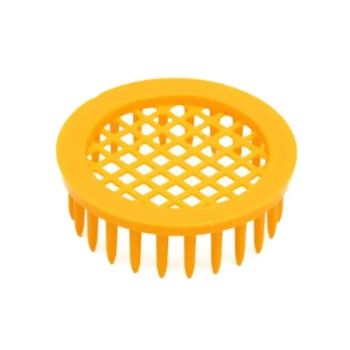
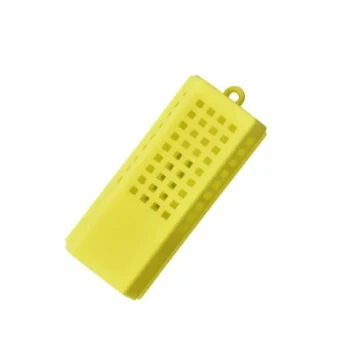
To ensure the survival of virgin queen bees in plastic mailing cages, you must strictly avoid liquid honey. Instead, the only viable feed option is solid queen candy. Because plastic lacks the porous, moisture-absorbing properties found in wooden cages, liquid feed will pool and contaminate the enclosure, leading to the injury or death of the queen.
The non-porous nature of plastic mailing cages demands the exclusive use of solid queen candy. Liquid honey presents a lethal risk in this environment, as it cannot be absorbed by the cage material and will inevitably coat the queen, causing suffocation or immobilization.
The Interaction Between Feed and Cage Material
The Problem with Non-Porous Plastic
Plastic mailing cages are fundamentally different from traditional wooden cages. They lack hygroscopic properties, meaning they cannot absorb moisture or liquids.
The Buffer Provided by Wood
In contrast, three-hole wooden cages are porous. If liquid honey leaks or is over-applied in a wooden cage, the material itself absorbs the excess moisture, acting as a safety buffer.
The Immediate Risk in Plastic
Because plastic cannot absorb excess fluid, any liquid honey introduced into the cage remains on the surface. This creates a wet, sticky environment that is hazardous for the insect inside.
Biological Risks to the Virgin Queen
Danger of Spiracle Blockage
When a queen bee is exposed to pooling liquid honey in a plastic cage, she is likely to become coated in the substance. This can block her spiracles (breathing holes), leading to asphyxiation.
Mechanical Damage
Even if the queen does not suffocate, coating her in sticky liquid honey causes mechanical impairment. Her wings and legs may become adhered to her body or the cage walls, rendering her permanently damaged.
Implementing the Correct Feed Strategy
Requirement for Solid Queen Candy
To mitigate these risks, you must use solid queen candy exclusively. This substance provides the necessary nutrition without introducing free-flowing liquid into the environment.
Utilizing the Feed Chamber
Plastic cages are designed with a dedicated feed chamber. Solid candy sits securely within this chamber, providing a stable food supply that does not migrate into the rest of the cage.
Maintaining a Dry Environment
The primary goal of using solid candy is to maintain a dry and clean internal environment. This ensures the queen remains mobile and free of contaminants during storage or transport.
Common Pitfalls to Avoid
Misjudging Feed Stability
A common error is assuming that a thick liquid honey is "solid enough." In a plastic environment, even viscous liquids can flow and smear when the cage is jostled during transport.
The Zero-Tolerance Threshold
Unlike wood, which offers a margin for error regarding moisture, plastic offers zero tolerance. There is no backup absorption mechanism, so any deviation from solid feed usually results in failure.
Ensuring Queen Survival During Storage
To guarantee the viability of your virgin queen bees, adhere to the following guidelines based on your equipment:
- If your primary focus is using plastic cages: You must strictly use solid queen candy to prevent liquid accumulation and keep the queen dry.
- If your primary focus is using liquid honey: You should switch to porous wooden cages, as they can absorb potential leaks and prevent spiracle blockage.
By respecting the physical limitations of plastic mailing cages and selecting the appropriate solid feed, you eliminate the risk of contamination and ensure the queen arrives safely.
Summary Table:
| Feature | Plastic Mailing Cages | Traditional Wooden Cages |
|---|---|---|
| Material Property | Non-porous (No absorption) | Porous (Hygroscopic/Absorbent) |
| Mandatory Feed | Solid Queen Candy | Solid Candy or Liquid Honey (limited) |
| Liquid Honey Risk | Lethal (Pooling & Suffocation) | Low (Material absorbs excess) |
| Environment | Must be kept strictly dry | Natural moisture buffer |
| Primary Goal | Prevent Spiracle Blockage | Safe storage and transport |
Maximize Your Apiary Productivity with HONESTBEE
At HONESTBEE, we understand that the survival of your virgin queens is critical to your commercial success. As a premier partner for commercial apiaries and distributors, we provide the high-quality beekeeping tools and machinery you need to scale your operations safely.
Whether you are looking for durable plastic or wooden mailing cages, specialized hive-making machinery, or high-efficiency honey-filling systems, HONESTBEE offers a comprehensive wholesale portfolio designed for industry professionals. From essential consumables to cultural honey-themed merchandise, we supply everything required to keep your business thriving.
Ready to upgrade your equipment and safeguard your queens? Contact our expert team today for wholesale inquiries and custom solutions!
References
- Gianluigi Bigio, Francis L. W. Ratnieks. Comparing Alternative Methods for Holding Virgin Honey Bee Queens for One Week in Mailing Cages before Mating. DOI: 10.1371/journal.pone.0050150
This article is also based on technical information from HonestBee Knowledge Base .
Related Products
- Durable Plastic Push In Queen Bee Cage
- Plastic Queen Marking Tube Cage with Plunger for Beekeeping
- Professional Multi-Compartment Queen Cage with Sliding Lid
- Plastic Long Marker Device for Catching and Marking Bees Queen Bee Marking Tube and Cage
- Professional Insulated Plastic Bee Hives
People Also Ask
- What advantages do push-in queen cages offer? Boost Acceptance Rates for Artificially Inseminated Queens
- What is a push-in queen cage and how does it differ from a standard queen cage? Boosting Your Queen Acceptance Rates
- How can a beekeeper obtain a push-in queen cage? DIY vs. Professional Sourcing Guide
- Why are specialized queen bee cages used for the banking of mated queen bees? Maximize Commercial Apiary Storage Efficiency
- What is a push-in queen cage and how does it differ from standard cages? Achieve Higher Queen Acceptance Rates