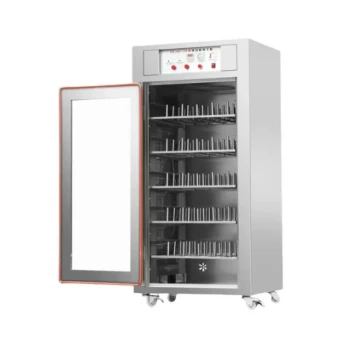
During the initial phase of the bee-bread drying cycle, the technical requirements for your equipment center on delivering high, uniform wind speed and substantial heat injection. Because the evaporation rate at this stage is limited primarily by surface vaporization, the machinery must be capable of aggressive moisture removal to prevent the process from stalling.
The primary bottleneck in the first stage of drying is surface vaporization, not internal diffusion. Consequently, equipment must provide intense airflow and thermal energy to maximize surface evaporation, which is the critical factor in reducing the overall duration of the drying cycle.
The Physics of the Initial Phase
Overcoming Vaporization Limits
At the beginning of the cycle, the moisture content on the surface of the bee-bread is high.
The drying rate is not yet limited by the movement of water from the inside of the material. Instead, it is limited by how quickly water can vaporize from the surface.
The Role of Moisture Migration
Effective drying requires a continuous flow of moisture from the core to the exterior.
By intensifying surface evaporation, you ensure that moisture migrating from the interior is removed immediately. If the surface remains saturated, this internal migration slows down, extending the process.
Essential Equipment Capabilities
High-Velocity Airflow
The equipment must be capable of generating high wind speeds.
Passive or low-velocity airflow is insufficient to strip the saturated boundary layer of air surrounding the bee-bread. High velocity is required to physically carry the vapor away as fast as it forms.
Uniform Air Distribution
Power must be matched with consistency. The equipment requires a design that ensures wind speed is uniform across the entire drying area.
Without uniformity, you risk creating localized pockets of humidity that retard the drying process for specific sections of the batch.
Robust Heat Injection
The system must possess sufficient heating capacity.
High airflow causes rapid evaporative cooling. Therefore, the equipment must inject enough heat to maintain the necessary temperature to drive evaporation despite this cooling effect.
Operational Trade-offs
Intensity vs. Complexity
Meeting these requirements demands robust hardware.
Achieving high, uniform wind speeds often requires more complex fan arrangements or baffling systems compared to standard drying units. However, relying on simpler, lower-velocity equipment will inevitably result in a longer total drying duration.
Making the Right Choice for Your System
To ensure your equipment is optimized for this specific phase of the bee-bread lifecycle, evaluate your setup against these priorities:
- If your primary focus is Cycle Speed: Ensure your fan capacity is rated to deliver high-velocity air to overcome surface saturation immediately.
- If your primary focus is Product Consistency: Prioritize the design of the airflow distribution system to ensure wind speed is uniform across all trays.
The efficiency of the entire drying process is dictated by how aggressively your equipment can handle surface evaporation in this first stage.
Summary Table:
| Technical Requirement | Critical Function | Impact on Drying Cycle |
|---|---|---|
| High-Velocity Airflow | Strips saturated boundary layers from surface | Prevents process stalling & carries vapor away |
| Uniform Air Distribution | Ensures consistent wind speed across all trays | Eliminates humid pockets & ensures product batch quality |
| Robust Heat Injection | Counters evaporative cooling effects | Maintains optimal temperature to drive surface vaporization |
| Surface Vaporization Focus | Maximizes initial moisture removal | Dictates the total duration and efficiency of the cycle |
Optimize Your Apiary Production with HONESTBEE
Are you looking to scale your commercial bee-bread production? HONESTBEE specializes in serving commercial apiaries and distributors with professional-grade solutions. From high-capacity drying machinery designed for uniform airflow to hive-making and honey-filling machines, we supply the full spectrum of beekeeping tools and essential consumables.
Why partner with HONESTBEE?
- Wholesale Expertise: Comprehensive hardware and tool portfolios tailored for bulk operations.
- Efficiency Driven: Equipment engineered to meet the rigorous physics of bee-bread processing.
- Global Supply: A one-stop shop for everything from machinery to honey-themed cultural merchandise.
Enhance your operational efficiency and product consistency today—contact our expert team at HONESTBEE to discuss your wholesale equipment needs!
References
- Sergei Oskin, Dmitry Tsokur. Improving the efficiency of the bee-bread drying process. DOI: 10.1088/1755-1315/1052/1/012104
This article is also based on technical information from HonestBee Knowledge Base .
Related Products
- High Quality Honey Dehumidifier Dryer Thickening Machine for Beekeeping
- High-Efficiency Pneumatic Bee Hive Making Machine for Rapid Box Assembly
- 0.5T Capacity Honey Dehumidifier Dryer with Vacuum Heating and Thickening Filtering Machine
- Professional Bee Frame Machine for Side Bar Shaping
- Fully Automatic Beeswax Embossing Machine Foundation Mill
People Also Ask
- Can you dehumidify honey? A Beekeeper's Guide to Preventing Fermentation
- How to dry up honey? The Safe Guide to Stabilizing Honey and Preventing Fermentation
- How can the moisture content of honey be reduced? A Guide to Safe, Effective Drying Methods
- How to remove humidity from honey? Protect Your Harvest from Fermentation
- How to decrease moisture in honey? Prevent Fermentation and Ensure Long-Term Quality