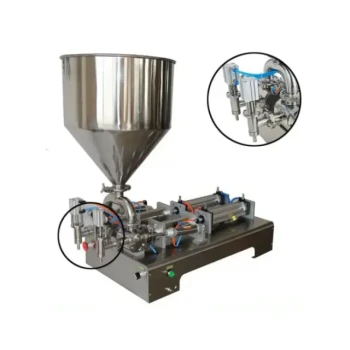
Industrial-grade honey filling machines provide a decisive technical advantage by automating the bottling process to deliver precise volumetric control and significantly reduced human intervention. These systems transform raw apiary yields into standardized commercial products by ensuring consistent net weights, minimizing product waste, and maintaining the rigorous hygiene standards required for entry into broad retail and wholesale distribution channels.
The core value of this technology is not just speed, but the ability to bridge the gap between agricultural harvest and retail compliance. By guaranteeing packaging consistency and airtight hygiene, industrial filling equipment enables apiaries to transition from small-scale units to scalable commercial enterprises capable of serving high-level markets.
Achieving Precision and Standardization
Automated Metering Control
Manual filling often leads to variances in product weight, resulting in either giveaway (profit loss) or under-filling (regulatory risk). Industrial machines utilize precision metering control systems to ensure every bottle contains the exact net weight specified. This technical accuracy eliminates waste and ensures compliance with strict weights and measures regulations.
Packaging Consistency
Retail environments demand uniformity. Industrial fillers ensure that every unit produced is identical in fill level and appearance. This standardization is technically necessary for branding and consumer trust, as it removes the visual irregularities associated with manual packing.
Enhancing Efficiency and Scalability
Removing Production Bottlenecks
During peak harvest seasons, high honey yields can overwhelm manual bottling lines. Automated machines provide the throughput speed necessary to process large volumes of raw material rapidly. This capability prevents production backlogs and ensures that increased hive yields translate directly into commercial revenue without delay.
Offsetting Labor Limitations
Processing honey, particularly from defensive bee populations, involves significant management and labor costs. Automated filling streamlines the post-harvest phase, reducing the dependency on manual labor for repetitive tasks. This allows operations to achieve economies of scale, maintaining profitability even as management costs for the apiary side increase.
Ensuring Hygiene and Market Readiness
Eliminating Secondary Contamination
The primary technical barrier to entering major retail markets is food safety. Industrial machines operate in enclosed filling environments that drastically reduce human contact with the product. This prevents secondary contamination from debris or pathogens, ensuring the final product meets the high sensory and sanitary standards required by regulators and consumers.
Extending Shelf Life through Sealing
Beyond simple filling, these machines integrate hygienic sealing processes to create airtight closures. This technical feature is critical for preserving the honey's quality over time. A secure, automated seal extends shelf life, allowing the product to withstand the logistics of export and long-term warehousing without degrading.
Operational Considerations and Trade-offs
Technical Complexity and Maintenance
Transitioning to industrial automation introduces a layer of technical complexity. Unlike manual operations, where labor is flexible, a machine failure can halt the entire production line. Operators must account for the need for regular maintenance and the technical skill required to calibrate and troubleshoot these systems.
Standardization vs. Artisan Flexibility
Industrial machines are designed for high-volume standardization. While this is efficient for mass market supply, it can reduce flexibility if an operation frequently changes bottle shapes or sizes for small-batch "artisan" runs. The system favors a streamlined, uniform product strategy over a highly varied, custom approach.
Making the Right Choice for Your Operation
- If your primary focus is entering major retail chains: Prioritize machines with advanced hygiene enclosures and precision metering to meet strict vendor compliance standards.
- If your primary focus is maximizing export volume: Focus on high-throughput automation that integrates airtight sealing to ensure product stability during long logistics chains.
- If your primary focus is cost reduction: Implement automated filling to offset rising labor costs, allowing you to reallocate manpower to hive management and harvest.
Industrial filling technology is the essential infrastructure that converts a high-yield agricultural operation into a stable, market-responsive commercial brand.
Summary Table:
| Feature | Technical Advantage | Business Impact |
|---|---|---|
| Automated Metering | Eliminates volumetric variance and weight errors | Reduces product waste and ensures regulatory compliance |
| Hygienic Sealing | Airtight closures in enclosed environments | Extends shelf life and prevents secondary contamination |
| High Throughput | Rapid processing of large raw material yields | Removes production bottlenecks during peak harvest seasons |
| Standardization | Uniform fill levels and packaging appearance | Builds consumer trust and prepares products for retail |
| Labor Automation | Reduced reliance on manual bottling tasks | Offsets rising labor costs and enables economies of scale |
Scale Your Honey Production with HONESTBEE
Transitioning from small-scale harvests to a dominant commercial brand requires more than just bees—it requires the right infrastructure. HONESTBEE specializes in empowering commercial apiaries and distributors with high-performance industrial honey filling machines, hive-making machinery, and a complete range of professional beekeeping tools.
Our solutions ensure your products meet the highest retail and export standards while significantly lowering your operational overhead. Whether you are looking to automate your bottling line or source essential industry consumables at wholesale, we provide the expertise and equipment you need to succeed in the global market.
Ready to optimize your apiary's output? Contact us today to explore our full equipment portfolio!
References
- Akhmat Rizkuna, Fandini Melia Anjani. Stingless Bee (Trigona sp.) Beekeeping as an Alternative Economic Source to Support Community Food Security in Lempake, Samarinda. DOI: 10.62383/jkm.v2i2.1443
This article is also based on technical information from HonestBee Knowledge Base .
Related Products
- Commercial Rotary Honey Filling Machine for Production
- Precision Durable Efficient HONESTBEE Rotary Honey Filling Machine
- Fully Automatic Honey Filling Packaging Machine for Processing Line
- Precision Automated Packaging Turntable Honey Spoon Filling Sealing Packing Machine
- Automatic Honey Filling and Filtering Machine for Beekeeping Bottle Filling
People Also Ask
- What role do commercial honey filling machines play in honey distribution? Scaling Efficiency and Quality Control
- What technical support do commercial-grade filling machines provide? Convert Honey NTFPs into Marketable Commodities
- What is the significance of specialized honey filling equipment? Scaling from Beekeeping to Commercial Success
- Why is professional honey filling machinery critical for honey production? Scale Your Apiary's Profit & Efficiency
- Why is high-capacity honey filling machinery necessary for Giant Honey Bees? Solve the Apis dorsata Volume Crisis