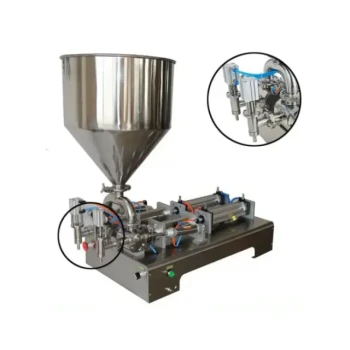
Industrial honey filling machines fundamentally transform late-stage processing through the application of precision volumetric control and anti-drip technology. These systems ensure highly consistent net content across mass production runs while utilizing temperature-controlled filtration to maintain fluidity, remove impurities, and eliminate air bubbles for a clear finished product.
Core Takeaway: Beyond simple automation, these machines provide a closed, controlled environment that effectively isolates honey from external contaminants and moisture. By integrating precise metering with advanced sealing, industrial equipment standardizes product quality, extending shelf life and preserving the biochemical integrity required for premium markets.
Achieving Absolute Consistency
Precision Volumetric Control
The primary technical advantage of industrial machinery is the ability to guarantee highly consistent net content across every unit produced.
Manual filling often leads to variances that result in either product giveaway (overfilling) or regulatory non-compliance (underfilling). Industrial machines utilize high-precision metering pumps to standardize volume, ensuring that large-scale harvests are converted into uniform commercial products.
Minimizing Material Loss
High-performance lines are equipped with specialized anti-drip technology and precision valves.
Honey is viscous and prone to trailing, which causes waste and soils the exterior of packaging. Anti-drip mechanisms cut the flow cleanly after every cycle, significantly reducing raw material loss and ensuring the cleanliness of the bottling process.
Optimizing Product Quality and Aesthetics
Temperature-Controlled Filtration
To handle honey's viscosity without damaging its properties, industrial lines integrate temperature-controlled filtration systems.
This technology maintains the honey at an optimal state of fluidity, allowing it to pass through filters that remove impurities like wax or bee parts. Crucially, this is achieved in a controlled manner that prevents overheating, which could otherwise degrade the honey's flavor or nutritional value.
Elimination of Air Bubbles
A technical byproduct of manual or gravity-fed filling is the entrapment of air, which affects visual clarity and can accelerate oxidation.
Industrial systems are engineered to fill containers in a way that yields a clear finished product without air bubbles. This improves the visual consistency of the packaging, meeting modern consumer aesthetic standards.
Ensuring Hygiene and Longevity
Closed-Loop Production Environments
Industrial-grade machines operate within a closed environment, significantly reducing the risk of honey exposure to ambient air and airborne particulates.
This automated isolation minimizes "secondary contamination" that frequently occurs via human contact during manual handling. By removing human error and direct contact from the equation, the hygiene standards of the final product are vastly improved.
Sealing and Shelf-Life Extension
The integration of high-quality sealing components is critical for preserving honey's biochemical activities and unique flavor.
Honey is hygroscopic, meaning it naturally absorbs moisture from the air, which can lead to fermentation. Integrated sealing technology effectively isolates the product, preventing moisture absorption and chemical changes during storage and transport.
Understanding the Operational Trade-offs
Maintenance of Precision Components
While precision valves and anti-drip mechanisms prevent waste, they introduce mechanical complexity.
Honey is prone to crystallization, which can seize intricate mechanical parts. Operators must adhere to strict, frequent sanitation schedules to prevent sugar crystals from damaging the metering pumps or clogging the anti-drip nozzles.
Thermal Management Risks
The reliance on temperature-controlled systems to maintain fluidity requires careful monitoring.
If the thermal controls are calibrated incorrectly or malfunction, there is a risk of "thermal abuse." Excessive heat can raise HMF (Hydroxymethylfurfural) levels, technically downgrading the honey's quality even if the filling process itself is mechanically perfect.
Making the Right Choice for Your Goal
When evaluating industrial filling technology, align the technical features with your primary business objective:
- If your primary focus is Maximizing Yield: Prioritize machines with volumetric control and anti-drip valves to eliminate material waste and prevent overfilling.
- If your primary focus is Product Quality: Select equipment with temperature-controlled filtration to ensure clarity and flow without compromising biochemical integrity.
- If your primary focus is Market Expansion: Focus on automated sealing and closed-environment systems to meet the strict hygiene and shelf-life standards of premium global retailers.
Investment in industrial filling is not just about speed; it is about securing the biological stability and commercial uniformity of your harvest.
Summary Table:
| Technical Feature | Key Advantage | Impact on Final Product |
|---|---|---|
| Precision Volumetric Control | Guaranteed consistent net content | Minimizes product waste and ensures regulatory compliance |
| Anti-Drip Technology | Clean flow cutoff | Reduces material loss and ensures packaging cleanliness |
| Temperature-Controlled Filtration | Optimal fluidity management | Removes impurities without damaging flavor or nutrition |
| Closed-Loop Environment | Isolation from contaminants | Enhances hygiene and prevents secondary contamination |
| Integrated Sealing | Moisture & air isolation | Extends shelf life and preserves biochemical integrity |
Scale Your Honey Production with HONESTBEE Professional Solutions
At HONESTBEE, we specialize in empowering commercial apiaries and distributors with the high-performance tools needed to dominate the global market. Our comprehensive wholesale offering includes everything from precision honey-filling machines and hive-making hardware to essential beekeeping consumables and cultural merchandise.
Whether you are looking to eliminate product waste with advanced anti-drip technology or ensure the biological stability of your harvest through controlled filtration, our industrial-grade machinery is designed for your success.
Ready to elevate your beekeeping business? Contact us today to explore our full spectrum of equipment!
References
- I.S. Minniakhmetov, D.V. Shelekhov. DEVELOPMENT OF BEEKEEPING IN BUZDYAK DISTRICT OF THE REPUBLIC OF BASHKORTOSTAN. DOI: 10.31563/1684-7628-2024-70-2-56-61
This article is also based on technical information from HonestBee Knowledge Base .
Related Products
- Commercial Rotary Honey Filling Machine for Production
- Precision Durable Efficient HONESTBEE Rotary Honey Filling Machine
- Fully Automatic Honey Filling Packaging Machine for Processing Line
- Economy Small Honey Filling Machine Honey Bottle Filler Packaging Machine
- Precision Automated Packaging Turntable Honey Spoon Filling Sealing Packing Machine
People Also Ask
- What role do commercial honey filling machines play in honey distribution? Scaling Efficiency and Quality Control
- What technical support do commercial-grade filling machines provide? Convert Honey NTFPs into Marketable Commodities
- What is the significance of specialized honey filling equipment? Scaling from Beekeeping to Commercial Success
- Why is professional honey filling machinery critical for honey production? Scale Your Apiary's Profit & Efficiency
- Why is high-capacity honey filling machinery necessary for Giant Honey Bees? Solve the Apis dorsata Volume Crisis