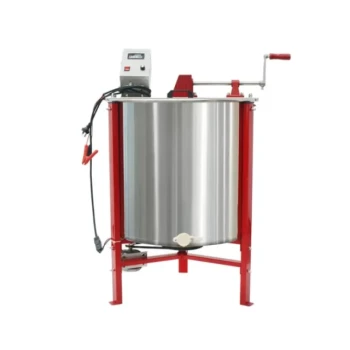
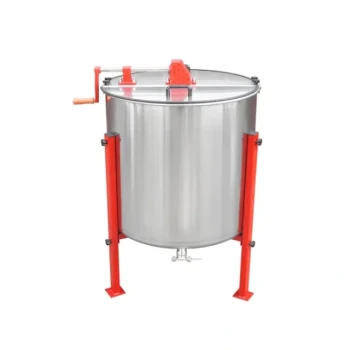
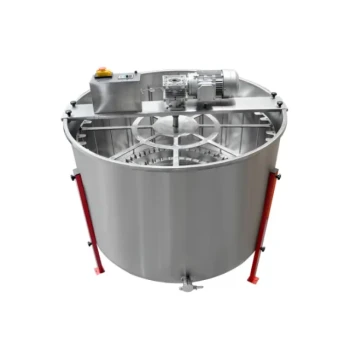
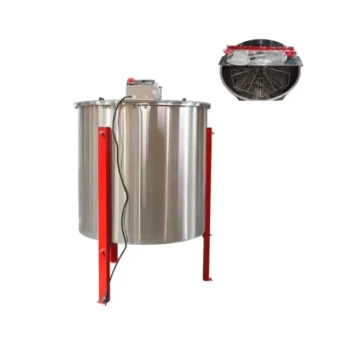
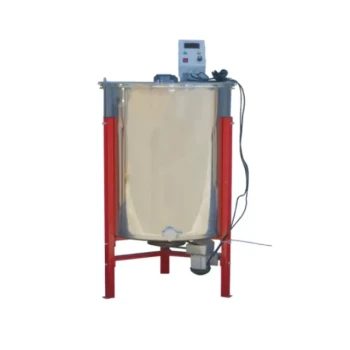
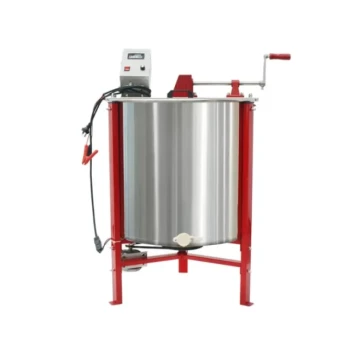
Commercial viability relies on maximum throughput. 100-120 frame radial honey extractors are utilized to process massive volumes of honeycomb simultaneously, drastically increasing the yield per extraction cycle. These high-capacity machines are the foundational hardware for industrial operations, allowing apiaries to shorten harvest windows and significantly reduce labor costs.
The primary value of these extractors lies in their ability to synchronize high-volume processing with short nectar flow periods, transforming honey harvesting from a manual bottleneck into a streamlined, industrial-scale operation.
The Mechanics of High-Capacity Extraction
Simultaneous Volume Processing
The defining feature of these extractors is the sheer capacity to handle 100-120 frames at once. By processing this volume in a single run, commercial operations can achieve industrial-scale yields that are impossible with smaller equipment.
The Radial Advantage
Radial extractors are designed to extract honey from both sides of the frame simultaneously. This eliminates the need to manually flip frames mid-cycle, further speeding up the process and reducing handling time.
Utilizing Centrifugal Force
These machines employ high-speed rotation to generate centrifugal force. This physical principle efficiently separates the honey from the comb structure without the need for heat or destructive crushing methods.
Operational and Economic Benefits
Reducing Labor Costs
Labor is often the highest variable cost in commercial beekeeping. By automating the extraction of hundreds of frames per hour, these machines drastically reduce the man-hours required per kilogram of honey produced.
Capitalizing on Short Nectar Flows
Nectar flows are often short and weather-dependent. Large-capacity extractors allow beekeepers to complete harvesting quickly during these peak production windows, maximizing the intake before the season ends.
Enhancing Hygiene and Safety
Industrial extraction occurs in a closed, mechanized environment. This prevents the entry of external pollutants and moisture, ensuring the final product meets the strict physical and chemical standards required for international export markets.
Asset Preservation
Protecting the Comb Structure
The precise control of rotation speeds ensures that honey is extracted without damaging the wax comb. Preserving the comb structure is critical for commercial sustainability.
Increasing Production Turnover
Because the wax comb remains intact, it can be immediately reused in the hive. This allows bees to focus energy on nectar collection rather than rebuilding wax, significantly increasing the annual honey yield per hive.
Understanding the Trade-offs
High Initial Capital Expenditure
While efficient, these machines represent a significant upfront financial investment. They are generally only cost-effective for operations with a high enough hive count to justify the amortization of the equipment.
Infrastructure Requirements
Running a 100-120 frame extractor requires a dedicated facility. You must have adequate floor space for the machine and the workflow it demands, as well as a robust power supply to handle the motor load.
Maintenance Complexity
Unlike simple manual extractors, industrial units involve complex moving parts and control systems. They require regular, skilled maintenance to prevent downtime during critical harvest windows.
Making the Right Choice for Your Goal
If you are evaluating whether to integrate a 100-120 frame radial extractor into your operation, consider your specific objectives:
- If your primary focus is Scalability: These machines are mandatory to break through the "hobbyist ceiling" and process commercial volumes without linear increases in labor hiring.
- If your primary focus is Asset Turnover: The ability to return undamaged combs to the hive immediately is the fastest way to boost honey production per bee colony.
- If your primary focus is Export Quality: The closed, mechanized filtration and extraction environment provides the consistency and hygiene necessary for premium and organic certification.
investing in high-capacity extraction is not just about speed; it is about securing the operational efficiency required to compete in the global market.
Summary Table:
| Feature | Commercial Benefit | Impact on Operation |
|---|---|---|
| 100-120 Frame Capacity | High-Volume Throughput | Shortens harvest windows & scales production |
| Radial Design | Dual-Sided Extraction | Eliminates manual flipping & reduces labor hours |
| Centrifugal Force | Cold Extraction | Preserves honey quality & maintains comb integrity |
| Closed Environment | Enhanced Hygiene | Meets international export & food safety standards |
| Comb Preservation | Rapid Hive Reuse | Bees focus on collection rather than wax building |
Elevate Your Apiary's Commercial Scale with HONESTBEE
Transitioning to industrial-scale honey production requires more than just equipment; it requires a strategic partnership. HONESTBEE specializes in empowering commercial apiaries and distributors with the robust machinery needed to dominate the global market.
From our high-capacity 100-120 frame radial extractors and automated honey-filling machines to specialized hive-making hardware and essential industry consumables, we provide the complete technical ecosystem your business demands. Our solutions are engineered to reduce your labor costs, protect your biological assets, and ensure your honey meets premium export standards.
Ready to optimize your harvest and maximize your ROI? Contact our commercial specialists today to discuss wholesale pricing and customized equipment configurations tailored to your operation.
References
- К. Хамід, Ф. Аллам. ОСОБЛИВОСТІ ВИРОБНИЦТВА МЕДУ У СХІДНИХ КРАЇНАХ. DOI: 10.37000/abbsl.2021.99.23
This article is also based on technical information from HonestBee Knowledge Base .
Related Products
- 24 Frame Honey Extractor Commercial Radial Honey Frame Extraction Machine
- Stainless Steel Manual 8 Frame Radial Honey Extractor Machine for Beehives
- Commercial Electric 12 Frame Honey Extractor Spinner Motorized Honey Extractor
- electric honey extractor honey centrifuge 3 frame honey extractor stainless steel honey frame extractor
- HONESTBEE 72 Frame Industrial Electric Honey Extractor for Beekeeping
People Also Ask
- How does a radial honey extractor leverage the natural structure of a honeycomb? Optimize Your Apiary's Efficiency
- How do modern honey extraction machines improve harvest efficiency? Boost Your Yield with Radial Technology
- Why must the head of the honey comb be placed near the center axis? Protect Your Comb During Radial Extraction
- Why is the width of iron rings varied for radial honey extractor tilt? Optimize Your Harvest with Precise Engineering
- What are the operational differences between radial and tangential honey extractors? Maximize Your Harvest Efficiency