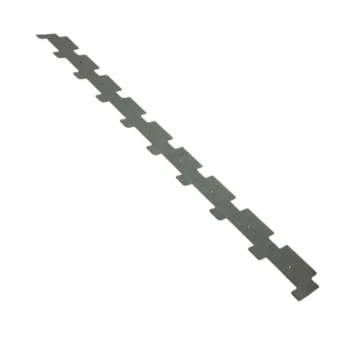
Standardization is the prerequisite for reliable experimental data. Langstroth hives with standard frames are necessary to guarantee that every honeybee colony maintains consistent strength and health throughout a study. This mechanical uniformity allows researchers to precisely dictate pollination pressure, ensuring that results reflect the experiment's variables rather than random differences between individual colonies.
Utilizing standard hive configurations eliminates biological noise, allowing researchers to isolate variables and generate data that is both scientifically accurate and commercially relevant.
Achieving Experimental Precision
Eliminating Biological Interference
The primary goal of using Langstroth hives in research is to neutralize the natural variability between bee colonies. Without standardized equipment, differences in internal hive space could skew data regarding brood quantity and food reserves.
By using standard frames (e.g., 435 by 300 mm), researchers ensure that every colony operates within the exact same physical constraints. This uniformity allows for valid comparisons across different experimental groups.
Controlling Pollination Pressure
To measure the impact of pollination accurately, researchers must control the "dose" of pollinators. Standard hives facilitate this by allowing for a precise count of bees per cage or unit.
This capability prevents experimental interference. It ensures that differences in crop yield or nectar secretion are attributed to the plant or the specific treatment, rather than an uneven number of foraging bees.
Bridging Research and Commercial Application
Creating a Standard Unit of Measurement
In controlled experiments, a "strong colony" must be a quantifiable metric, not a subjective description. The Langstroth setup establishes a standard unit, typically defined as a colony covering 8 to 9 frames.
This definition allows pollination services to be measured and traded like any other industrial input. It enables the precise matching of pollination resources to crop requirements, such as allocating one standard strong colony per hectare.
Compatibility with Industry Operations
Research conducted in Langstroth hives is immediately applicable to the real world because it mirrors the hardware used in commercial apiaries.
This compatibility ensures that management protocols tested in the lab—such as the installation of essential oil paper strips or protein feeding—can be seamlessly scaled up. Data points like "frames covered by bees" become universal metrics that commercial beekeepers can instantly understand and apply.
Understanding the Operational Trade-offs
The Requirement for Rigorous Maintenance
While standardization improves data quality, it imposes a strict operational burden. A hive is only "standard" if it meets the specific frame count (e.g., 8 to 9 frames of bees).
Vulnerability to Deviation
If a colony's population drops below this standard threshold, it no longer serves as a valid experimental unit. This requires constant monitoring and management to ensure all hives in the study remain at the specified strength, as a weak colony in a standard box introduces the very variables you are trying to eliminate.
Applying Standardization to Your Projects
To maximize the value of your pollination management or research, align your hardware choices with your ultimate goals:
- If your primary focus is experimental accuracy: Adhere strictly to standard frame dimensions to eliminate internal hive space variables that could alter brood and food storage data.
- If your primary focus is commercial scalability: Use standard Langstroth configurations to ensure your biological data and management protocols are directly compatible with large-scale industrial apiaries.
- If your primary focus is economic optimization: Utilize the "standard strong colony" metric (8-9 frames) to precisely calculate the pollination units required per hectare for maximum profit.
By treating the hive as a calibrated instrument rather than a simple box, you transform beekeeping from an art into a measurable science.
Summary Table:
| Feature | Experimental Benefit | Commercial Application |
|---|---|---|
| Standard Frame Size | Eliminates biological noise and spatial variables | Enables universal management protocols |
| Standardized Volume | Ensures consistent brood and food reserve space | Allows for predictable hive strength |
| Quantifiable Metrics | Defines 'Strong Colony' as 8-9 frames for accuracy | Facilitates precise billing for pollination services |
| Mechanical Uniformity | Neutralizes hive-to-hive physical differences | Simplifies transport and equipment compatibility |
Elevate Your Apiary Operations with HONESTBEE
Precision in research and efficiency in commercial beekeeping start with the right equipment. HONESTBEE specializes in serving commercial apiaries and distributors by providing a comprehensive range of high-quality, standardized beekeeping solutions.
Whether you are conducting controlled pollination experiments or scaling up industrial honey production, our portfolio has you covered. From precision-engineered Langstroth hives and specialized hive-making machinery to honey-filling systems and essential industry consumables, we deliver the tools you need to transform your operations into a measurable science.
Ready to optimize your yield and streamline your workflow?
Contact us today to discuss your wholesale equipment needs!
References
- Afonso H. Jung, Jerson Vanderlei Carús Guedes. Foraging, spatial distribution and the effect of honeybees on soybean yield. DOI: 10.21475/ajcs.20.14.12.2855
This article is also based on technical information from HonestBee Knowledge Base .
Related Products
- Stainless Steel 9 Frame Hive Spacer Durable Precise for Commercial Beekeeping
- Wooden Bee Hive Frames for Beekeeping and Wholesale
- Durable Plastic Frame Spacer
- Long Langstroth Style Horizontal Top Bar Hive for Wholesale
- Langstroth Honey Bee Box Hive Boxes for Different Depths
People Also Ask
- What is the function of Langstroth frames in comb foundation construction? Optimize Your Apiary's Structural Integrity
- What are the specific dimensions for the wooden parts of Langstroth beehive frames? Precision Guide for All Sizes
- How are Langstroth beehive frames assembled? A Step-by-Step Guide for a Durable Hive
- What is the purpose of Langstroth beehive frames in beekeeping? Key to Professional Hive Management & Scaling
- What is the purpose of Langstroth beehive frames? Unlock the Key to Modern Beekeeping