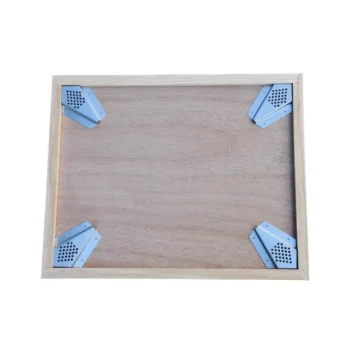
Screened beehive bottom boards and monitoring papers function as essential, non-invasive diagnostic interfaces for collecting naturally fallen Varroa destructor mites. By acting as a physical trap that separates the colony from fallen debris, these tools allow researchers to accurately quantify parasite loads without disrupting the hive's internal biological environment.
Core Takeaway These devices solve the problem of data loss caused by hygienic bee behavior. By preventing bees from removing fallen mites or mites from reattaching to hosts, screened boards provide the precise, quantitative data needed to correlate pathogen levels with winter mortality rates and colony resistance.
The Mechanics of Accurate Data Collection
Non-Invasive Monitoring
The primary function of these tools is to collect naturally fallen mites over a specific period. This method allows for the evaluation of a colony's health status without the need to open the hive or destroy bees to take a sample.
Because the process is non-destructive, it is particularly valuable for long-term studies where the colony must remain viable for future observation.
Preserving Data Integrity
A critical feature of the screened bottom board is the physical barrier it creates. In a standard hive, worker bees will naturally clean debris, including fallen mites, from the bottom board.
The screen separates the bees from the "catch." This prevents the bees from cleaning the monitoring paper and stops live mites from crawling back up and reattaching to a host. This ensures that the count reflects the true "natural fall" rate, rather than a number skewed by bee activity.
The Role in Pathogen and Resistance Analysis
Quantifying Parasite Load
To analyze the relationship between pathogens and colony survival, researchers need quantitative data.
By counting the mites collected on the monitoring papers, scientists can establish a clear metric for the parasite load of a specific colony. This data is the foundation for analyzing correlations between mite infestation levels and winter mortality rates.
Identifying Natural Resistance
In breeding programs, these tools are used to evaluate population growth dynamics of mites across different colonies.
Beekeepers and researchers look for colonies that demonstrate an ability to suppress mite proliferation. Furthermore, the collected samples allow for the assessment of injured mites, a core metric used to determine if a colony possesses specific natural resistance traits, such as grooming behavior that damages the parasite.
Common Pitfalls to Avoid
The Risk of Data Distortion
The effectiveness of this method relies entirely on the integrity of the screen barrier.
If the separation between the bees and the monitoring paper is compromised, the data becomes unreliable. Worker bees may remove the samples, or mites may escape, leading to an underestimation of the infestation level. Accurate calculation of natural mite fall rates requires a system where the "catch" is strictly isolated from the colony's hygienic behavior.
Making the Right Choice for Your Goal
Using these tools effectively depends on the specific metrics you are trying to gather.
- If your primary focus is analyzing winter mortality: Focus on the correlation between the quantitative mite count and colony survival rates to identify at-risk hives early.
- If your primary focus is breeding for resistance: Examine the collected debris for the proportion of injured mites and low population growth to identify colonies with superior genetic defense traits.
By standardizing the collection phase with screened boards, you ensure that every data point is traceable and consistent.
Summary Table:
| Feature | Function | Benefit for Beekeepers |
|---|---|---|
| Screened Barrier | Physically separates bees from fallen debris | Prevents bees from removing mites, ensuring accurate counts |
| Monitoring Paper | Collects naturally fallen Varroa mites | Provides quantitative data for parasite load assessment |
| Non-Invasive Design | Collects data without opening or disrupting the hive | Maintains colony stability for long-term health studies |
| Damage Assessment | Allows inspection of injured mites | Identifies colonies with natural grooming/resistance traits |
Maximize Your Colony’s Potential with HONESTBEE
At HONESTBEE, we understand the complex needs of commercial apiaries and distributors. As your premier wholesale partner, we supply a comprehensive range of professional beekeeping tools, from high-precision screening equipment to industrial honey-filling machines.
Whether you are scaling up your pathogen monitoring program or optimizing honey production, our specialized hardware and industry consumables are designed to drive your success. Contact us today to discover how our tailored equipment solutions can strengthen your business and protect your colonies.
References
- Jorgen Ravoet, Dirk C. de Graaf. Comprehensive Bee Pathogen Screening in Belgium Reveals Crithidia mellificae as a New Contributory Factor to Winter Mortality. DOI: 10.1371/journal.pone.0072443
This article is also based on technical information from HonestBee Knowledge Base .
Related Products
- Langstroth Screen Bottom Board for Beekeeping Wholesale
- Australian Pine Wood Langstroth Screen Bottom Board for Wholesale
- Langstroth Solid Bottom Board for Beekeeping
- Solid Bottom Board Australian Pine Wood Langstroth Bottom Board for Wholesale
- HONESTBEE Top Bar & Bottom Bar Forming Machine | Bee Frame Machine
People Also Ask
- What role do screen bottom boards and monitoring inserts play in assessing Varroa mite mortality and maintaining hive hygiene in Langstroth hives?
- What is the primary function of a screen bottom board? Achieve Accurate Varroa Mite Assessment in Your Apiary
- Why is the combination of a screen bottom board and a sticky trap board essential for monitoring Varroa mite? Guide
- What is the primary function of a standard screen bottom board when assessing honeybee grooming behavior? - Key Mite Data
- Why might a screen bottom board be less effective for pest control? Understanding the 'Mixed Sunlight' Complication