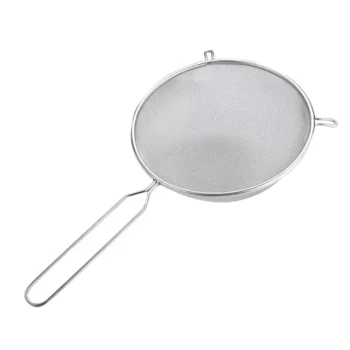
A 200-mesh fine mesh filter is the definitive tool for the final polishing stage of honey harvesting. Its necessity lies in its ability to physically intercept microscopic contaminants—specifically minute wax chips and particulates—that coarser filters allow to pass through, thereby ensuring the honey achieves the high degree of clarity and purity required for the commercial market.
The 200-mesh filter serves as the critical bridge between a raw harvest and a retail-ready product. By removing fine impurities that affect texture and appearance, it ensures the honey meets strict sensory quality standards for commercial circulation.
The Mechanics of Fine Filtration
Physical Interception of Micro-Particulates
The primary function of a 200-mesh filter is mechanical exclusion. While standard filters remove bees, large wax cappings, and visible debris, a 200-mesh screen is tight enough to catch minute impurities.
This includes fine dust and microscopic wax chips that often remain suspended in the liquid after initial straining. By trapping these elements, the filter prevents them from settling as sediment in the final jar.
Achieving Visual Clarity
Ripened honey is prized for its appearance. A 200-mesh filter significantly improves the optical clarity of the product.
Without this level of fine filtration, honey may appear cloudy or hazy. This step effectively "polishes" the liquid, resulting in the bright, translucent aesthetic that consumers associate with high-quality honey.
Meeting Commercial Standards
Ensuring Sensory Quality
Commercial circulation requirements demand consistency in both taste and texture. "Sensory quality" refers not just to flavor, but to the mouthfeel of the honey.
Particulates that pass through coarser filters can introduce a gritty texture. A 200-mesh filter ensures the honey is smooth on the palate, which is a non-negotiable requirement for premium commercial products.
Preparing for Bottling
To compete in the marketplace, honey must look pure on the shelf. Impurities can act as nucleation sites, potentially accelerating crystallization in an uncontrolled manner.
By removing these minute particles, you produce a stable, clean product that meets the expectations of the general consumer market.
Understanding the Trade-offs
Impact on Processing Speed
The major trade-off of using a 200-mesh filter is a reduction in flow rate. Because the mesh is so fine, the honey must pass through very small openings, which significantly slows down the bottling or storage process compared to coarser filtration.
Risk of Clogging
Fine filters are prone to rapid clogging if the honey has not been pre-filtered. Attempting to pass raw honey directly through a 200-mesh screen without a coarser pre-filter will result in immediate blockage, halting operations.
Making the Right Choice for Your Goal
To determine if this level of filtration aligns with your harvesting objectives, consider your final output requirements:
- If your primary focus is Commercial Retail: You must use a 200-mesh filter to ensure the clarity, smoothness, and shelf appeal expected by consumers.
- If your primary focus is Speed and Volume: You should use this filter only as a final step after passing the honey through coarser screens (e.g., 60 or 100 mesh) to prevent bottlenecks.
Using a 200-mesh filter is the industry standard for transforming raw harvest into a polished, professional commodity.
Summary Table:
| Filtration Feature | 200-Mesh Filter Impact | Benefit to Honey Quality |
|---|---|---|
| Particle Removal | Captures microscopic wax chips & dust | Prevents sediment and gritty texture |
| Visual Impact | High-level polishing | Achieves bright, translucent optical clarity |
| Market Readiness | Meets strict sensory standards | Produces professional, retail-ready honey |
| Crystallization | Removes nucleation sites | Helps maintain stability and shelf appeal |
| Processing Speed | Slower flow rate | Requires pre-filtration for efficiency |
Elevate Your Honey Quality with HONESTBEE Professional Equipment
At HONESTBEE, we understand that commercial success depends on the purity and presentation of your harvest. Whether you are a large-scale commercial apiary or a global distributor, we provide the comprehensive tools needed to scale your operations and meet premium market standards.
Our extensive portfolio includes:
- Precision Filtration & Processing: High-quality mesh filters and advanced honey-filling machines.
- Industrial Machinery: Professional-grade hive-making equipment and processing lines.
- Essential Consumables: A full spectrum of beekeeping tools and specialized hardware.
- Brand Growth: Unique honey-themed cultural merchandise to differentiate your brand.
Ready to optimize your production and deliver world-class honey? Contact HONESTBEE today to explore our wholesale solutions and let us help you build a more efficient, profitable beekeeping business.
References
- Nana Guo, Yazhou Zhao. An effective and economic method to produce re-ripe honey with honeybee colonies. DOI: 10.1590/fst.23618
This article is also based on technical information from HonestBee Knowledge Base .
Related Products
- Professional Stainless Steel Honey Filter with Support Handle
- Nylon Honey Strainer Square Filter Cloth for Honey Filters
- Conical Nylon Honey Strainer Filter Bag for Beekeeping and Honey Filtration
- Stainless Steel Triangle Support Honey Strainer and Filters
- Professional Stainless Steel Honey Filtering Machine with Water Bath Heating for Beekeeping
People Also Ask
- Why are stainless steel filters essential during the initial purification phase of honey processing? Ensure Purity
- What are the benefits of using a high-quality honey filter? Elevate Purity and Preserve Natural Flavor
- What is the primary purpose of honey filters? Achieve Professional Clarity & Pure Honey Quality
- What micron filter should I use for honey? Choose the Right Filter for Sales or Competitions
- Why do people filter honey? For Clarity, Stability, and Consumer Appeal