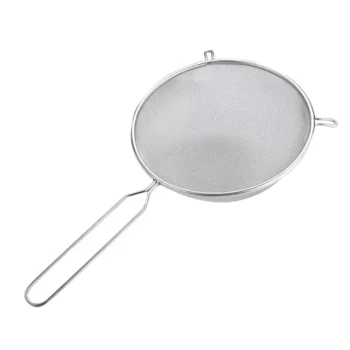
The primary purpose of using a fine-mesh metal sieve in honey pretreatment is to mechanically isolate coarse physical contaminants from the liquid sample. Typically utilizing a 0.5mm aperture, this process effectively filters out wax debris, bee fragments, and honeycomb particles that are introduced during extraction. By removing these suspended solids, you prepare a clean substrate that prevents physical debris from skewing sensitive analytical measurements.
Unfiltered solid impurities introduce random errors into sensitive instruments like optical refractometers. Sieving ensures that metrics such as specific gravity and refractive index reflect the actual chemical composition of the honey, rather than the physical debris suspended within it.
The Impact on Analytical Accuracy
Preventing Optical Distortion
When measuring honey, you often rely on optical refractometers to determine moisture content or total soluble solids. These devices function by measuring how light bends as it passes through the liquid.
Suspended particles like wax or bee parts scatter light unpredictably. This scattering creates random errors in the refractive index readings, leading to data that does not accurately represent the honey's actual quality.
Ensuring Consistent Specific Gravity
Specific gravity is a measurement of the honey's density relative to water. This property is strictly dependent on the dissolved sugars and moisture content of the honey itself.
Large impurities occupy volume and have a different density than the liquid honey. Leaving these contaminants in the sample alters the mass-to-volume ratio, resulting in false specific gravity values that render the test invalid.
Protecting Electrochemical Instruments
Modern analysis often involves electrochemical testing. Solid particulates can coat or interfere with the electrodes used in these tests.
Filtration through a 0.5mm sieve removes the visible contaminants that might physically block sensors or alter the electrical conductivity of the sample, ensuring the reading is purely based on the honey's chemical properties.
Operational Considerations and Trade-offs
Mechanical vs. Chemical Purity
It is critical to understand that sieving is strictly a physical filtration method. It removes solid debris, but it does not remove dissolved chemical contaminants or microscopic adulterants.
While it prepares the sample for physical testing, a sieve cannot improve the chemical grade of the honey if the liquid itself is compromised.
The Importance of Mesh Size
The choice of a 0.5mm aperture is intentional and presents a trade-off between purity and biological integrity.
This size is small enough to catch wax and insect parts, but large enough to allow microscopic pollen grains to pass through. If the mesh were too fine, you would filter out the pollen, which is necessary for botanical classification and microscopic analysis.
Making the Right Choice for Your Goal
To ensure your honey analysis yields valid data, align your pretreatment with your specific analytical objectives:
- If your primary focus is Optical Analysis (Refractometry): Ensure you use a 0.5mm sieve to remove all light-scattering wax particles, or your moisture readings will be unreliable.
- If your primary focus is Pollen Classification: Verify that your sieve is not finer than 0.5mm, as a smaller mesh will inadvertently strip the sample of the biological markers you need to count.
- If your primary focus is Specific Gravity: Prioritize the removal of honeycomb fragments, as these low-density solids will cause the greatest variance in your density calculations.
Proper filtration is the baseline requirement for transforming raw extraction into a verifiable scientific sample.
Summary Table:
| Feature | Specification/Impact | Benefit for Honey Analysis |
|---|---|---|
| Standard Aperture | 0.5 mm | Removes wax/debris while preserving pollen |
| Optical Impact | Prevents light scattering | Ensures accurate refractometer moisture readings |
| Density Impact | Normalizes mass-volume ratio | Provides valid specific gravity measurements |
| Instrument Care | Sensor protection | Prevents electrode interference and physical damage |
| Filtration Type | Mechanical/Physical | Prepares a clean substrate for chemical testing |
Elevate Your Honey Processing with HONESTBEE Professional Equipment
Precise analysis starts with professional-grade filtration. HONESTBEE specializes in supporting commercial apiaries and distributors with high-performance beekeeping tools and industrial machinery designed for excellence.
From fine-mesh sieving solutions and honey-filling machines to specialized hive-making hardware, we provide the full spectrum of equipment and consumables needed to scale your operations and ensure product purity.
Ready to optimize your production line? Contact our expert team today to discover how our wholesale solutions can enhance your efficiency and honey quality.
References
- Mahmood K. H. Al-Mashhadani. STUDIES ON SOME PHYSICAL PROPERTIES OF EGYPTIAN AND IRAQIAN HONEY.. DOI: 10.21608/jppp.2015.75431
This article is also based on technical information from HonestBee Knowledge Base .
Related Products
- 0.5T Capacity Honey Dehumidifier Dryer with Vacuum Heating and Thickening Filtering Machine
- Professional Stainless Steel Honey Filter with Support Handle
- Stainless Steel Double Layer Honey Strainer Sieve Filters
- Stainless Steel Triangle Support Honey Strainer and Filters
- Professional Wide Blade Honey Scraper for Beekeeping and Honey Processing
People Also Ask
- What is the primary function of professional dehumidification equipment in honey processing? Stability & Quality
- How to dry up honey? The Safe Guide to Stabilizing Honey and Preventing Fermentation
- What is the process for using a dehumidifier to lower honey's moisture content? Expert Drying Techniques
- How to decrease moisture in honey? Prevent Fermentation and Ensure Long-Term Quality
- How to remove humidity from honey? Protect Your Harvest from Fermentation