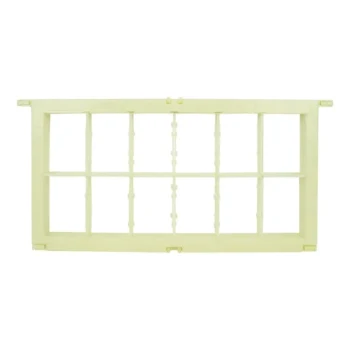
Standardizing biological measurement is critical for accurate analysis. A standardized 5x5 cm grid is utilized to convert the irregular, organic distribution of capped brood on a comb into quantifiable, fixed units. By overlaying this grid, researchers and beekeepers can translate visual area into specific cell counts—where one 5x5 cm unit represents approximately 100 worker bee cells—ensuring data is objective rather than estimated.
The primary function of the grid is to eliminate human error and subjectivity from the assessment of colony strength. It transforms abstract biological patterns into numerical data, allowing for precise comparisons of breeding capacity and the effectiveness of nutritional supplements.
Converting Biology into Mathematics
Overcoming Irregular Distribution
Honeybee brood patterns are rarely uniform. The queen lays eggs in concentric but often irregular circles, creating "patches" of brood that are difficult to measure with a simple ruler.
The 5x5 cm grid acts as an overlay that imposes a geometric standard onto this organic shape. It allows the observer to break down complex curves into countable blocks.
The 100-Cell Standard
The specific dimension of 5x5 cm is not arbitrary. In standard comb construction, this area corresponds to approximately 100 worker bee cells.
This conversion factor allows for rapid calculation. Instead of counting thousands of individual cells, a technician simply counts the grid squares and multiplies by 100 to generate a statistically valid population estimate.
The Value of Objective Comparison
Eliminating Subjective Estimation
Without a grid, assessing colony strength relies on visual estimation (e.g., "this frame looks 60% full"). This method is prone to significant human error and varies from person to person.
The grid ensures repeatability. Two different researchers measuring the same frame with a grid should yield nearly identical data, making the findings scientifically robust.
Measuring Nutritional Impact
A critical application of this tool is evaluating feeding programs. As noted in the primary documentation, the grid is essential for comparing breeding capacity after colonies receive protein supplements.
By quantifying the exact change in capped brood area, apiarists can determine if a specific supplement actually increased reproduction rates or if the colony growth was coincidental.
Understanding the Trade-offs
Time vs. Precision
While the grid method provides superior accuracy compared to visual guessing, it is labor-intensive. Counting grid squares takes significantly longer than a quick visual inspection. It is best reserved for scenarios where data integrity is more valuable than speed, such as scientific studies or testing new feeds.
The "Partial Square" Ambiguity
Brood areas rarely line up perfectly with the grid lines. Users must establish a consistent protocol for handling partial squares on the perimeter of the brood pattern. Failing to standardize whether to round up or down for half-filled squares can introduce a slight margin of error.
Making the Right Choice for Your Goal
To determine if this measurement method aligns with your objectives, consider the following:
- If your primary focus is Scientific Research: You must use the grid to ensure your data on colony reproduction is statistically significant and publishable.
- If your primary focus is Commercial Feed Testing: Use the grid on a sample set of hives to calculate the precise Return on Investment (ROI) of your protein supplements.
- If your primary focus is Routine Inspection: Visual estimation may suffice, as the time cost of grid measurement may outweigh the benefits for general colony management.
Adopting the 5x5 cm grid shifts colony assessment from an intuitive art to a measurable, data-driven science.
Summary Table:
| Feature | Grid-Based Measurement | Visual Estimation |
|---|---|---|
| Accuracy | High (Converts area to exact cell count) | Low (Prone to human error) |
| Unit Conversion | 1 grid square (5x5cm) ≈ 100 cells | Subjective percentage (%) |
| Consistency | Repeatable across different observers | Varies by individual experience |
| Primary Use | Scientific research & supplement testing | Routine hive management |
| Speed | Labor-intensive and time-consuming | Fast and efficient |
Maximize Your Apiary Productivity with HONESTBEE
At HONESTBEE, we understand that data-driven beekeeping is the key to scaling a successful operation. Whether you are a commercial apiary or a distributor, we provide the professional-grade tools and machinery you need to turn insights into results.
Our extensive portfolio includes:
- Advanced Machinery: Hive-making and honey-filling machines to streamline production.
- Beekeeping Hardware: High-quality tools designed for precision and durability.
- Essential Consumables: A full spectrum of supplies to support colony health and growth.
Ready to elevate your beekeeping business with a comprehensive wholesale partner? Contact us today to explore our full equipment catalog and see how HONESTBEE can deliver value to your supply chain.
References
- O. Mischenko, D. Kryvoruchko. The efficiency of using hydrocarbon-protein feeding for honey bees. DOI: 10.31073/agrovisnyk202103-05
This article is also based on technical information from HonestBee Knowledge Base .
Related Products
- Assembled Wooden Bee Frames with Plastic Foundation for Durability and Convenience by HONESTBEE
- Professional Sectional Comb Honey Frame with 250g Cassette System for Beekeeping
- Assembled Wooden Bee Frames with Beeswax Foundation Ready to Use by HONESTBEE
- HONESTBEE Wired and Assembled Wooden Bee Frames Foundation for a Thriving Hive
- Plastic Bee Frame Beekeeping Hive Frames for Wholesale
People Also Ask
- When should frames with new foundation be given to colonies? Master Timing for a Thriving Hive
- What are bee frames and how are they sized? A Professional Guide to Standardization & Material Choice
- How do you re-wax bee frames? A Simple Guide to Faster Comb Building
- What types of bee frames can be cleaned and returned to service? A Guide to Safe Apiary Refurbishment
- Can beekeepers switch between wooden and plastic frames? Optimize Your Hive's Performance