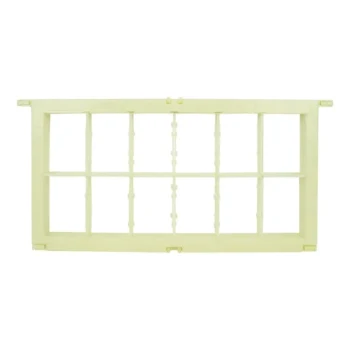
The primary function of a standardized square grid frame is to convert visual estimates of brood patterns into precise mathematical data regarding a queen's fertility. By overlaying a specific grid (typically 5x5 cm) onto a honeycomb, technicians can subdivide the comb into fixed units that correlate to a specific number of cells. This allows for the accurate calculation of total capped brood and the derivation of the queen's average daily egg-laying rate.
Using a standardized grid transforms subjective observation into objective metrics. By establishing a fixed cell count per unit area, beekeepers can rapidly calculate daily laying rates and scientifically predict future colony population growth.
The Mechanics of Standardization
Establishing the Base Unit
To evaluate a queen effectively, you must move beyond guessing. The industry standard utilizes a measurement frame often specified at 5x5 cm per grid unit.
Field data establishes that this specific surface area contains approximately 100 worker cells. This known constant is the foundation of the entire evaluation process.
Simplifying the Counting Process
Counting thousands of individual cells is impractical and prone to error. The grid allows technicians to simply count the "units" (squares) covering the brood area.
By multiplying the number of full grid units by 100, the technician instantly derives the total number of capped brood cells. This method offers high-speed quantification without sacrificing significant accuracy.
Calculating Reproductive Metrics
Deriving the Daily Laying Rate
The total count of capped brood is a snapshot, but the daily egg-laying rate is the true performance indicator. To find this, the total capped brood count is divided by the duration of the capped developmental stage.
The primary reference indicates a standard calculation period of 12 days. Dividing the total brood count by 12 provides the queen's average daily production.
Evaluating Colony Expansion
This data is not just about the queen's current status; it is a predictive tool. Understanding the daily laying rate allows beekeepers to forecast the rate of colony proliferation.
By tracking these numbers, you can determine if the colony is expanding efficiently enough to meet production goals or survive environmental stressors.
Understanding the Trade-offs
Measurement Frequency
While the grid provides a snapshot, accurate evaluation requires consistency over time. Some protocols suggest periodic measurements at intervals, such as every 13 days, to account for fluctuations.
Relying on a single measurement may not account for temporary environmental factors or brood cycles.
Contextual Variables
The grid measures capped worker brood, but it does not inherently account for drone brood or empty cells within the pattern (spotty brood).
Technicians must visually verify that the grid units being counted are fully dense with brood. Blindly applying the "100 cells per unit" rule to a spotty brood pattern will inflate the queen's performance metrics.
Making the Right Choice for Your Goal
To effectively use a standardized measurement frame, you must align your methodology with your specific management objectives.
- If your primary focus is Commercial Breeding: Prioritize the average daily rate calculation to strictly select queens with the highest biological output for propagation.
- If your primary focus is Colony Health Monitoring: Focus on periodic consistency to identify sudden drops in laying rates, which may indicate disease or environmental stress.
- If your primary focus is Production Planning: Use the total capped brood count to predict the workforce population size available for the upcoming honey flow.
Standardized measurement replaces intuition with evidence, ensuring your management decisions are based on the biological reality of the hive.
Summary Table:
| Metric | Value/Standard | Purpose |
|---|---|---|
| Grid Unit Size | 5x5 cm | Standardized area for rapid measurement |
| Cell Density | ~100 cells per unit | Constant for calculating total brood count |
| Capped Stage Duration | 12 Days | Divisor used to derive daily laying rate |
| Evaluation Goal | Quantitative Data | Eliminates subjective bias in queen selection |
Elevate Your Apiary Operations with HONESTBEE
At HONESTBEE, we understand that precision is the backbone of successful commercial beekeeping. Whether you are a large-scale commercial apiary or a specialized distributor, our mission is to supply you with the high-performance tools and machinery needed to optimize your production.
From advanced hive-making and honey-filling machines to a comprehensive selection of beekeeping hardware and consumables, we provide everything you need to scale your operations efficiently. Empower your business with data-driven results and professional-grade equipment.
Contact our team today to discuss wholesale solutions and equipment packages
References
- I. I. Dvylyuk, І. І. Kovalchuk. Reproductive ability of bee queens at the conditions of feeding citrates of Argentum and Cuprum. DOI: 10.15407/animbiol19.02.030
This article is also based on technical information from HonestBee Knowledge Base .
Related Products
- JZBZ Langstroth Queen Rearing Frame for Beekeeping
- Automatic Heat Preservation 6 Frame Pro Nuc Box for Honey Bee Queen Mating
- Professional Wooden Requeening Frame for Beekeeping
- Assembled Wooden Bee Frames with Plastic Foundation for Durability and Convenience by HONESTBEE
- HONESTBEE Wired and Assembled Wooden Bee Frames Foundation for a Thriving Hive
People Also Ask
- Why use finishing colonies for queen cell capping? Secrets to Superior Queen Quality and Performance
- How do queen rearing frames and grafting needles function together? Master the Doolittle Method for High-Quality Queens
- What is the purpose of queen rearing frames? Master Controlled Queen Production for Your Apiary
- What are the functions of queen rearing frames and artificial queen cells? Master Bee Genetic Improvement
- What roles do professional queen rearing frames and artificial queen cells play? Scaling Your Queen Bee Production