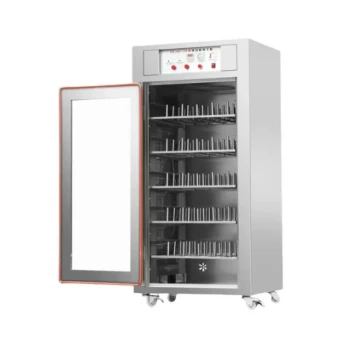
A vacuum drying oven is the only reliable method to dehydrate drone larva homogenate without destroying its medicinal value. By utilizing negative pressure to lower the boiling point of water, this equipment allows for rapid dehydration at temperatures not exceeding 34°C. This specific thermal limit is critical because it prevents the denaturation of heat-sensitive bioactive components that would otherwise be destroyed by standard drying methods.
Core Takeaway The biological potency of drone larva homogenate relies entirely on the preservation of heat-sensitive compounds like decenoic acids and sulfhydryl groups. Vacuum drying creates a low-temperature, low-oxygen environment that removes moisture while maintaining the structural integrity and physiological activity of these vital ingredients.
The Mechanics of Low-Temperature Preservation
Manipulating the Boiling Point
Standard drying relies on high heat to evaporate water, which "cooks" biological materials. A vacuum drying oven circumvents this by creating a negative pressure environment.
In a vacuum, the boiling point of water drops significantly. This allows moisture within the homogenate to evaporate efficiently at approximately 34°C to 35°C, ensuring the product is dried without ever reaching temperatures that cause thermal damage.
Protecting Thermolabile Components
The primary value of drone larva homogenate lies in its bioactive profile, specifically its decenoic acids and sulfhydryl groups. These compounds are thermolabile, meaning they break down rapidly when exposed to heat.
By strictly maintaining processing temperatures below 34°C, the vacuum oven prevents oxidative decomposition. This ensures that enzymes, hormones, and other physiological activators remain potent in the final product.
Product Stability and Shelf Life
Achieving Critical Moisture Levels
To ensure long-term stability, the internal moisture content of the homogenate must be drastically reduced. Vacuum drying allows operators to control residual moisture levels to below 1.2%.
At this level of dryness, microbial growth is inhibited. This allows the biological activity of the homogenate to remain stable throughout its intended shelf life.
Preventing Oxidation
Oxidation is the enemy of biological potency. In a standard oven, hot air reacts with the product, degrading sensitive compounds.
Vacuum drying inherently removes air from the chamber during the drying process. This oxygen-deprived environment protects the homogenate from oxidative stress, further preserving its nutritional and medicinal quality.
Understanding the Trade-offs
The Challenge of Hygroscopicity
While vacuum drying preserves quality, the resulting product is highly hygroscopic. This means the dried homogenate will aggressively absorb moisture from the surrounding environment if exposed to air.
The Requirement for Immediate Sealing
Because the product is so sensitive to re-absorbing moisture, the drying process cannot be viewed in isolation. It must be paired with rigorous sealing protocols.
If the vacuum seal is broken or if the product is packed in a humid environment, the quality will decline rapidly. High-level vacuum sealing or nitrogen-rich packing is often required immediately after drying to maintain the benefits achieved by the oven.
Making the Right Choice for Your Goal
If your primary focus is Maximum Bioactivity: Ensure your equipment creates sufficient negative pressure to keep the process temperature strictly at or below 34°C to protect decenoic acids.
If your primary focus is Long-Term Storage: Verify that your drying cycle can consistently achieve a residual moisture content below 1.2% to prevent spoilage and degradation.
If your primary focus is Commercial Viability: Invest in post-drying handling equipment that allows for aseptic, vacuum-sealed packaging to prevent the hygroscopic product from degrading before it reaches the customer.
To deliver a high-value biological product, precise temperature control via vacuum technology is not optional; it is the baseline requirement for success.
Summary Table:
| Feature | Vacuum Drying (at 34°C) | Standard Heat Drying |
|---|---|---|
| Temperature Control | Precise low-temp (under 34°C) | High heat (over 60°C+) |
| Bioactive Preservation | Maintains decenoic acids & enzymes | Destroys thermolabile compounds |
| Oxidation Risk | Near zero (oxygen-deprived) | High (exposure to hot air) |
| Moisture Content | Below 1.2% (Shelf-stable) | Often inconsistent |
| Product Integrity | Retains medicinal value | Thermal denaturation |
| Physical State | Highly hygroscopic powder | Brittle or "cooked" texture |
Elevate Your Bee Product Processing with HONESTBEE
To maintain the medicinal potency of drone larva homogenate, precision equipment is non-negotiable. HONESTBEE specializes in supporting commercial apiaries and distributors with high-performance beekeeping machinery and essential tools. From specialized vacuum drying ovens and honey-filling machines to large-scale hive-making hardware, we provide the full spectrum of equipment needed to scale your operations.
Ready to enhance your product quality and shelf life? Contact us today to discover how our wholesale solutions can optimize your production line.
References
- Д. В. Митрофанов, Н.В. Будникова. Physico-chemical parameters of drone brood homogenate adsorbed on lactose-free adsorbents during storage. DOI: 10.32417/1997-4868-2024-24-03-358-367
This article is also based on technical information from HonestBee Knowledge Base .
Related Products
- 0.5T Capacity Honey Dehumidifier Dryer with Vacuum Heating and Thickening Filtering Machine
- HONESTBEE Professional Cabinet Bottle Dryer
People Also Ask
- What is the primary function of professional dehumidification equipment in honey processing? Stability & Quality
- How to dry up honey? The Safe Guide to Stabilizing Honey and Preventing Fermentation
- What is the process for using a dehumidifier to lower honey's moisture content? Expert Drying Techniques
- How to decrease moisture in honey? Prevent Fermentation and Ensure Long-Term Quality
- How to remove humidity from honey? Protect Your Harvest from Fermentation