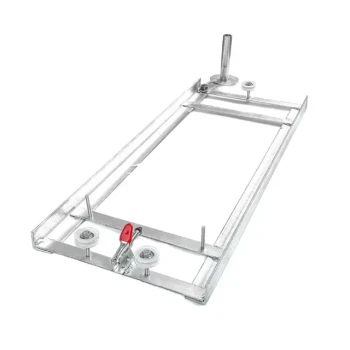
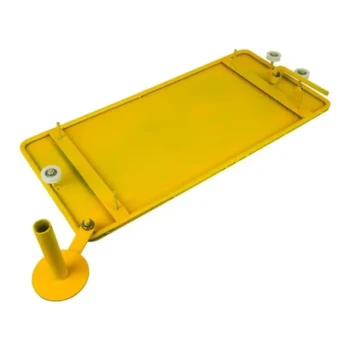
The wire mesh acts as a selective filter, while the white sheet serves as a high-contrast display for accurate data collection.
This system separates the colony from its waste. The wire mesh allows small parasites to fall through while physically preventing bees from accessing the bottom board. The underlying white surface ensures these tiny, dark mites stand out visually, enabling beekeepers to accurately quantify the colony's parasite load without disturbing the hive.
By physically separating the bees from fallen debris, this setup eliminates "hygienic interference." It ensures that the mites you count are the actual number falling from the colony, not just the ones the bees failed to clean up.
The Mechanics of Accurate Monitoring
The Wire Mesh as a Selective Barrier
The wire mesh acts as a strictly physical isolation tool. Its grid size is calibrated to be permeable to falling debris and Varroa mites, but impermeable to the bees themselves.
Preventing Hygienic Interference
Honey bees are naturally hygienic creatures. If allowed access to the bottom of the hive, they will actively clean away dead mites and debris.
Without the mesh, bees would remove the evidence of infestation before you could count it. The mesh preserves the integrity of the data by keeping the fallen mites out of the bees' reach.
Blocking Re-infestation
Beyond monitoring, the mesh serves a protective sanitary function. Live mites that fall naturally or due to grooming cannot easily climb back up through the mesh to re-attach to a host bee.
Visualizing the Data
The Necessity of High Contrast
Varroa mites are small and typically dark reddish-brown. On a standard wooden bottom board or dark surface, they are nearly impossible to distinguish from general hive debris.
The white plastic or paper creates a sharp visual contrast. This allows technical personnel or researchers to quickly scan the board and differentiate mites from wax scales or pollen.
Continuous, Non-Destructive Assessment
This method allows for "natural drop" monitoring. Because the bees are physically separated from the collection area, the sheet can remain in place for days.
This provides a continuous, longitudinal view of the infestation levels without requiring the hive to be opened or the bees to be handled.
Understanding the Trade-offs
The Risk of Live Mites
While the mesh prevents bees from cleaning the board, it does not kill the mites. If the white sheet is not coated with a sticky substance (like Vaseline), live mites may crawl off the board or be blown away by wind, skewing the count.
Debris Accumulation
The mesh is a non-discriminating filter. It allows wax cappings, pollen, and other hive trash to fall alongside the mites.
On a white sheet, this accumulation can sometimes create visual "noise," requiring the observer to carefully distinguish between a mite and a piece of dark propolis or dirt.
Making the Right Choice for Your Goal
To get the most out of this monitoring setup, consider how you prepare the white sheet.
- If your primary focus is absolute accuracy: Coat the white paper with a sticky substance (like Vaseline) to trap live mites instantly and prevent them from crawling away or being blown off.
- If your primary focus is rapid, frequent sampling: Use a dry white plastic sheet that can be quickly wiped clean and re-inserted, accepting that a small margin of live mites might escape.
The reliability of your data depends entirely on your ability to see the mites and the bees' inability to touch them.
Summary Table:
| Feature | Function | Benefit |
|---|---|---|
| Wire Mesh | Physical isolation barrier | Prevents bees from cleaning away mites (Hygienic Interference) |
| White Surface | High-contrast background | Makes small, dark Varroa mites easily visible for accurate counting |
| Selective Filtering | Permeable to debris/parasites | Allows for continuous monitoring without opening or disturbing the hive |
| Sticky Coating | Optional adhesive (e.g., Vaseline) | Traps live mites to prevent re-infestation or wind-blown data errors |
Scaling Your Apiary Operations with Precision
At HONESTBEE, we understand that accurate pest management is the backbone of a successful commercial apiary or distribution business. As a premier global supplier, we provide the high-quality tools and machinery you need to maintain healthy, productive colonies at scale.
Whether you are looking for wholesale beekeeping tools, advanced hive-making machinery, or high-capacity honey-filling solutions, HONESTBEE delivers comprehensive equipment packages tailored to your professional needs. From essential consumables to cultural merchandise, we equip you to lead the industry.
Ready to elevate your beekeeping business? Contact our specialist team today to discuss wholesale opportunities and custom equipment solutions.
References
- GHADA S. REFAEI, Ola Roshdy. Incidence of Parasitic and Non-Parasitic Mites of Honeybee, Apis mellifera (Linnaeus). DOI: 10.21608/jppp.2018.44098
This article is also based on technical information from HonestBee Knowledge Base .
Related Products
- Stainless Steel Bee Hive Frame Wire for Beekeeping
- HONESTBEE Professional Frame Wiring Board and Jig
- HONESTBEE Durable Frame Wiring Board with Integrated Tensioner
- Langstroth Screen Bottom Board for Beekeeping Wholesale
People Also Ask
- What are the arguments for and against wiring beehive frames? Balance Durability and Management Flexibility
- What are the drawbacks of wiring beehive frames? Key Limitations and Structural Trade-offs Revealed
- How is the wire secured at the top of the frame? A Guide to Locking in Tension for Strong Honeycomb
- What factors determine the amount of wiring needed in beehive frames? Tailor Your Strategy for Your Climate
- What tools are needed to wire a beehive frame? Essential Equipment for Durable Frame Construction