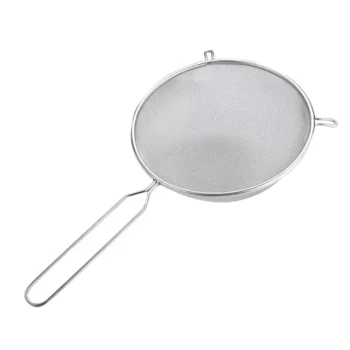
The use of an 80-mesh standard sieve is critical in the manufacturing of honeybee pollen substitute because it guarantees a particle size of less than 500 microns. This precise level of filtration is necessary to accommodate the specific physiological feeding mechanisms of worker bees, ensuring the powder is fine enough to be physically ingested without waste.
The effectiveness of a pollen substitute is defined not just by its ingredients, but by its physical accessibility. An 80-mesh sieve acts as a biological gatekeeper, ensuring the feed is fine enough to be metabolized into the Royal Jelly required for colony survival.
The Physiology of Feed Acceptance
The 500-Micron Threshold
The 80-mesh sieve is used to create a strict upper limit on particle size, capping it at 500 microns.
This dimension is not arbitrary; it directly mirrors the maximum particle size that a honeybee can comfortably handle and ingest.
Aligning with Bee Anatomy
Honeybees possess distinct physiological feeding characteristics that limit their ability to consume coarse solids.
If the powder particles exceed the 500-micron limit, worker bees cannot process them effectively. The 80-mesh standard ensures the mechanical properties of the feed match the biological capabilities of the insect.
From Ingestion to Production
Enabling Digestion
Ingestion is only the first step; the powder must be easily digestible to be of value.
By ensuring the powder is sufficiently fine, the surface area is maximized, allowing for rapid breakdown within the bee's digestive system.
Fueling Royal Jelly Secretion
The ultimate goal of feeding pollen substitute is to empower worker bees to secrete Royal Jelly.
When worker bees can effectively ingest and convert this nutritional energy, they produce the Royal Jelly necessary to feed the queen and rear brood. A coarser grind would hinder this conversion process, stalling colony growth.
Understanding the Trade-offs
The Cost of Consistency
Using an 80-mesh sieve adds a processing step that requires time and equipment maintenance.
However, skipping this step to save time results in a product that bees may physically reject or be unable to utilize, rendering the ingredients wasted.
Quality Control vs. Volume
Achieving a sub-500 micron size may reduce the throughput speed of production compared to coarser grinding.
This is a necessary trade-off: high volume is irrelevant if the end product is biologically incompatible with the consumer (the bee).
Making the Right Choice for Your Goal
To maximize the effectiveness of your pollen substitute, consider these priorities:
- If your primary focus is nutritional uptake: rigor strictly adhere to the 80-mesh standard to ensure every gram of powder is physically accessible to the bees.
- If your primary focus is colony expansion: prioritize the fineness of the grind to maximize the conversion of feed into Royal Jelly for brood rearing.
Precision in particle size is the bridge between raw ingredients and a thriving hive.
Summary Table:
| Feature | 80-Mesh Standard Specification | Impact on Bee Health |
|---|---|---|
| Particle Size | < 500 Microns | Matches bee anatomy for easy ingestion |
| Physical Form | Ultra-fine Powder | Maximizes surface area for rapid digestion |
| Biological Goal | Enhanced Bioavailability | Efficient conversion into Royal Jelly |
| Primary Benefit | Waste Reduction | Prevents rejection of coarse feed particles |
Elevate Your Beekeeping Operation with HONESTBEE
At HONESTBEE, we understand that precision is the difference between a struggling hive and a thriving one. As a leading provider for commercial apiaries and distributors, we offer a comprehensive wholesale range of professional-grade beekeeping tools and machinery—including specialized equipment for producing high-quality pollen substitutes.
Whether you need industrial honey-filling machines, precision hive-making hardware, or essential industry consumables, our portfolio is designed to enhance your efficiency and product quality. Partner with us to access the high-performance tools your business deserves.
Ready to scale your production? Contact us today to explore our wholesale offerings and see how HONESTBEE can support your growth!
References
- Ratna Iffany Faradilla Besari, Lilik Eka Radiati. Benguk Tempeh Flour (<i>Mucuna pruriens</i> L.): Royal Jelly Production of <i>Apis mellifera</i> in the Dearth Period. DOI: 10.1051/bioconf/202519100030
This article is also based on technical information from HonestBee Knowledge Base .
Related Products
- Professional Stainless Steel Honey Filter with Support Handle
- Stainless Steel Triangle Support Honey Strainer and Filters
People Also Ask
- Why are stainless steel filters essential during the initial purification phase of honey processing? Ensure Purity
- What are the benefits of using a high-quality honey filter? Elevate Purity and Preserve Natural Flavor
- What is the primary purpose of honey filters? Achieve Professional Clarity & Pure Honey Quality
- What micron filter should I use for honey? Choose the Right Filter for Sales or Competitions
- Why do people filter honey? For Clarity, Stability, and Consumer Appeal