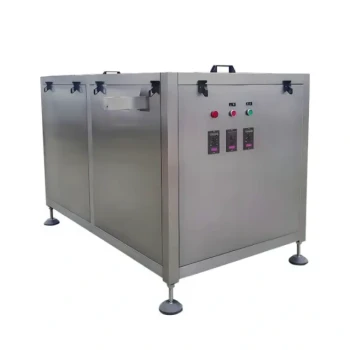
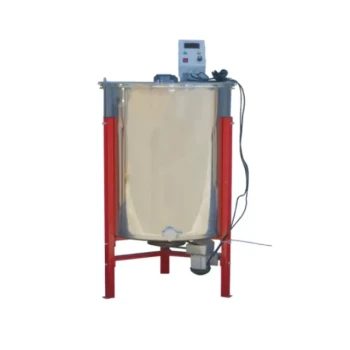
An industrial-grade centrifuge operating at 3000 rpm is strictly necessary because it generates the critical force required to destabilize the robust emulsion formed during the MeSA-VASEME microextraction process. This specific rotational speed provides enough energy to force fine solvent particles to overcome their surface tension and coalesce. Without this mechanical intervention, the phases would remain mixed, preventing the formation of the clear enriched phase needed for analysis.
The 3000 rpm threshold provides the kinetic energy essential for breaking the stable emulsion barrier, leveraging density differences to force solvent separation and ensure high analyte recovery.
The Mechanics of Emulsion Breaking
Overcoming Surface Tension
The MeSA-VASEME process creates a "stable emulsion system." This means the extraction solvent is dispersed as microscopic particles throughout the aqueous phase.
These particles are naturally resistant to merging due to surface tension. The centrifugal force generated at 3000 rpm is the mechanical key that overpowers this tension, forcing the fine particles to crash into one another and coalesce.
Leveraging Density Differences
Once the particles coalesce, the process relies on physics to segregate the materials. The solvent and the aqueous phase have different densities.
The centrifuge acts as a powerful accelerator for this separation. It pushes the now-coalesced solvent particles to the bottom of the container, effectively "sedimenting" the liquid to form a distinct layer.
The Impact on Process Efficiency
Creating a Clear Enriched Phase
The visual goal of this step is clarity. A successful run results in a clear enriched phase at the bottom of the tube.
If the centrifugal force is insufficient, the mixture remains cloudy. This clarity is the visual indicator that the solvent has been successfully pulled out of suspension.
Ensuring High Recovery Rates
The ultimate technical goal is recovery. The solvent contains the extracted analytes (the substances you are analyzing).
If the phase separation is incomplete, solvent—and therefore analyte—remains trapped in the water. The 3000 rpm speed ensures the separation is thorough, maximizing the volume of solvent recovered.
Understanding the Risks of Inadequate Centrifugation
The Pitfall of Lower Speeds
It is a common error to assume that "some separation" is enough. However, below 3000 rpm, the force may be insufficient to break the specific emulsion stability of this system.
This results in a partial separation where the interface between liquids is ill-defined. This leads to contamination of the sample or loss of the target analyte.
Equipment Stability
The requirement is for an "industrial-grade" centrifuge. This implies a need for consistent, sustained rotational velocity.
Standard laboratory centrifuges that fluctuate in speed may fail to maintain the constant force vector needed to pack the solvent particles at the bottom of the container.
Optimizing the Separation Step
To ensure the success of your MeSA-VASEME process, equipment selection must be dictated by the physics of the emulsion.
- If your primary focus is high recovery rates: Ensure your centrifuge is calibrated to reach and maintain a full 3000 rpm to guarantee the emulsion is completely broken.
- If your primary focus is sample purity: Verify that a clear, distinct enriched phase has formed at the bottom; if the phase is cloudy, the centrifugal force or duration was likely insufficient.
Precision in this mechanical step is the defining factor between a stable emulsion and a successful extraction.
Summary Table:
| Feature | Requirement | Impact on MeSA-VASEME Process |
|---|---|---|
| Rotational Speed | 3000 RPM | Provides kinetic energy to break the stable emulsion barrier |
| Equipment Grade | Industrial-grade | Ensures consistent, sustained velocity for uniform separation |
| Physical Action | Coalescence | Overcomes surface tension to merge microscopic solvent particles |
| Visual Outcome | Phase Clarity | Indicates successful separation of the enriched phase |
| Technical Goal | High Recovery | Minimizes analyte loss by preventing solvent entrapment |
Maximize Your Lab’s Extraction Efficiency with HONESTBEE
At HONESTBEE, we understand that precision is the backbone of successful industrial processes. Just as the MeSA-VASEME method requires exact centrifugal force, your operations deserve high-performance equipment tailored to your needs.
We provide a comprehensive wholesale range of industrial machinery, specialized beekeeping tools, and honey-filling equipment designed for commercial apiaries and global distributors. From hive-making machines to essential industry consumables, our products empower you to achieve high recovery rates and superior purity in every batch.
Ready to upgrade your production line? Contact us today to discover how HONESTBEE’s professional-grade solutions can streamline your business and boost your bottom line.
References
- Yanawath Santaladchaiyakit, Supalax Srijaranai. Methyl Salicylate-Based Vortex-Assisted Surfactant-Enhanced Emulsification Microextraction and HPLC for Determination of Fungicides in Honey Samples. DOI: 10.17344/acsi.2017.3413
This article is also based on technical information from HonestBee Knowledge Base .
Related Products
- electric honey extractor honey centrifuge 3 frame honey extractor stainless steel honey frame extractor
- Fully Automatic High Speed Centrifugal Bottle Unscrambler
- Manual Hand Crank 4 Frame Honey Extractor Centrifuge for Beekeeping
- Professional 4 Frame Self Reversing Electric Honey Extractor for Beekeeping
People Also Ask
- What are the characteristics of electric honey extractors? Boost Your Apiary Efficiency with Automated Technology
- What are the disadvantages of using an electric honey extractor? Weighing Cost, Power, and Comb Safety
- What are the advantages of an electric honey extractor? Boost Efficiency and Scale Your Honey Production
- What are the technical advantages of electric honey extractors? Maximize Yield and Protect Your Bee Colony
- How does an electric honey extractor affect the quality of honey? Preserve Flavor & Purity with Precision Extraction