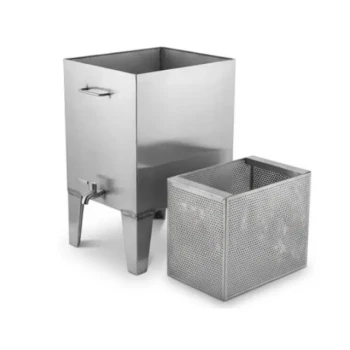
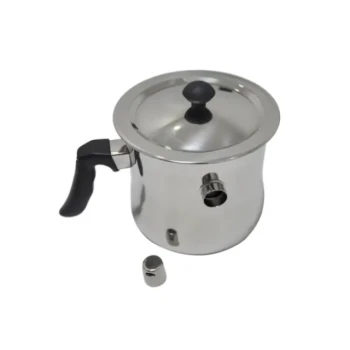
Installing discharge valves at different heights is the primary mechanism for achieving layered extraction. This physical configuration allows operators to separate clean beeswax from heavy impurities based on density. By draining specific layers independently, you can isolate and remove toxic sediments from the bottom before harvesting the purified wax from the top.
To insure the safety of beeswax foundations, this design utilizes gravity to trap heavy metals like lead and cadmium in the bottom layer. This guarantees that only the purified middle layer is used for final production.
The Mechanics of Layered Extraction
Exploiting Density Differences
In a liquid state, beeswax is lighter than the impurities it often contains. Over time, gravity causes heavier particulates to settle at the bottom of the container.
This natural separation creates distinct stratifications within the tank. The placement of your valves must correspond to these physical layers.
The Function of the Lowest Valve
The valve installed at the lowest point of the container is not for harvesting product. Its specific purpose is waste elimination.
You use this valve to discharge "dark sediments." According to processing data, this bottom layer contains high concentrations of heavy metals, specifically lead, cadmium, and arsenic.
Accessing the Purified Middle Layer
Valves installed at higher elevations on the container wall are designed to tap into the cleanest section of the wax.
Once the bottom sediment is drained, opening the upper valves allows you to extract the purified wax liquid. This ensures the raw material extracted is sourced strictly from the middle layer, which holds the lowest contaminant levels.
Ensuring Quality in Foundation Production
Reducing Heavy Metal Content
The primary goal of this multi-valve design is to lower the heavy metal load in the final product.
If you were to drain the tank from a single bottom outlet, you would mix the settled toxins back into the clean wax. Multiple heights provide a mechanical failsafe against this contamination.
Securing Hive Health
The wax harvested from the upper valves is typically destined for beeswax foundation production.
Because these foundations are introduced directly into beehives, maintaining low levels of heavy metals is critical for the health of the colony. The valve configuration is a direct quality control measure for this application.
Understanding the Trade-offs
Yield vs. Purity
Using this method requires accepting a small loss in total volume.
By discarding the bottom layer to eliminate heavy metals, you inevitably sacrifice a small amount of wax trapped in the sediment. This is a necessary trade-off to maintain safety standards.
Operational Complexity
Adding multiple discharge points increases the mechanical complexity of the vessel.
Operators must follow a strict sequence—draining the bottom first—to prevent cross-contamination. Failure to adhere to this order negates the benefits of the design.
Optimizing Your Processing Setup
Before finalizing your equipment design, consider your specific production targets.
- If your primary focus is maximum purity: Ensure your extraction valves are placed well above the estimated sediment line to avoid any accidental intake of heavy metals.
- If your primary focus is waste management: Implement a routine schedule for opening the lowest valve to prevent sediment buildup from reaching the intake level of your production valves.
Strategic valve placement turns a standard storage container into a precision purification tool.
Summary Table:
| Valve Position | Primary Function | Materials Extracted | Impact on Quality |
|---|---|---|---|
| Lowest Valve | Waste Elimination | Dark sediments, Lead, Cadmium, Arsenic | Removes toxic contaminants |
| Middle/Upper Valves | Product Harvesting | Purified beeswax liquid | Ensures clean, safe wax for foundations |
| Top Layer | Surface Management | Light debris or air bubbles | Maintains physical consistency |
Elevate Your Beeswax Processing with HONESTBEE
Are you a commercial apiary or distributor looking to optimize your production quality? HONESTBEE specializes in professional-grade beekeeping machinery and tools designed for precision.
Our comprehensive wholesale offering includes advanced honey-filling machines, specialized hive-making equipment, and high-purity beeswax processing tools that ensure your foundations meet the highest safety standards. By partnering with us, you gain access to the full spectrum of industry consumables and hardware tailored to your scale.
Ready to upgrade your equipment? Contact us today to discuss how our solutions can enhance your efficiency and product purity.
References
- Ivana Tlak Gajger, Bruno Čalopek. Variations in lead, cadmium, arsenic, and mercury concentrations during honeybee wax processing using casting technology. DOI: 10.1515/aiht-2016-67-2780
This article is also based on technical information from HonestBee Knowledge Base .
Related Products
- HONESTBEE Classic Twist Up Lip Balm Tubes
- Steam Beeswax Melter Wax Warmer for Wax Processing
- Honey Gate Valve with Ergonomic Ball Handle Plastic Bee Honey Tap for Beekeeping Bottling and Honey Extractor Equipment
- Beeswax Melter for Candle Making Honey Bee Wax Melter
- Plastic Transporting Bee Packages and Nuc Boxes for Beekeeping
People Also Ask
- What are the technical advantages of using wide-mouth lids as containers for syrup medication? Ensure Hive Safety
- What is the primary purpose of using disposable sterile sampling tubes? Ensure Pure Honey Antibiotic Testing
- Why is lemon oil the most effective additive for promoting honeycomb construction? Boost Your Hive Building Efficiency
- Why must light-proof storage bottles be used in the royal jelly harvesting process? Protect Bioactive Potency
- Why are 0.5 ml small-capacity centrifugal tubes used for nectar and honey samples? Ensure Precise Sample Integrity