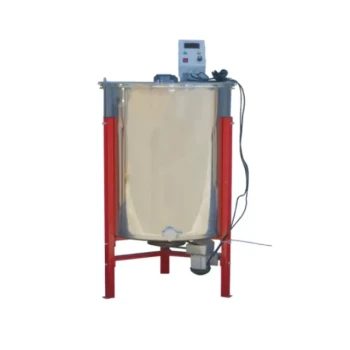
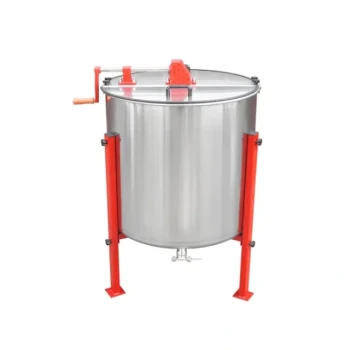
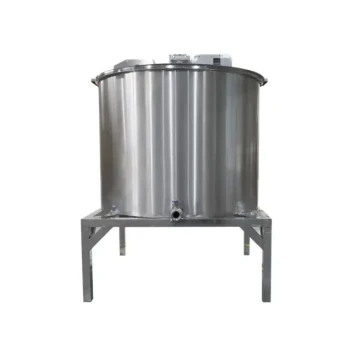
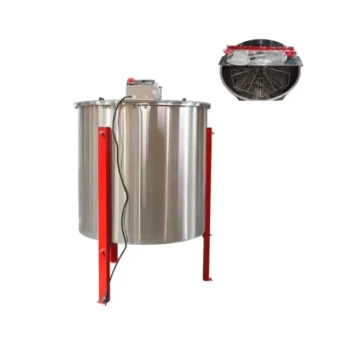
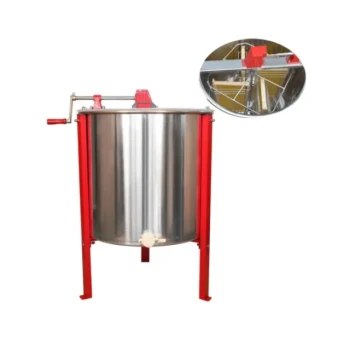
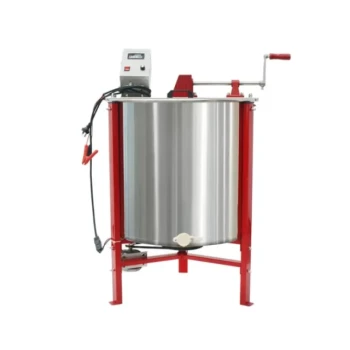
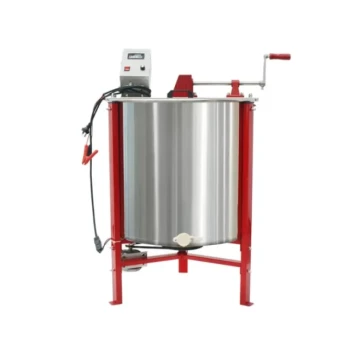
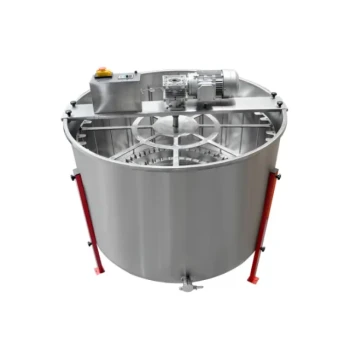
Professional centrifugal honey extractors are the cornerstone of high-efficiency apiary management. These devices utilize high-speed rotation to generate centrifugal force, which slings the liquid honey out of the wax cells without physical crushing. This specific mechanism allows for the complete separation of honey from the comb while leaving the delicate wax structure intact and undamaged.
The necessity of this equipment extends beyond simple extraction; it is fundamentally about energy economics within the hive. By preserving the structural integrity of the honeycomb, you eliminate the need for bees to rebuild wax, directly converting their energy into higher honey yields and shorter production cycles.
The Mechanics of Preservation
Maintaining Structural Integrity
Traditional harvesting methods often involve crushing or pressing the honeycomb to release the liquid.
In contrast, professional extractors use centrifugal force to evacuate the cells.
This ensures the wax frame remains structurally sound, preventing the destruction of the colony's storage infrastructure.
Enhancing Hygiene and Quality
Beyond the physical structure, centrifugal extraction supports higher hygiene standards.
By spinning the honey out rather than pressing it, you minimize the mixing of wax particles and other impurities into the final product.
This method also limits air contact, helping to preserve the natural aroma and enzyme activity that define high-quality raw honey.
The Biology of Efficiency
The High Cost of Wax Production
To a bee colony, beeswax is an expensive resource to manufacture.
Bees must consume significant quantities of honey and expend vast amounts of energy to secrete fresh wax for rebuilding combs.
When you utilize an extractor that protects the comb, you effectively save the colony from this "construction tax."
Accelerating the Production Cycle
The primary reference highlights that recycling honeycombs is the key to apiary productivity.
When intact, empty combs are returned to the hive, bees can immediately begin cleaning and refilling them.
This creates a "wet comb" advantage, significantly shortening the time required between harvests compared to colonies starting from scratch.
Understanding the Trade-offs
Operational Precision Required
While extractors prevent damage caused by crushing, they introduce a need for rotational precision.
If a frame is spun too violently, the centrifugal force can still rupture the wax foundation (a "blowout").
Operators must carefully manage speed to balance extraction efficiency with the tensile strength of the wax.
Equipment Maintenance
Unlike simple straining cloths, professional extractors are complex mechanical devices.
They require regular cleaning to prevent crystallization buildup in the moving parts.
Furthermore, they represent a larger footprint for storage and a higher initial capital investment than manual methods.
Making the Right Choice for Your Goal
To determine if a professional centrifugal extractor fits your operation, consider your specific objectives:
- If your primary focus is maximizing yield: Prioritize centrifugal extraction to return intact combs to the hive, allowing bees to focus energy on nectar collection rather than wax secretion.
- If your primary focus is honey quality: Use this equipment to separate honey with minimal air exposure and impurities, preserving the natural enzymes and flavor profile.
Ultimately, the centrifugal extractor is not just a harvesting tool, but a conservation device that respects the energy investment of the colony.
Summary Table:
| Feature | Centrifugal Extraction | Manual Pressing/Crushing |
|---|---|---|
| Comb Integrity | Preserved (Reusable) | Destroyed (Must be rebuilt) |
| Honey Quality | High (Low impurities, minimal air contact) | Lower (High wax particles/oxidation) |
| Hive Productivity | High (Bees focus on nectar collection) | Low (Bees must secrete wax) |
| Production Cycle | Shortened (Immediate refilling) | Lengthened (Rebuilding required) |
| Labor Intensity | Low (Automated/Mechanical) | High (Manual labor) |
Maximize Your Honey Yield with HONESTBEE Precision Equipment
At HONESTBEE, we understand that for commercial apiaries and distributors, efficiency is the foundation of profitability. Our professional centrifugal honey extractors are engineered to preserve your valuable honeycombs, eliminating the 'wax construction tax' and allowing your colonies to focus on production.
Beyond extractors, we offer a comprehensive wholesale portfolio—from hive-making and honey-filling machinery to essential industry consumables and unique honey-themed merchandise. Partner with us to streamline your operations with high-performance beekeeping tools and hardware.
Ready to scale your honey production? Contact us today to discuss our wholesale solutions!
References
- Génesis Payró-García, Manuela de Jesús MONTEJO-ZAMUDIO. The productivity in the beekeeping sector of Comalcalco, Tabasco, for the design of an improvement proposal. DOI: 10.35429/ejrn.2021.13.7.28.32
This article is also based on technical information from HonestBee Knowledge Base .
Related Products
- electric honey extractor honey centrifuge 3 frame honey extractor stainless steel honey frame extractor
- Manual Hand Crank 4 Frame Honey Extractor Centrifuge for Beekeeping
- Professional 4 Frame Self Reversing Electric Honey Extractor for Beekeeping
- Electric 4 Frame Tangential Honey Extractor
- 24 Frame Honey Extractor Commercial Radial Honey Frame Extraction Machine
People Also Ask
- What are the characteristics of electric honey extractors? Boost Your Apiary Efficiency with Automated Technology
- What are the disadvantages of using an electric honey extractor? Weighing Cost, Power, and Comb Safety
- What are the advantages of an electric honey extractor? Boost Efficiency and Scale Your Honey Production
- What are the technical advantages of electric honey extractors? Maximize Yield and Protect Your Bee Colony
- How does an electric honey extractor affect the quality of honey? Preserve Flavor & Purity with Precision Extraction