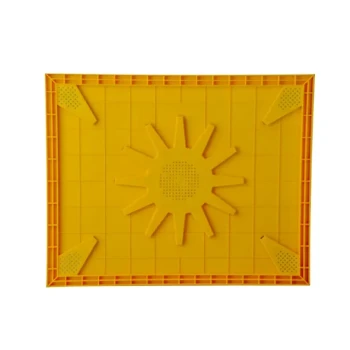
Petroleum jelly acts as the essential binding agent that transforms a standard board into a functional trap for hive parasites. By creating a semi-solid, sticky surface, it ensures that parasites falling from the colony are immediately immobilized and cannot return to the hive or be lost to the environment.
The sticky board method relies entirely on the retention capability of the coating; petroleum jelly provides a non-drying, odorless matrix that withstands hive airflow to guarantee accurate pest counts and effective removal.
The Mechanics of Parasite Retention
Creating a Physical Adsorption Barrier
Petroleum jelly serves as a semi-solid adhesive matrix. Unlike thinner oils that might absorb into the board or run off, the jelly acts as a physical adsorption barrier. When a parasite, such as a Varroa mite or Phorid fly, contacts the board, this viscous layer ensures immediate and permanent entrapment.
Counteracting Hive Airflow
Bee colonies are dynamic environments where bees constantly fan their wings to circulate air. This wing fanning creates internal air currents strong enough to lift lightweight debris and parasites. The petroleum jelly anchors fallen pests to the board, preventing them from being blown back up into the colony and reintroduced to the bees.
Ensuring Data Accuracy
Securing the "Natural Fall"
For beekeepers using sticky boards to monitor infestation levels rather than just control them, data integrity is vital. The adhesive layer captures the "natural mite fall"—mites that die or fall off bees naturally. Without this sticky layer, the count would be artificially low, leading to incorrect estimates of the colony's infestation rate.
preventing Environmental Loss
Once a parasite is outside the hive structure on the board, it is vulnerable to external factors. The jelly prevents the wind from blowing the specimens away. Furthermore, it prevents scavengers, such as ants, from carrying off the mites before the beekeeper can perform a count.
Understanding the Trade-offs
The Importance of Odor Neutrality
A critical material property of petroleum jelly is that it is generally odorless. Bees are highly sensitive to scent and chemical signals. Using an adhesive with a strong chemical odor could agitate the colony or disrupt pheromone communication, whereas petroleum jelly remains unobtrusive.
Application Challenges
While effective, petroleum jelly requires manual application to ensure an even coat. If the layer is too thin, larger pests may escape; if too thick, it can become messy to handle during inspection. It is a physical trap only and does not contain chemical miticides, meaning it controls pests solely through mechanical capture.
Making the Right Choice for Your Goal
To maximize the effectiveness of the sticky board method, tailor your application to your specific objective:
- If your primary focus is Pest Clearance: Ensure a consistent, edge-to-edge coating to prevent pests from finding "safe zones" where they can crawl back up to the frames.
- If your primary focus is Infestation Monitoring: Prioritize a clean application on a gridded board to facilitate accurate counting and prevent wind or scavengers from skewing your data.
Petroleum jelly provides the necessary adhesion to turn gravity into an effective tool for hive health management.
Summary Table:
| Feature | Role of Petroleum Jelly | Benefit to Beekeeping |
|---|---|---|
| Adhesion | Creates a viscous, semi-solid trap | Prevents parasites from returning to the hive |
| Airflow Resistance | Anchors debris against wing-fanning | Ensures captured pests are not blown back to bees |
| Scent Profile | Odorless and non-reactive | Avoids disrupting colony pheromones or behavior |
| Data Integrity | Prevents scavenger theft and wind loss | Guarantees accurate monitoring of infestation levels |
| Mechanism | 100% mechanical/physical capture | Non-chemical pest management solution |
Maximize Your Apiary Productivity with HONESTBEE
Efficient parasite management is the cornerstone of a thriving commercial apiary. At HONESTBEE, we specialize in supporting commercial beekeepers and distributors with a comprehensive range of professional tools and machinery. From specialized hive-making and honey-filling machines to a full spectrum of essential consumables, our wholesale offerings are designed to scale your operations.
Ready to elevate your beekeeping business? Our team is dedicated to providing high-quality equipment and cultural merchandise that drive value for your brand. Contact us today to discuss your wholesale needs and discover how HONESTBEE can empower your success.
References
- Amber Rana, Barish E. James. The efficacy of clove oil to manage Varroa destructor and Apocephalus borealis, in Apis mellifera L. colony. DOI: 10.52804/ijaas2023.4213
This article is also based on technical information from HonestBee Knowledge Base .
Related Products
- Langstroth Solid Bottom Board for Beekeeping
- Solid Bottom Board Australian Pine Wood Langstroth Bottom Board for Wholesale
- Langstroth Screen Bottom Board for Beekeeping Wholesale
- HONESTBEE Multi Exit Plastic Bee Escape Board for Efficient Honey Harvesting
- Australian Pine Wood Langstroth Screen Bottom Board for Wholesale
People Also Ask
- What are the functions of solid bottom boards for a beehive? Essential Thermal Protection and Winter Survival Tips
- What is the purpose of a solid bottom board for bee hives? Enhance Hive Health and Winter Survival
- How does climate influence the choice between a solid and screened bottom board? Optimize Your Hive for Local Weather
- What is the primary function of a bottom board in a modern modified beehive system? Essential Foundation Guide
- What are the characteristics of a solid bottom board for a beehive? Boost Colony Health and Thermal Insulation