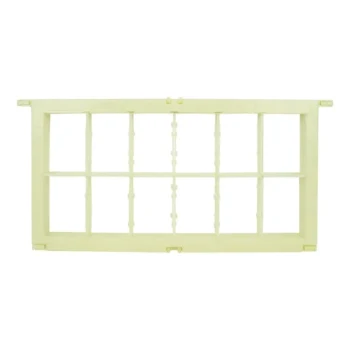
The counting function of standard bee frames acts as the fundamental metric for quantifying colony strength. It provides a standardized visual unit—the frame itself—to measure the total adult bee population within a hive. By comparing the number of frames covered by bees at specific intervals, such as before and after flowering, researchers can objectively determine how factors like environmental stressors or pesticide exposure affect colony population density.
Standard frames provide a consistent, physical baseline for biological data. This standardization transforms subjective observations into quantifiable metrics, allowing precise calculation of population shifts, hygienic efficiency, and winter survival rates essential for health censuses.
Quantifying Colony Strength and Stress Response
Visualizing Population Shifts
The primary utility of the standard frame is its role as a "biological ruler." Rather than attempting to count individual insects, researchers count the number of frames fully covered by adult bees. This method offers a rapid, reproducible way to track the expansion or contraction of a colony over time.
Identifying Environmental Impact
This metric is critical for assessing external threats. By establishing a baseline frame count, researchers can detect abnormal colony shrinkage. A sudden drop in the number of covered frames serves as a direct indicator of mortality events caused by pesticide exposure or severe environmental stressors.
The Link Between Population and Hygienic Efficiency
Distinguishing Genetics from Manpower
A critical challenge in bee health censuses is isolating the cause of poor hive hygiene. A colony might fail to remove dead brood because it lacks the genetic trait for hygiene, or simply because it lacks the workforce. Frame counting solves this by quantifying the "worker density."
Correlating Density with Cleaning Speed
Recording bee spaces allows scientists to correlate colony strength with cleaning speeds. By normalizing the data against the number of occupied frames, researchers can determine if a decrease in cleaning efficiency is a behavioral issue or a result of population loss. This ensures that breeding data is not skewed by the colony's physical size.
Standardization in Breeding and Wintering
Reducing Experimental Error
Standardized brood frames provide a consistent substrate for testing. Because these frames offer a uniform area of capped larvae, they allow researchers to define fixed test areas. This significantly reduces experimental errors caused by irregular cell arrangement, providing the reliable phenotypic data necessary for breeding queens with superior hygienic traits.
Calculating Winter Survival (ZOP)
Frame counting is the basis for calculating the Wintering Expenditure Percentage (ZOP). By counting occupied frames before and after the winter season, researchers apply specific formulas to measure how much of the population was lost. This metric reflects how well different honeybee breeds adapt to specific climatic conditions.
Understanding the Trade-offs
The Risk of Visual Estimation
While frame counting is efficient, it relies on visual assessment. If the standard for "covered" is not rigorously defined (e.g., strictly 100% coverage vs. partial coverage), human error can introduce inconsistencies into the data.
Dependence on Hardware Standards
The accuracy of this method assumes that "standard frames" are indeed identical across the census. Variations in frame dimensions or comb construction by the bees can alter the actual surface area available, potentially skewing the correlation between "frame count" and actual bee population.
Making the Right Choice for Your Goal
To utilize frame counting effectively in your research or management plan, align your approach with your specific objective:
- If your primary focus is Environmental Impact: Compare frame counts before and after the crop flowering period to isolate the effects of pesticides or forage availability.
- If your primary focus is Genetic Breeding: Use standard frames to define fixed testing areas, ensuring hygiene scores reflect genetic traits rather than colony size.
- If your primary focus is Climate Adaptation: Calculate the Wintering Expenditure Percentage (ZOP) by recording frame occupancy changes across the wintering period.
By treating the standard frame as a calibrated scientific instrument, you turn general observation into precise, actionable data regarding honeybee health.
Summary Table:
| Metric Type | Function of Standard Frame | Key Insight Provided |
|---|---|---|
| Colony Strength | Visualizing frame coverage | Quantifies adult population shifts and colony expansion. |
| Stress Response | Baseline frame count comparison | Identifies mortality events from pesticides or environment. |
| Hygienic Efficiency | Measuring worker density | Distinguishes genetic traits from simple manpower shortages. |
| Winter Survival | ZOP calculation (Before/After) | Measures breed adaptation to specific climatic conditions. |
| Breeding Quality | Defining fixed test areas | Provides reliable phenotypic data by reducing substrate error. |
Maximize Your Apiary Productivity with HONESTBEE
Precise data requires standardized equipment. At HONESTBEE, we empower commercial apiaries and global distributors by providing the high-precision tools necessary for accurate health censuses and efficient colony management.
From precision-engineered standard frames and hive-making machinery to advanced honey-filling systems and cultural merchandise, our comprehensive wholesale portfolio is designed to scale your operations. Whether you are looking to improve breeding outcomes or streamline honey production, our team is ready to supply the hardware and consumables your business demands.
Ready to upgrade your beekeeping infrastructure?
Contact HONESTBEE today for a wholesale consultation.
References
- Maryann Frazier, F. A. Drummond. Assessing Honey Bee (Hymenoptera: Apidae) Foraging Populations and the Potential Impact of Pesticides on Eight U.S. Crops. DOI: 10.1093/jee/tov195
This article is also based on technical information from HonestBee Knowledge Base .
Related Products
- Assembled Wooden Bee Frames with Plastic Foundation for Durability and Convenience by HONESTBEE
- Assembled Wooden Bee Frames with Beeswax Foundation Ready to Use by HONESTBEE
- Wooden Bee Hive Frames for Beekeeping and Wholesale
- HONESTBEE Wired and Assembled Wooden Bee Frames Foundation for a Thriving Hive
- Plastic Bee Frame Beekeeping Hive Frames for Wholesale
People Also Ask
- When should frames with new foundation be given to colonies? Master Timing for a Thriving Hive
- What types of bee frames can be cleaned and returned to service? A Guide to Safe Apiary Refurbishment
- Do you have to wire bee frames? Essential Guide to Frame Strength & Honey Harvesting
- Can beekeepers switch between wooden and plastic frames? Optimize Your Hive's Performance
- How do you re-wax bee frames? A Simple Guide to Faster Comb Building