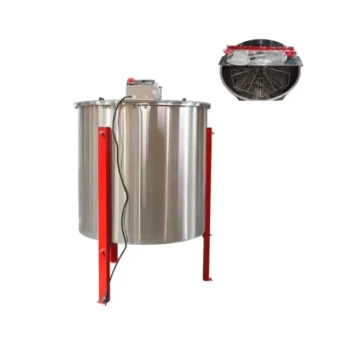
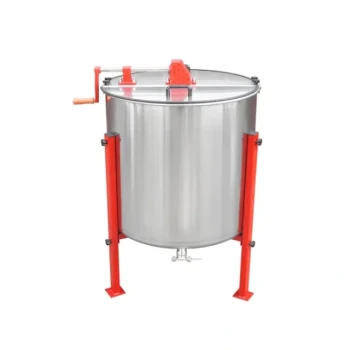
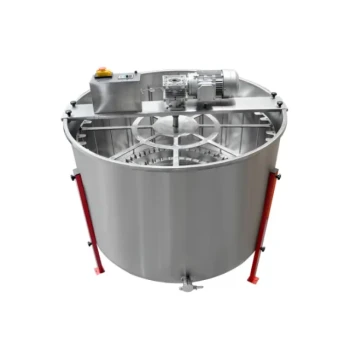
The industrial-grade honey extractor serves as the backbone of high-efficiency beekeeping by mechanizing the separation process with adjustable centrifugal force. Unlike manual methods that crush the comb or rely on inconsistent gravity, this equipment spins frames at stable speeds to rapidly expel honey while leaving the wax structure completely intact for immediate reuse.
Core Insight: True efficiency in beekeeping is biological, not just mechanical. By preserving the honeycomb structure during extraction, you eliminate the need for bees to consume energy and honey rebuilding wax, thereby directing the colony’s entire productive capacity toward gathering new nectar.
Maximizing Biological Efficiency
For large-scale Apis cerana apiaries, the primary bottleneck is not harvesting time, but the recovery time of the bee colony.
The Value of Comb Preservation
Industrial extractors utilize centrifugal force to remove honey without damaging the physical structure of the wax combs.
This is critical because bees consume significant amounts of honey and energy to secrete the wax required to build new combs.
Shortening the Production Cycle
By recycling intact, clean honeycombs back into the beehive immediately after extraction, you bypass the reconstruction phase.
This drastically shortens the preparation time for the next collection cycle, directly increasing the total honey yield per season.
Scaling Operations with Precision
Beyond biological benefits, industrial-grade equipment introduces consistency that manual processing cannot match.
Throughput and Stability
Electric industrial extractors provide stable rotation speed control, ensuring high extraction rates without the fluctuations typical of manual equipment.
Models designed for scale (such as 10-frame units) allow for simultaneous processing, significantly reducing the man-hours required for on-site processing.
Quality and Purity Control
For large batches, uniformity is essential for commercial viability.
Industrial extraction ensures higher consistency in color and impurity control, resulting in a product with higher purity and greater market value compared to traditional methods.
Understanding the Trade-offs
While industrial extractors are superior for yield and efficiency, they introduce specific operational demands that must be managed.
Infrastructure Requirements
Unlike simple manual tools, industrial extractors often require a reliable power source for electric motors and stable speed regulation.
This can be a logistical challenge when harvesting in remote apiary locations typical of Apis cerana foraging grounds.
Maintenance and Complexity
The move from manual to mechanical processing introduces moving parts that require strict maintenance protocols.
Proper cleaning is essential to prevent cross-contamination between batches, which can be more labor-intensive than maintaining simple manual equipment.
Making the Right Choice for Your Goal
Selecting the right equipment depends on the specific bottlenecks currently limiting your apiary's growth.
- If your primary focus is increasing total yield: Prioritize extractors with precise speed controls to ensure maximum comb preservation, reducing the energy burden on your bees.
- If your primary focus is operational throughput: Choose multi-frame (e.g., 10-frame) electric units to minimize the time spent on on-site processing during peak nectar flow.
By shifting from manual extraction to industrial centrifugation, you transform honey harvesting from a destructive reset into a continuous, sustainable production loop.
Summary Table:
| Feature | Industrial-Grade Extractor | Manual Extraction Method |
|---|---|---|
| Mechanism | Precision Centrifugal Force | Gravity or Manual Crushing |
| Comb Preservation | High (Wax structure stays intact) | Low (Often damages or destroys wax) |
| Processing Speed | Fast (Simultaneous multi-frame) | Slow (Individual or small batches) |
| Product Purity | High (Uniform color & low impurities) | Variable (Higher risk of debris) |
| Energy Focus | Nectar gathering (Reuse ready) | Wax reconstruction (Bees must rebuild) |
Elevate Your Commercial Honey Production with HONESTBEE
Are you looking to scale your apiary operations and maximize seasonal yields? HONESTBEE provides professional-grade solutions tailored for commercial apiaries and distributors worldwide. From industrial honey-filling machines and high-capacity honey extractors to specialized hive-making machinery, we supply the full spectrum of equipment needed to transform your harvesting efficiency.
Our comprehensive wholesale offering ensures you have access to essential industry consumables and honey-themed cultural merchandise to grow your brand. Don't let manual processes limit your growth—partner with HONESTBEE to access durable, high-performance beekeeping technology.
Ready to optimize your harvest? Contact us today to explore our wholesale equipment catalog!
References
- Randall Hepburn, Colleen Hepburn. Bibliography of<i>Apis cerana</i>Fabricius (1793). DOI: 10.1051/apido:2006038
This article is also based on technical information from HonestBee Knowledge Base .
Related Products
- HONESTBEE 72 Frame Industrial Electric Honey Extractor for Beekeeping
- 32 Frame Commercial Electric Honey Extractor for Beekeeping and Honey Production
- Commercial Electric 12 Frame Honey Extractor Spinner Motorized Honey Extractor
- 8-Frame Electric Self-Reversing Honey Extractor Spinner for Commercial Honey Extraction Equipment
- Commercial 48-Frame Stainless Steel Honey Extractor
People Also Ask
- What is the importance of balancing honeycomb frames within a honey extractor? Ensure Stability and Protect Machinery
- How is honey separated from the frames after they are uncapped? Efficient Extraction Methods for High Yields
- What are the main benefits of using a honey extractor? Maximize Yields and Protect Your Honeycomb
- What are the recommended methods for removing honey from the honeycomb? Top Extraction Techniques for Maximum Efficiency
- How do manual honey extractors compare to electric honey extractors? Choosing the Right Tool for Your Apiary Growth