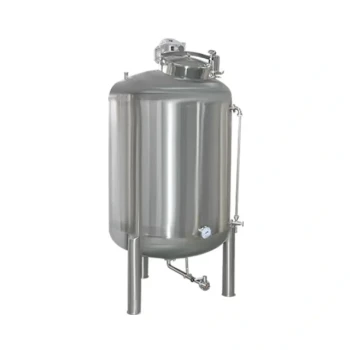
Food-grade industrial storage tanks are the critical defense system for maintaining the chemical integrity and market value of honey during commercial distribution. By providing a sealed and chemically inert environment, these tanks primarily function to prevent oxidation, block moisture absorption, and eliminate contamination risks. This ensures the honey retains its stability and quality throughout the extended supply chain, from extraction to final packaging.
Core Insight Honey is a chemically complex, living agricultural product that is highly vulnerable to its environment. Specialized industrial tanks are not merely storage vessels; they are essential preservation tools that lock in biological activity and flavor while locking out moisture and contaminants.
Preserving Chemical Stability and Purity
The Necessity of Inert Materials
The primary function of these tanks is to provide a chemically inert physical environment. Honey can react with certain metals or low-grade plastics, which alters its composition.
Food-grade tanks are engineered to be non-reactive. This ensures that the vessel itself does not leach chemicals into the product or alter the honey's natural pH and chemical structure.
Preventing Oxidation
Exposure to air is a significant threat to processed honey. Oxidation can darken the honey and degrade its delicate flavor profiles.
Industrial tanks utilize tight seals to minimize oxygen contact. This preservation of the anaerobic environment is vital for maintaining the honey's original sensory characteristics during long-haul transport.
Defending Against Environmental Threats
Controlling Moisture Absorption
Honey is naturally hygroscopic, meaning it aggressively attracts and holds water molecules from the surrounding air.
If honey absorbs too much environmental moisture, it becomes unstable and susceptible to fermentation or spoilage. Sealed storage tanks create an impermeable barrier against humidity, ensuring the water content remains at safe, stable levels.
Blocking External Odors
Beyond moisture, honey acts as a sponge for ambient smells. Without proper containment, it will absorb odors from the logistics environment, such as diesel fumes or warehouse scents.
Specialized food-grade containers isolate the honey completely. This guarantees that the flavor profile arriving at the packer is identical to the flavor profile that left the extraction facility.
Optimizing Logistics and Distribution
Managing Temperature and Light
Industrial-grade equipment often includes features for temperature control and light shielding.
Fluctuating temperatures and exposure to sunlight can accelerate crystallization and degrade biological activity. By stabilizing the thermal environment, these tanks prevent the "aging" of the honey during transit.
Durability and Impact Resistance
The distribution phase involves rigorous physical handling. Unlike fragile materials that may crack under stress, industrial tanks—often made from high-grade plastics or metals—offer superior impact resistance.
This leak-proof performance minimizes product loss. Furthermore, using lighter materials like food-grade plastic for these tanks can reduce long-distance shipping costs while maintaining safety.
Understanding the Operational Trade-offs
Capital Investment vs. Product Safety
Implementing high-quality, temperature-controlled, or strictly food-grade logistics equipment requires a higher upfront capital investment than standard general-purpose containers.
However, cutting costs here often leads to product rejection due to crystallization, spoilage, or flavor tainting.
Material Weight Considerations
While stainless steel tanks offer the highest durability and inertness, they add significant weight to logistics, increasing fuel costs.
Food-grade plastic offers a lightweight alternative that is easier to handle and cheaper to ship, but it must be rigorously certified to ensure it offers the same level of chemical inertness as metal.
Making the Right Choice for Your Supply Chain
To select the appropriate storage solution, you must weigh the specific risks of your distribution route against your logistical capabilities.
- If your primary focus is preserving sensory quality: Prioritize tanks with superior sealing and light-shielding capabilities to prevent flavor degradation and oxidation.
- If your primary focus is long-distance logistics: Select lightweight, high-impact food-grade plastic containers to reduce shipping costs while ensuring leak-proof performance.
- If your primary focus is shelf-life stability: Ensure the tanks offer temperature control features to prevent accelerated crystallization or fermentation due to moisture.
The integrity of the storage vessel is the single most important factor in ensuring the honey that reaches the consumer is as high-quality as the honey that left the hive.
Summary Table:
| Feature | Protection Mechanism | Commercial Benefit |
|---|---|---|
| Inert Materials | Prevents chemical leaching & pH changes | Ensures product purity and regulatory compliance |
| Airtight Sealing | Blocks oxygen and ambient odors | Preserves delicate flavor profiles and prevents darkening |
| Hygroscopic Shield | Prevents moisture absorption | Eliminates risk of fermentation and spoilage |
| Thermal Stability | Minimizes temperature fluctuations | Reduces crystallization and maintains biological activity |
| Impact Resistance | Leak-proof industrial construction | Minimizes product loss during rigorous logistics |
Maximize Your Honey Quality with HONESTBEE Solutions
At HONESTBEE, we understand that for commercial apiaries and distributors, the right storage is the difference between premium product and lost profit. We provide a comprehensive range of professional beekeeping tools, honey-filling machinery, and high-performance food-grade storage equipment designed to withstand the rigors of global logistics.
Whether you are looking to upgrade your extraction facility or source durable wholesale consumables, our team is ready to support your growth. Contact us today to discover how our specialized hardware and industry expertise can optimize your supply chain and protect your liquid gold.
References
- Catherine Phillips. Following beekeeping: More-than-human practice in agrifood. DOI: 10.1016/j.jrurstud.2014.06.013
This article is also based on technical information from HonestBee Knowledge Base .
Related Products
- Professional Honey Storage Tank with Agitation System
- Stainless Steel Honey Storage Tank with Lid for Honey
- Stainless Steel Honey Storage and Settling Tank with Double Strainer
- Food Grade Plastic Honey Bucket Pail for Beekeeping
People Also Ask
- What economic role do honey storage tanks play? Boost Your Revenue Through Strategic Inventory Management
- What roles do industrial honey storage tanks and filtration meshes play in processing? Ensure Purity & Consistency
- What is the purpose of a honey storage tank? Streamline Your Honey Processing for Quality & Efficiency
- What are honey storage tanks used for? Essential Features for Quality Preservation and Profit
- How do large honey storage tanks and gravity fall filling systems improve honey packaging efficiency and safety?