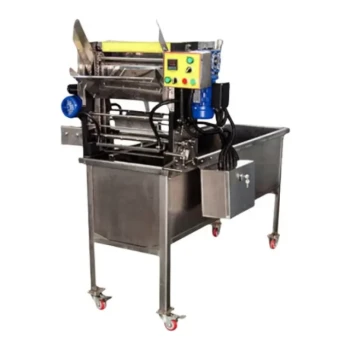
Professional honey labeling machines function as the critical interface between production quality and market access. For exporters, these systems are not merely about aesthetics; they are the primary tool for ensuring compliance with strict international regulations regarding traceability, organic certification, and geographic indications, which are mandatory for entry into markets like the European Union.
Core Takeaway In the global honey trade, a label is a legal document as much as a marketing tool. Professional labeling equipment automates the precise presentation of vital regulatory data while creating the high-end visual consistency required to differentiate your brand in a crowded international marketplace.
Navigating International Regulatory Compliance
The Necessity of Precise Traceability
International markets enforce rigorous standards regarding product origin and safety. Professional labeling machines are engineered to accurately display vital traceability data.
This includes batch numbers, harvest dates, and specific geographic indications. Without the high-precision application of this data, products risk rejection at customs for failing to meet legal transparency standards.
Meeting Diverse Certification Standards
Different regions, such as the European Union or Saudi Arabia, have distinct requirements for labeling organic certifications and ingredient lists.
Automated equipment allows exporters to standardize how these certifications are displayed. This ensures that every unit complies with the specific legal frameworks of the target country, facilitating smoother market entry.
Strategic Brand Differentiation
Visual Consistency and Premium Appeal
Global consumers often perceive the quality of the packaging as a reflection of the quality of the product. Professional machines ensure that labels are applied with perfect alignment and without physical defects like bubbles or tearing.
This standardization creates a visually appealing product that conveys a high-end brand image. In competitive markets, this level of polish is often the deciding factor for consumers choosing between brands.
Communicating Product Value
Honey is often sold based on its unique properties, such as being organic or hailing from a specific region (e.g., Caucasian Gray Bee honey).
High-performance labeling acts as the physical medium to communicate these value propositions. It transforms raw honey from a commodity into a high-value export good by clearly highlighting its unique attributes through professional presentation.
Operational Efficiency and Scale
Supporting High-Volume Trade
To compete globally, exporters must maintain consistent supply levels. Industrial-grade labeling enables high-speed processing that manual methods cannot match.
This equipment accelerates the turnover rate of large-scale trade. It ensures that the speed of labeling matches the high-volume output of industrial filtration and filling processes, preventing bottlenecks in the production line.
Reducing Human Error
Manual labeling introduces the risk of inconsistency and human error regarding variable data (such as expiration dates).
Automated systems utilize flow control and precise metering to ensure every label is identical. This reliability is essential for passing export certifications that demand strict adherence to packaging specifications.
Understanding the Trade-offs
Capital Investment vs. Market Access
Implementing professional labeling systems requires significant upfront capital. For smaller producers, this cost can be a barrier to entry compared to manual application.
However, this expense must be weighed against the risk of rejected shipments. In international trade, the cost of non-compliance usually exceeds the cost of equipment amortization.
Flexibility vs. Specialization
High-speed machines are often optimized for specific bottle shapes or label types.
If an exporter frequently changes bottle designs to suit different markets, they may face downtime while reconfiguring machinery. It is crucial to balance the need for speed with the need for packaging versatility.
Making the Right Choice for Your Goal
When selecting labeling equipment for export operations, align your choice with your specific market strategy:
- If your primary focus is Regulatory Compliance: Prioritize machines with advanced variable data printing capabilities to ensure traceability codes and expiration dates are legible and accurate for every batch.
- If your primary focus is Brand Positioning: Select equipment capable of handling complex label textures and non-standard shapes to maximize visual impact on the shelf.
- If your primary focus is Volume and Efficiency: Invest in fully automated lines that integrate seamlessly with filling and sealing machinery to minimize bottlenecks and labor costs.
Professional labeling is not an optional upgrade for exporters; it is a foundational technical requirement for transforming a local agricultural product into a globally tradeable commodity.
Summary Table:
| Key Feature | Benefit for Honey Exporters | Impact on International Trade |
|---|---|---|
| Automated Traceability | Precise batch & harvest data printing | Ensures compliance with EU/Global customs |
| Visual Consistency | Bubble-free, perfect label alignment | Establishes premium brand trust & appeal |
| Regulatory Integration | Standardized display of certifications | Facilitates entry into diverse legal markets |
| High-Speed Throughput | Rapid processing of large-scale orders | Eliminates production bottlenecks & human error |
| Packaging Versatility | Adaptable to various bottle shapes | Supports strategic brand differentiation |
Scale Your Apiary Operations Globally with HONESTBEE
Transitioning from local production to international trade requires more than just high-quality honey—it requires professional-grade presentation and total regulatory compliance. HONESTBEE specializes in supporting commercial apiaries and distributors by providing the industrial tools needed to succeed on the global stage.
From high-precision honey labeling and filling machines to specialized hive-making hardware and honey-themed cultural merchandise, we offer a comprehensive wholesale portfolio designed to enhance your efficiency and market value. Let us help you turn your raw honey into a premium, export-ready commodity.
Ready to elevate your production line? Contact the HONESTBEE experts today to find the perfect machinery for your business.
References
- Vidal Salazar Solano, Isaac Shamir Rojas Rodríguez. La configuración del mercado global de la miel: un análisis de equivalencia estructural. DOI: 10.22201/enesl.20078064e.2023.25.82397
This article is also based on technical information from HonestBee Knowledge Base .
Related Products
- Fully Automatic Honey Filling Packaging Machine for Processing Line
- Precision Automated Packaging Turntable Honey Spoon Filling Sealing Packing Machine
- Automatic Single-Dose Snap & Squeeze Honey Sachets Packing Machine
- Honey Stick Filler Vertical Paste Sachet Packing Machine for Honey Sachets
- Double Nozzle Small Honey Filling Machine Honey Sachet Packing Packaging Equipment
People Also Ask
- Why are fully automatic honey filling and packaging lines essential? Boost Your Honey's Market Value and Quality
- What is a fully-automatic honey filler? Streamline Your Production with High-Precision Automation
- How do automated honey filling and packaging machines affect profitability? Boost Margins with HONESTBEE Technology
- How do automated honey filling and packaging machines contribute to the market value of honey products? Maximize Your ROI
- How do industrial-grade automated honey filling and packaging machines mitigate the risk of physical contamination?