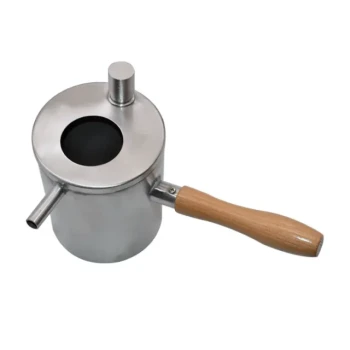
Beeswax samples must undergo melting, shaping, and cooling to fundamentally transform the raw material into a standardized state suitable for analytical testing. This preparation eliminates physical irregularities—such as internal voids or uneven surfaces—creating a uniform contact area. This ensures that precision instruments measure the intrinsic physical properties of the wax itself, rather than reacting to inconsistent shapes or structural defects.
Core Insight Raw beeswax is structurally chaotic. By melting and reforming the sample into standardized pellets or flakes, you isolate the material's inherent characteristics from its physical history, ensuring that subsequent data reflects the chemistry of the wax rather than the geometry of the sample.
The Necessity of Standardization
Removing Structural Bias
Raw beeswax is rarely uniform; it contains natural irregularities, random shapes, and hidden internal voids.
If you attempt to analyze raw samples directly, these physical inconsistencies introduce "noise" into the data.
Melting the sample acts as a reset button, homogenizing the material and eliminating these structural variables.
Optimizing the Equipment Interface
Precise analysis often relies on a mechanical interface, such as a precision cutting element.
For this equipment to function correctly, there must be a uniform contact surface between the machine and the sample.
Shaping the melted wax into standardized pellets or flakes provides this consistent geometry, allowing the instrument to engage with the sample predictably every time.
The Role of Temperature Control
Reaching Thermal Equilibrium
The cooling phase is just as critical as the melting phase.
After shaping, the wax must be cooled to ambient temperature to solidify the sample and lock in the standardized form.
Ensuring Material Stability
According to supplementary data, the physical properties of beeswax—specifically hardness and thermal conductivity—are highly sensitive to temperature changes.
Beyond simple cooling, the sample should ideally be conditioned in a constant temperature chamber to reach full thermal stability.
This prevents temperature fluctuations from altering the material's resistance, ensuring that measurements are repeatable and accurate.
Understanding the Risks of Improper Prep
The Cost of Inconsistency
Skipping or rushing the melting and shaping process leads to interference errors.
If a cutting instrument hits an internal air pocket or an uneven ridge, the resulting data spike will be interpreted as a material property, leading to false reports.
Thermal Volatility
Failing to let the sample cool and stabilize creates volatility in measurement.
Because wax softens significantly with heat, testing a sample that has not fully cooled will yield artificially low hardness or resistance values, rendering the analysis void.
Making the Right Choice for Your Goal
To ensure your beeswax analysis yields usable data, consider the following approach:
- If your primary focus is Data Accuracy: Prioritize the cooling and conditioning phase; ensure the sample reaches thermal equilibrium in a controlled chamber to prevent false reports caused by temperature sensitivity.
- If your primary focus is Equipment Longevity: Ensure the reshaping process creates a perfectly flat contact surface; irregular shapes can cause uneven wear or incorrect engagement with precision cutting elements.
Standardization is not merely a step in the process; it is the baseline requirement for valid physical analysis.
Summary Table:
| Preparation Step | Primary Function | Impact on Analytical Quality |
|---|---|---|
| Melting | Homogenizes material and removes air pockets | Eliminates structural noise and physical inconsistencies |
| Shaping | Creates standardized geometry (pellets/flakes) | Ensures a uniform contact surface for precision instruments |
| Cooling | Reaches thermal equilibrium | Prevents false data caused by material softness and volatility |
| Conditioning | Stabilizes material in a constant temperature | Guarantees repeatable and accurate physical property data |
Elevate Your Beekeeping Operations with HONESTBEE
At HONESTBEE, we understand that precision in beeswax analysis is the foundation of high-quality wax products. As a dedicated partner to commercial apiaries and distributors, we provide more than just tools—we provide the technological edge you need to scale.
From honey-filling and hive-making machinery to a full spectrum of beekeeping equipment and consumables, our wholesale solutions are designed to optimize your production efficiency. Whether you are looking for specialized hardware or honey-themed cultural merchandise, we offer the expertise to support your growth.
Ready to upgrade your equipment or stock the industry's best supplies?
Contact HONESTBEE Today for Custom Wholesale Solutions
References
- Kinga Ewa Bednarzewska. Business model of a patented invention developed at a university on the example of the “WAXO” beeswax quality analyzer. DOI: 10.29119/1641-3466.2024.198.1
This article is also based on technical information from HonestBee Knowledge Base .
Related Products
- Beeswax Machine Press Embosser Wax Foundation Mold Printer Bee Hive Equipment Making Sheet
- Beeswax Foundation Sheets Beehive Foundation for Wholesale
- Colorful Silicone Beeswax Foundation Mold Mould for Beekeeping
- Economy Manual Beeswax Embossing Mill Wax Foundation Machine Roller
- Electric Beeswax Flat Sheet Machine with Operating Tray for Wax Processing
People Also Ask
- What equipment is needed to make beeswax foundation? A Guide to DIY Wax Sheet Production
- What miscellaneous equipment is needed for making foundation? A Guide to the Essential Tools
- What miscellaneous equipment is useful when making beeswax foundation? Essential Support Tools for Beekeepers
- What specific equipment is required for making beeswax foundation? Essential Tools for High-Quality Production
- What is the recommended temperature for melting beeswax to make foundation sheets? Master the 70°C-80°C Ideal Range