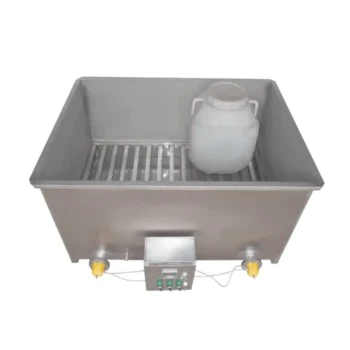
Stingless bee honey requires professional processing primarily to prevent rapid spoilage caused by its unique chemical composition. Unlike standard honey, it possesses a naturally high moisture content that renders it unstable at room temperature. Without professional intervention, this moisture leads to immediate fermentation, degrading the honey's quality and commercial viability.
The natural composition of stingless bee honey creates a perfect environment for biological instability. Professional dehydration and sterilization are not optional luxuries; they are critical steps to arrest fermentation and transform a volatile raw ingredient into a stable, high-end health product.
The Science of Instability
The Moisture Threshold
Stingless bee honey is distinct from Apis (common honeybee) honey because it naturally holds a significantly higher percentage of water.
This excess moisture creates high water activity within the substance. While this gives the honey its unique texture, it also acts as a catalyst for instability.
The Fermentation Risk
Because of the high moisture content, this honey is highly susceptible to rapid fermentation at room temperature.
Naturally occurring yeasts thrive in this environment. If left untreated, these microorganisms multiply quickly, causing the honey to sour, spoil, or turn into vinegar.
Professional Processing Solutions
Removing Excess Water
To stabilize the product, producers must use professional dehumidification or dehydration equipment.
These systems are designed to systematically reduce the water content. By lowering the moisture levels, the physical environment becomes hostile to spoilage organisms, effectively halting biological degradation.
Eliminating Microorganisms
Reducing moisture is often paired with sterilization to ensure total safety.
Low-temperature pasteurization is the preferred method here. It targets and eliminates fermenting microorganisms without subjecting the honey to the high heat that would destroy its nutritional value.
Understanding the Trade-offs
Temperature Sensitivity
The challenge in processing stingless bee honey lies in the method of sterilization.
While heat kills microbes, excessive heat destroys distinct therapeutic compounds. Operators must strictly adhere to low-temperature protocols to sterilize the product while retaining its status as a "health product."
Consistency vs. Raw Appeal
Processing alters the honey from its rawest state to ensure storage stability.
While some enthusiasts prefer raw honey, it is commercially risky due to spoilage. Professional processing trades a small degree of "rawness" for the ability to guarantee a consistent, safe product that does not ferment on the shelf.
The Commercial Impact
Extending Shelf Life
Unprocessed stingless bee honey has a very short window of viability.
Professional processing significantly extends the shelf life, allowing the product to be stored, shipped, and sold without the risk of the container exploding from fermentation gases or the product spoiling.
Meeting High-End Standards
Premium markets demand consistency.
To position stingless bee honey as a high-end health product, it must meet strict quality control standards. Processing ensures that every jar offers the same viscosity, taste, and safety profile.
Making the Right Choice for Your Product
Processing is the bridge between a traditional remedy and a globally marketable commodity.
- If your primary focus is Shelf Stability: Prioritize dehydration to lower moisture content to a level where yeast cannot reproduce.
- If your primary focus is Market Safety: Utilize low-temperature pasteurization to actively kill existing microbes and prevent fermentation during transport.
Professional processing is the only reliable method to secure the value of your harvest and ensure consumer safety.
Summary Table:
| Process Step | Primary Goal | Key Benefit |
|---|---|---|
| Dehydration | Reduce water content | Prevents natural spoilage and yeast growth |
| Sterilization | Eliminate microorganisms | Arrests fermentation and ensures consumer safety |
| Low-Temp Pasteurization | Biological stabilization | Kills microbes while preserving nutritional value |
| Maturation | Quality consistency | Guarantees shelf-stable, high-end commercial profiles |
Elevate Your Honey Production with HONESTBEE
Transition from raw harvest to a world-class commercial product with the right technology. HONESTBEE specializes in supporting commercial apiaries and distributors with professional-grade honey-processing machinery and beekeeping tools.
Whether you need precision honey-filling machines to ensure consistency or advanced dehydration systems to prevent fermentation, our comprehensive wholesale offering is designed to scale your business. Don't let your harvest spoil—secure the value of your honey and meet high-end market standards with our specialized hardware and industry consumables.
Ready to optimize your facility? Contact us today to explore our full spectrum of equipment and machinery!
References
- Rodolfo Jaffé, Vera Lúcia Imperatriz-Fonseca. Bees for Development: Brazilian Survey Reveals How to Optimize Stingless Beekeeping. DOI: 10.1371/journal.pone.0121157
This article is also based on technical information from HonestBee Knowledge Base .
Related Products
- High Quality Honey Dehumidifier Dryer Thickening Machine for Beekeeping
- 0.5T Capacity Honey Dehumidifier Dryer with Vacuum Heating and Thickening Filtering Machine
- Honey Concentrating and Filtering Dehumidifier Machine 2T Capacity for Honey
- Honey Concentrating Vacuum Heating Thickening Machine Dehumidifier for Honey
- Economy Small Scale Honey Dryer Dehumidifier Thickening Machine
People Also Ask
- Can you dehumidify honey? A Beekeeper's Guide to Preventing Fermentation
- How to dry up honey? The Safe Guide to Stabilizing Honey and Preventing Fermentation
- How can the moisture content of honey be reduced? A Guide to Safe, Effective Drying Methods
- How to remove humidity from honey? Protect Your Harvest from Fermentation
- How to decrease moisture in honey? Prevent Fermentation and Ensure Long-Term Quality