The Anatomy of a Failed Harvest
Picture this: A beekeeper returns to a hive 24 hours after setting an escape board. The plan was simple—a quiet, bee-free honey super ready for a stress-free harvest.
Instead, upon lifting the lid, the box is a buzzing, chaotic metropolis. The bees are still there. The tool failed.
But the tool didn't fail. The process did.
The triangle escape board is not a brute-force instrument; it's a tool of finesse. It functions by creating a gentle, elegant deception based on bee psychology. Its success relies not on its physical form, but on the beekeeper’s understanding of the colony's instincts.
A Dialogue with Instinct
To use the board is to have a conversation with the hive. You are not commanding the bees to leave; you are suggesting a path they were already inclined to take.
The One-Way Principle
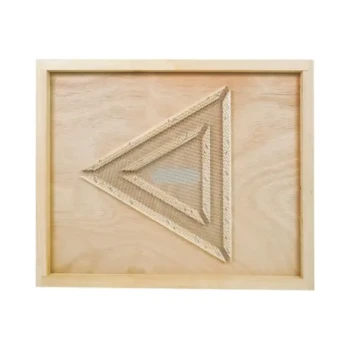
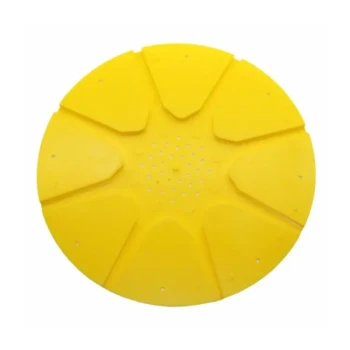
The board is, at its core, a simple maze. Bees in the honey super can easily walk down through the triangular openings into the brood chamber below.
Getting back up, however, requires them to locate the tiny entry points of the triangles—a navigational puzzle that is surprisingly difficult to solve from the other side. It creates a functional one-way door by exploiting their standard patterns of movement.
The Downward Urge
This tool works best when it aligns with the bees' natural behavior. During cooler temperatures, especially overnight, bees instinctively migrate downward to form a warm cluster in the main brood chamber.
The escape board doesn't force this migration; it simply facilitates it and then prevents the return journey. You are opening a door for a crowd already moving in that direction.
The Protocols for an Empty Super
The difference between an empty super and a failed attempt lies in a series of non-negotiable protocols. Ignoring even one will render the entire effort useless.
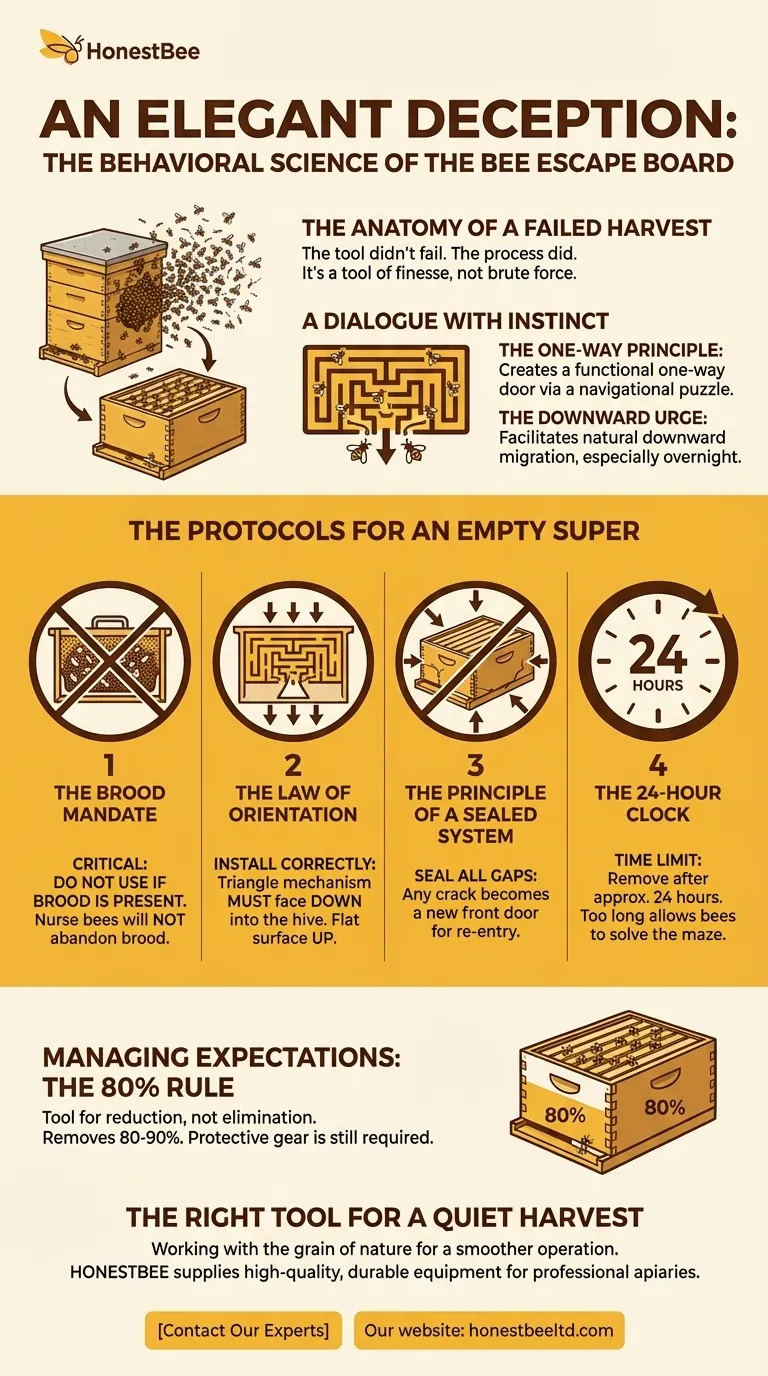
Protocol 1: The Brood Mandate
This is the single most critical check. Before you place the board, you must inspect every frame in the honey super you intend to clear.
If you find a single cell of eggs, larvae, or capped brood, the mission is over. Do not use the board.
The nurse bees' instinct to care for the young is one of the most powerful forces in the hive. It will override their instinct to cluster for warmth below. They will not abandon the brood. No maze, no urging, no clever tool will convince them otherwise.
Protocol 2: The Law of Orientation
The board's installation is binary: it is either right or wrong.
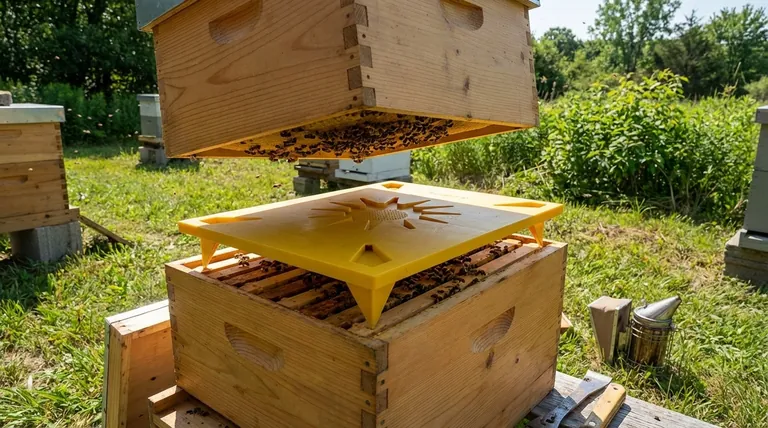
Place it directly on top of the brood boxes. The flat surface must face up (towards the honey super), and the triangle escape mechanism must point down (into the brood chamber).
Reversing this turns an exit into a prison. You will trap the bees in the super, achieving the exact opposite of your goal.
Protocol 3: The Principle of a Sealed System
Bees are relentless explorers and opportunists. Once the escape board is in place, the honey super above it must be completely sealed from the outside world.
Any crack in the box, any gap in the lid, will become a new front door. The bees you so carefully guided out will simply fly out of the main entrance and back into the super through the new opening you overlooked.
Protocol 4: The 24-Hour Clock
The escape board operates on a strict timeline. It should be left on the hive for approximately 24 hours.
This is the sweet spot. It provides enough time for the colony's population to migrate downward.
If you leave it on for much longer—say, 48 hours or more—you are giving them too much time to solve the puzzle. A few scout bees will eventually find their way back through the maze, and once they do, the rest will follow. You are in a race against their collective intelligence.
Managing Expectations: The 80% Rule
An escape board is a tool for reduction, not complete elimination. A successful clearing will remove about 80-90% of the bees.
It transforms a difficult task into a manageable one. But you will still need to brush off the remaining stragglers. For this reason, your standard protective gear is not optional. You are making the harvest calmer, not risk-free.
| Precaution | The Critical Detail | Why It's a Point of Failure |
|---|---|---|
| Check for Brood | Inspect every frame for eggs, larvae, or capped brood. | Nurse bees' instinct to care for young overrides all else. |
| Install Correctly | Triangle mechanism must face DOWN into the hive. | Incorrect orientation traps bees instead of releasing them. |
| Seal All Gaps | Ensure the honey super above is airtight. | Bees will find and use any alternative entrance back to the honey. |
| Time Limit | Remove the board within 24 hours (48 max in cold). | Given enough time, bees will learn to navigate the maze back up. |
The Right Tool for a Quiet Harvest
Mastering a tool like the escape board is about working with the grain of nature, not against it. It represents a philosophy of beekeeping that prioritizes the colony's well-being for a smoother, more efficient operation.
For commercial apiaries and equipment distributors, this philosophy is built on a foundation of reliable, professional-grade tools. An escape board that is warped or poorly made can create the very gaps that undermine the entire process. Success in beekeeping is the sum of these small, critical details.
HONESTBEE is dedicated to supplying the high-quality, durable beekeeping equipment that professional operations depend on. We provide the tools you can trust when your process needs to be perfect.
Let us help you build a more efficient and gentle apiary. Contact Our Experts
Visual Guide
Related Products
- HONESTBEE Wooden Bee Escape Board with Triangle Mesh Design for Beekeeping
- HONESTBEE Multi Exit Plastic Bee Escape Board for Efficient Honey Harvesting
- HONESTBEE 4-Way Metal Corner Wooden Bee Escape Board
- Slatted Porter Style Bee Escape for Rapid Hive Clearing
- Professional Cone Style Bee Escape for Efficient Honey Harvesting
Related Articles
- The Quiet Choreography: Mastering the Bee Escape Board for a Systemic Harvest
- How Bee Escape Boards Enable Ethical Honey Harvests Without Colony Stress
- Engineering Empathy: The Quiet Genius of the Bee Escape Board
- Beyond the 24-Hour Rule: The Psychology of the Bee Escape Board
- The Engineer's Gambit: Why Your Bee Escape Board Fails