The Tipping Point Hiding in Plain Sight
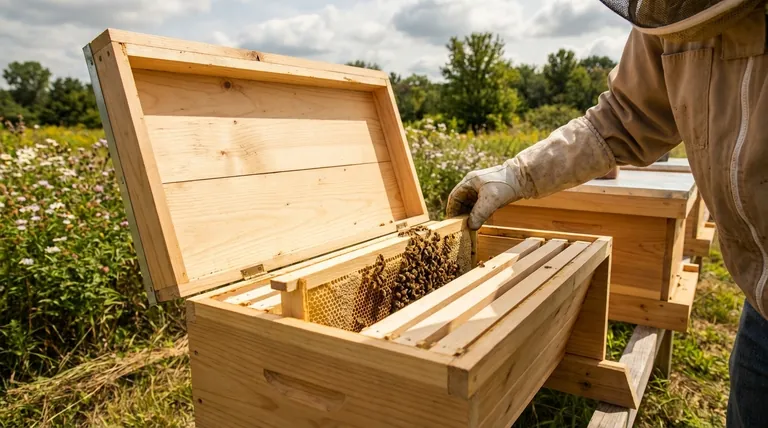
A beekeeper opens their top bar hive on a warm June afternoon. The air hums with activity. Every comb is heavy with brood, pollen, or glistening nectar. Only one or two empty top bars remain at the back.
To the novice, this looks like peak success—a full, booming metropolis. To the veteran, it’s a silent alarm. This isn't a destination; it's a critical decision point. The colony is telling you it's about to outgrow its world.
Managing a top bar hive isn’t about building bigger boxes. It’s about understanding the psychology of the colony and managing the invisible architecture of their living space.
The Language of Boundaries
Unlike Langstroth hives where management is done in entire supers, the top bar hive operates on a principle of incremental adjustment. It’s a more intimate conversation with the colony, and your primary tool for this dialogue is deceptively simple.
Your Primary Tool: The Follower Board
The follower board is the most critical component you're not harvesting honey from. It's a solid panel, shaped like a comb, that acts as a movable back wall for the hive.
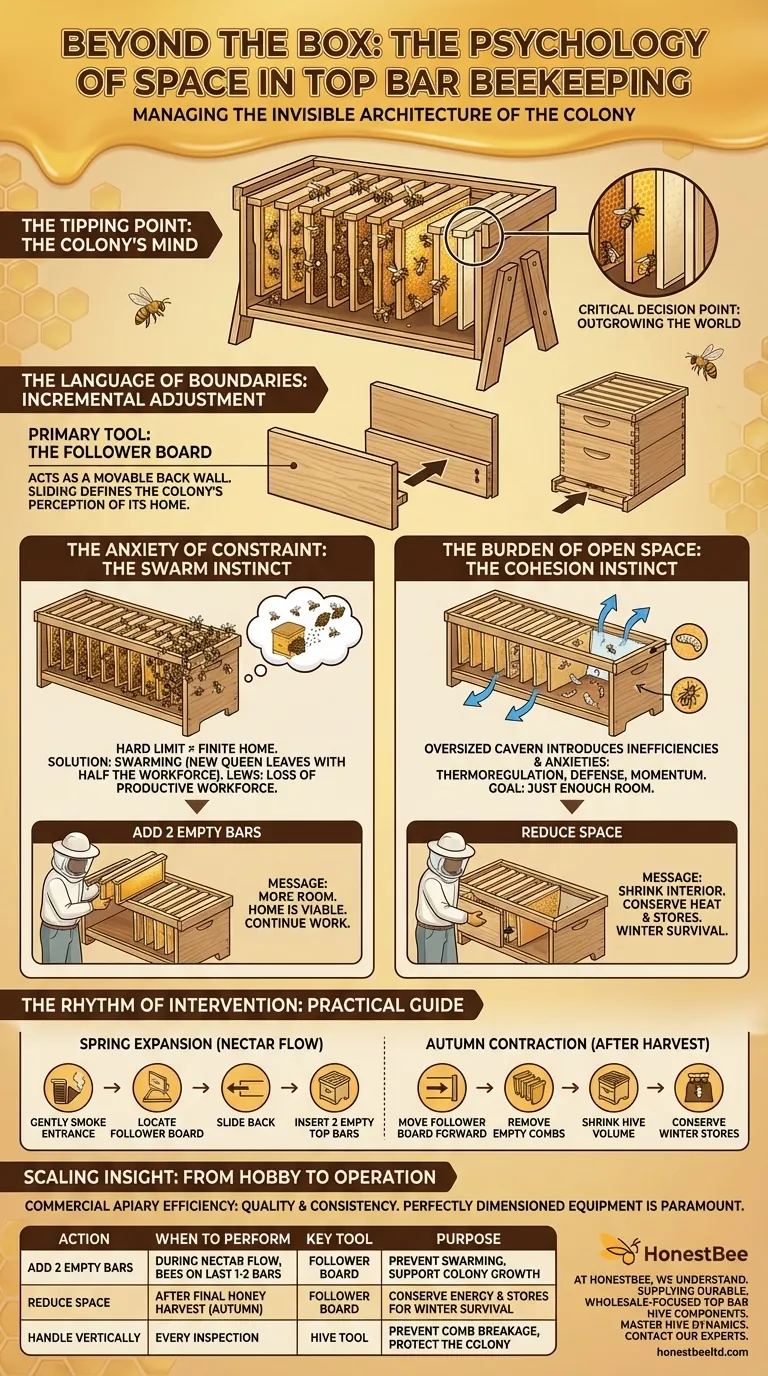
For the bees, this board is the end of their universe. They will build comb up to it but not beyond it. By sliding this board, you are not just adding space; you are redefining the colony's entire perception of its home. You are the architect of their world.
The Colony's Mind: A Delicate Balance
Your decisions directly influence the colony's collective mindset, which oscillates between two powerful, primal instincts: the drive to expand and the need for a secure, cohesive home.
The Anxiety of Constraint: The Swarm Instinct
When bees start working on their final empty bar, they sense a hard limit. Their programming, honed over millions of years, tells them that a finite home cannot support infinite growth.
The solution is elegant and profound: swarming. They will raise a new queen and the old queen will leave with half the workforce to found a new colony. For the bees, this isn't a failure—it's the ultimate expression of success. For the beekeeper, it's the loss of a productive workforce.
By adding two new bars just as they approach this limit, you send a clear message: "There is more room. This home is still viable. Continue your work."
The Burden of Open Space: The Cohesion Instinct
The temptation might be to add five or ten bars at once, giving them all the room they could ever need. This is a crucial mistake.
A colony thrives on cohesion. An oversized, cavernous space introduces profound inefficiencies and anxieties:
- Thermoregulation: A larger volume requires more energy to keep warm, diverting resources from brood-rearing and foraging.
- Defense: The bees must patrol the entire cavity, making it harder to defend against pests like wax moths or small hive beetles.
- Momentum: It can break the chain of comb construction, leaving a disorganized space that discourages focused expansion.
Your goal is to provide just enough room to encourage growth without creating a stressful, unmanageable void.
The Rhythm of Intervention: A Practical Guide
Successful management is about timing and gentle, purposeful action. It follows the cadence of the seasons.
The Spring Expansion
During a nectar flow, when the colony is rapidly expanding, follow this simple process once they are working on the last 1-2 empty bars.
- Gently smoke the hive entrance.
- Open the lid and locate the follower board.
- Carefully slide the board back, creating a gap for two new bars.
- Insert two empty top bars directly next to the last drawn comb.
- Push all bars together snugly and close the hive.
The Autumn Contraction
After the final honey harvest, the colony's goal shifts from expansion to survival. You must reverse the process.
Move the follower board forward, removing empty or partially drawn combs. This shrinks the hive's interior volume, allowing the bees to form a tight cluster and efficiently conserve heat and honey stores through the winter.
A Note on Gentle Handling
New comb is incredibly fragile. When inspecting, always treat each bar with respect. Gently break any wall attachments with your hive tool and always keep the comb oriented vertically, just as it hung in the hive. A simple tilt can cause a heavy, beautiful comb to snap off the bar.
Scaling Insight: From Hobby to Operation
For a commercial apiary, these principles aren't just best practices; they are core to operational efficiency and profitability. A single lost swarm is a lesson. A systemic failure to manage space across dozens or hundreds of hives can be a catastrophic loss of production.
This is where the quality and consistency of your equipment become paramount. Perfectly dimensioned top bars and follower boards that don't warp ensure that these subtle adjustments can be made smoothly and effectively across an entire operation.
| Action | When to Perform | Key Tool | Purpose |
|---|---|---|---|
| Add 2 Empty Bars | During nectar flow, bees on last 1-2 bars | Follower Board | Prevent swarming, support colony growth |
| Reduce Space | After final honey harvest (Autumn) | Follower Board | Conserve energy & stores for winter survival |
| Handle Vertically | Every inspection | Hive Tool | Prevent comb breakage, protect the colony |
At HONESTBEE, we understand that professional beekeeping is a game of inches. We supply commercial apiaries and distributors with the durable, wholesale-focused top bar hive components required to manage colony psychology at scale.
Mastering hive dynamics begins with reliable equipment that lets your expertise shine. Contact Our Experts
Visual Guide
Related Products
- Top Bar Beehive for Beekeeping Wholesales Kenya Top Bar Hive
- Long Langstroth Style Horizontal Top Bar Hive for Wholesale
- HONESTBEE Top Bar & Bottom Bar Forming Machine | Bee Frame Machine
- HONESTBEE Square Top Hive Bee Feeder Top Bee Feeder
- HONESTBEE Round Hive Top Bee Feeder for Syrup
Related Articles
- How to Inspect Top Bar Hives Without Damaging Comb: A Beekeeper’s Guide
- Beyond Pest Control: The Operational Logic of the Kenyan Top-Bar Hive
- How Top Bar Hives Naturally Boost Bee Health and Simplify Beekeeping
- How to Optimize Honey Storage in Top Bar Hives for Healthier Colonies
- Top Bar Hives: A Sustainable Approach to Bee-Friendly Beekeeping