The Beekeeper's Misguided Instinct
It’s the first real cold snap of the season. Your instinct, born from millions of years of mammalian evolution, screams to protect your bees from the freezing temperatures. You want to wrap the hive, seal it tight, and make it warm.
This is a well-intentioned, but potentially fatal, mistake.
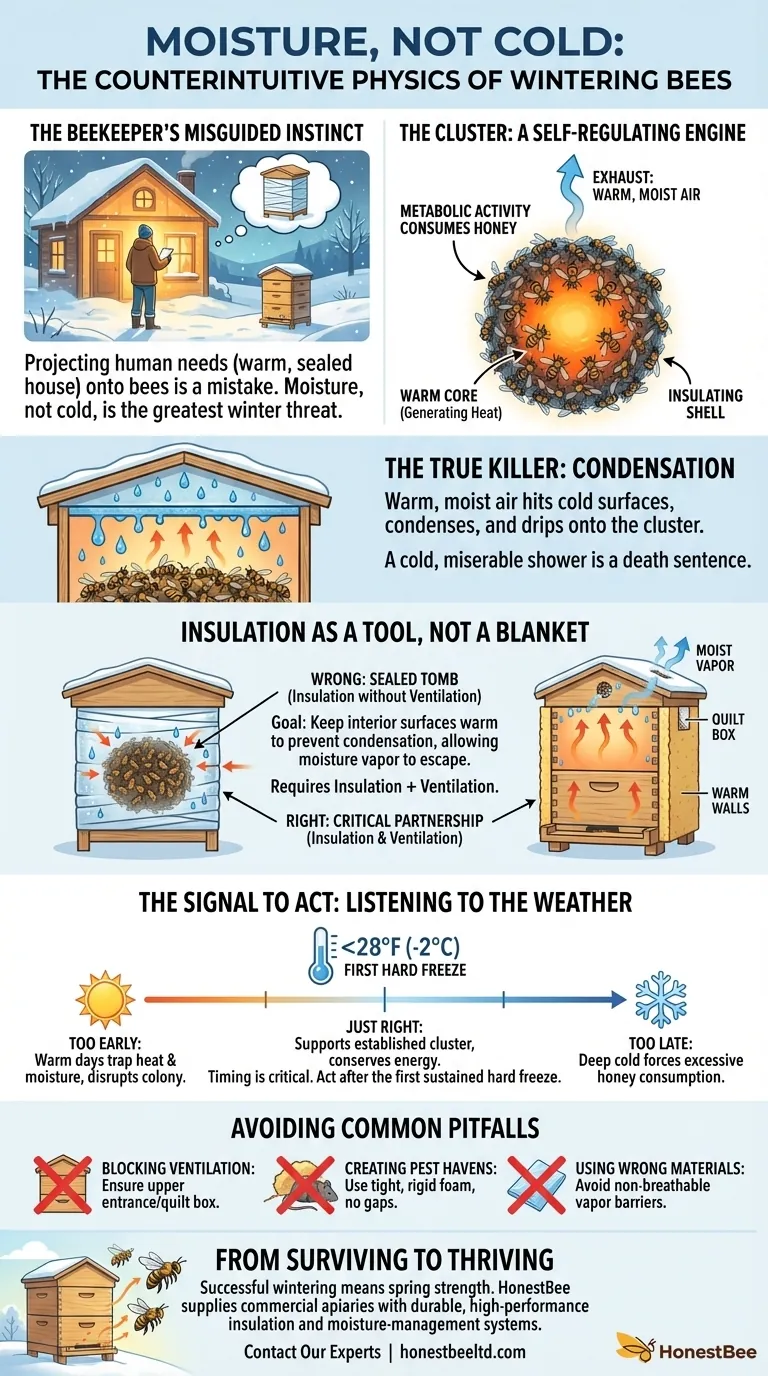
We project our own needs—a warm, sealed house—onto a living system that operates on entirely different principles. The greatest threat to a honey bee colony in winter is not the cold. It’s the moisture they create themselves.
The Cluster: A Self-Regulating Engine
To understand how to help, we first have to appreciate the engineering marvel of the winter cluster. As temperatures drop, bees form a dense ball, with a warm core and an insulating outer layer of bodies.
Bees in the core generate heat by vibrating their wing muscles, keeping the queen and brood (if any) at a stable temperature. This cluster is a living furnace, a self-regulating engine that consumes honey for fuel.
And like any engine, it has an exhaust. The byproduct of all that metabolic activity is warm, moist air.
The True Killer in the Hive
Healthy, dry bees can survive astonishingly cold temperatures. Wet, chilled bees will die quickly.
When the warm, moist air from the cluster rises and hits a cold inner surface of the hive—the lid or an upper wall—it condenses into water droplets. This is the same physics that fogs up a car window on a cold day.
That condensation can then drip back down onto the bees. A cold, miserable shower in the middle of winter is a death sentence for the cluster.
Insulation as a Tool, Not a Blanket
The goal of insulation is not to heat the hive. It is to change the physics of the hive box itself.
Your job is to help the bees manage their own heat and moisture more efficiently. Proper insulation is a tool for this, not a blanket to stop the cold.
The Right Intervention
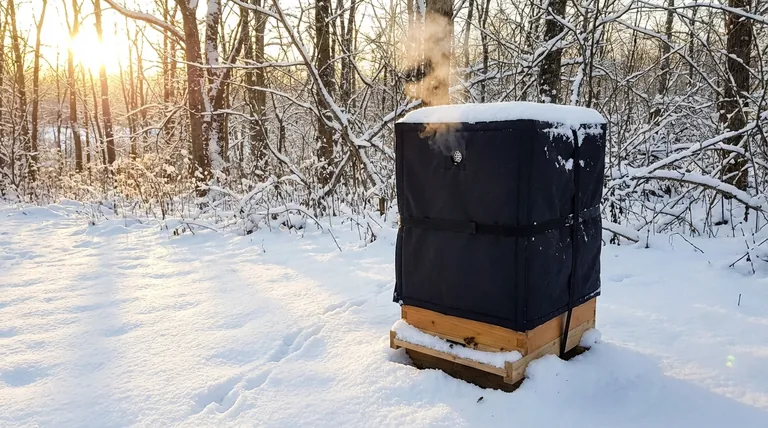
By wrapping the hive with rigid foam or a specialized hive cover, you keep the interior surfaces of the hive warmer. If the surface temperature remains above the dew point, condensation simply won't form on the walls or ceiling above the bees.
The moisture remains as vapor.
The Critical Partnership: Insulation and Ventilation
This strategy only works if that water vapor has an escape route. Insulation without ventilation is a sealed, damp tomb.
The moisture must be allowed to rise and exit through a dedicated ventilation point, such as a small upper entrance or a quilt box. This is why professional-grade wintering systems, like those from HONESTBEE, are designed as a system—combining high-R-value insulation with engineered ventilation solutions to create a dry, stable environment.
The Signal to Act: Listening to the Weather, Not Anxiety
Timing is everything. Acting too soon or too late can do more harm than good. Your cue comes from the weather, not your calendar.
The Hard Freeze Trigger
The ideal time to install insulation is just after the first sustained hard freeze—when temperatures drop below 28°F (-2°C) for several hours.
This signal is critical because it indicates two things have happened: brood rearing has likely ceased, and the bees have fully committed to their tight winter cluster. You are now supporting a stable system, not interfering with its formation.
The Peril of Acting Too Soon
If you insulate while daytime temperatures are still warm, you risk trapping heat and moisture. This can confuse the bees, causing them to break cluster, consume honey stores too quickly, and live in the exact damp conditions you want to prevent.
It's like turning up the thermostat and sealing the windows in a crowded, steamy room. It creates chaos.
The Cost of Waiting Too Long
Waiting until the dead of winter means the colony has already been forced to fight off the initial cold snaps on its own. They have already burned through precious honey reserves—a fuel they cannot replenish until spring. You’ve forced them to pay a tax you could have helped them avoid.
Avoiding Common Pitfalls
How you insulate is as important as when. Good intentions can go wrong if implemented poorly.
- Blocking Ventilation: Never seal the hive completely. Always ensure there is a small upper entrance or ventilated quilt box for moisture to escape.
- Creating Pest Havens: Ensure insulation wraps are tight and rigid foam boards have no gaps. Loose insulation creates a perfect winter home for mice.
- Using the Wrong Materials: Never wrap a hive in a non-breathable vapor barrier like plastic sheeting. This traps moisture directly against the wood, promoting condensation and mold.
| Timing Factor | The Signal | The Consequence |
|---|---|---|
| Just Right | First hard freeze (<28°F / -2°C) | Supports an established winter cluster, conserves energy. |
| Too Early | Persistently warm daytime temperatures | Traps excess heat and moisture, disrupting the colony. |
| Too Late | Deep winter cold has already set in | Forces bees to burn through critical honey stores unnecessarily. |
From Surviving to Thriving
Successful wintering isn't about a single action, but about understanding the bees' natural system and providing the right support at precisely the right time. The goal is not for the colony to merely survive winter, but to emerge in spring strong, healthy, and ready to build.
For commercial operations where every colony's strength impacts the bottom line, using reliable, purpose-built equipment isn't a luxury; it's a critical investment. HONESTBEE supplies commercial apiaries and distributors with durable, high-performance hive insulation and moisture-management systems designed for this very purpose.
To ensure your colonies have the best chance to thrive, Contact Our Experts.
Visual Guide