A Beekeeper's Worst Fear
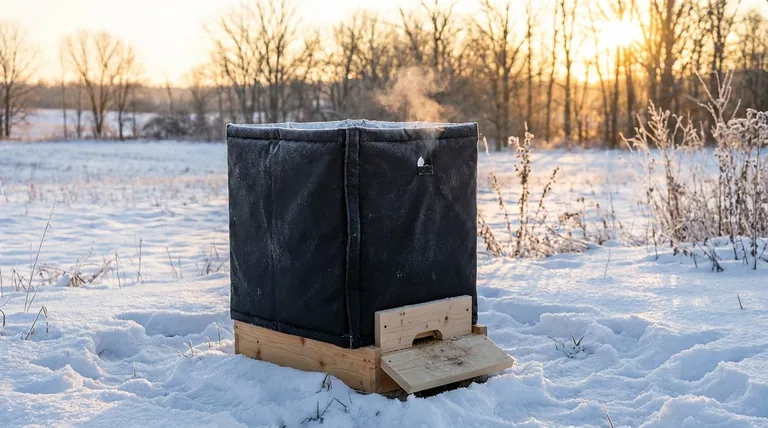
It’s a deceptively sunny day in early spring. A beekeeper approaches a silent hive, full of hope. But lifting the lid reveals a tragedy: a full cluster of bees, motionless, heads down in the cells.
The honey stores are plentiful. The hive seems secure. They didn’t starve, and they weren't exposed to the wind. So what happened?
They were likely killed by a single drop of water. And another, and another. This is the counterintuitive reality of wintering a beehive: the most dangerous enemy is not the cold, but the colony's own breath.
The Misunderstood Goal: It's Not About Warmth
Our human instinct is to seal things up to keep them warm. We add insulation, patch drafts, and trap heat. Applying this logic to a beehive is a fatal mistake.
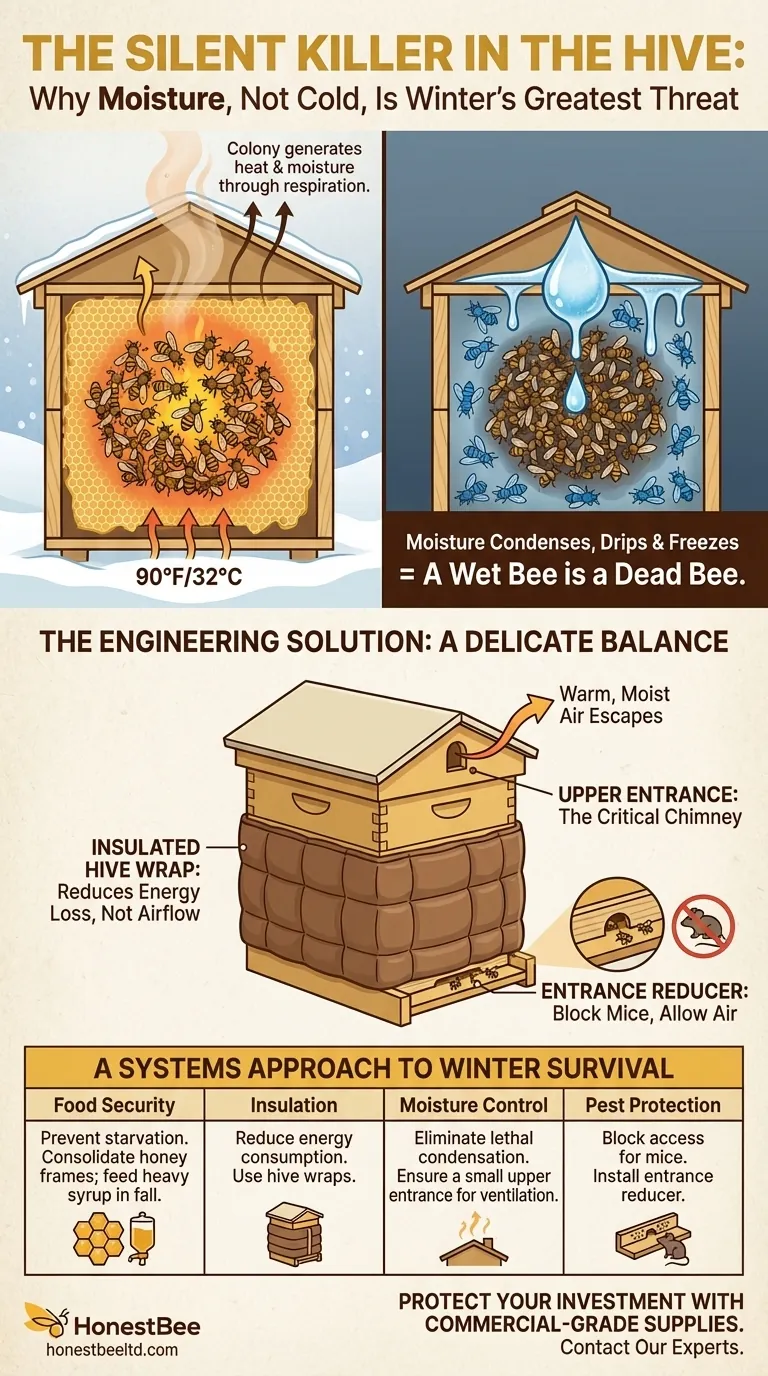
The goal of winterization is not to heat the hive. The bees do that themselves, forming a thermoregulating cluster and vibrating their wing muscles to generate warmth. A strong colony can keep the center of its cluster at a balmy 90°F (32°C) even when it's freezing outside.
The beekeeper's job is not to provide heat, but to create a stable environment where the bees' own survival mechanism can function optimally. This means managing two primary threats: starvation and moisture.
Managing the Obvious Threats: Fuel and Shelter
Before we confront the silent killer, we must address the basics. A winter cluster is an engine that runs on honey. Running out of fuel means the engine stops, and the colony freezes.
Fueling the Winter Engine
A colony needs a massive amount of honey to get through winter. Beekeepers ensure this by leaving sufficient stores and sometimes supplementing with sugar syrup in the fall.
Critically, the food must be accessible. Frames of honey are consolidated into a single box, so the cluster doesn't have to break formation and cross a frigid, empty gap to reach its next meal—a journey from which they might never return.
A Defensible Thermal Envelope
While bees generate their own heat, we can reduce how much energy they have to expend. A standard wooden hive has poor insulation.
This is where equipment like insulated hive wraps comes in. By wrapping the hive, you reduce heat loss to the wind and surrounding air. The bees burn less honey to maintain their core temperature, conserving precious fuel for the long months ahead. The goal is to reduce energy expenditure, not to create a hermetically sealed box.
The Real Enemy: The Physics of Condensation
Now, for the invisible threat.
A honeybee cluster, like any living organism, respires. As they consume honey, they release carbon dioxide and warm, moist water vapor.
In a sealed, poorly ventilated space, this warm, moist air rises. It hits the cold inner cover or top of the hive, and the laws of physics take over. The water vapor condenses into liquid water.
This is where the tragedy unfolds. The water drips back down.
A wet bee is a dead bee. Cold water hitting the cluster is a death sentence, chilling them far faster than the ambient air ever could. The colony perishes in a cold, damp tomb, surrounded by the very food that was meant to save them.
The Engineering Solution: A Delicate Balance
Preventing this fate requires a system that embraces, rather than fights, the elements of nature. It's a careful balance of insulation and ventilation.
The Critical Role of a Chimney
The solution is simple, yet brilliant: provide a small opening at the top of the hive.
This upper entrance acts as a chimney. It allows the warm, moist air to escape before it can condense and rain down on the bees. Yes, a small amount of heat escapes with it, but this is a necessary trade-off. Sacrificing a little heat to expel a lot of deadly moisture is the key to survival.
This opening also serves as a backup exit for the bees on warmer winter days if the main entrance is blocked by snow or dead bees.
The Guard at the Gate
A warm, sheltered hive full of food is an irresistible target for mice seeking refuge. A single mouse can terrorize a colony, destroying comb and fouling the hive.
The solution is another piece of simple, elegant engineering: an entrance reducer. This device narrows the main hive opening to a slot that is too small for a mouse but large enough for bees to pass through. It's the simplest form of security, but one of the most effective.
A Systems Approach to Winter Survival
Effective winterization isn't about a single action, but a holistic strategy that addresses all the interconnected threats a colony faces. Success depends on understanding the system as a whole.
| Winterization Pillar | Primary Goal | Key Tools & Actions |
|---|---|---|
| Food Security | Prevent starvation | Consolidate honey frames; feed heavy syrup in fall |
| Insulation | Reduce energy consumption | Use hive wraps or other insulation materials |
| Moisture Control | Eliminate lethal condensation | Ensure a small upper entrance for ventilation |
| Pest Protection | Block access for mice | Install a properly sized entrance reducer or mouse guard |
For a commercial apiary, losing a percentage of your colonies over winter isn't just a disappointment; it's a significant financial blow. Ensuring you have durable, well-designed equipment is the foundation of a successful wintering strategy. Protecting your colonies means protecting your investment and ensuring a strong start to the next season. At HONESTBEE, we provide commercial-grade winterization supplies built to withstand the elements and give your bees the best possible chance of survival.
To prepare your apiary for the challenges ahead, Contact Our Experts.
Visual Guide
Related Products
- Wholesales Dadant Size Wooden Bee Hives for Beekeeping
- Metal Bee Hive Stand Bee Box Stand for Beekeeping
- Wooden Bee Hive Frames for Beekeeping and Wholesale
- High-Performance Langstroth Bee Hives for Global Professional Beekeeping
- HONESTBEE Professional Hive Top Bee Feeder Feeding Solution
Related Articles
- Beyond the Bee Box: Why Your First Apiary Investment Determines Your Success
- How to Assemble Wooden Beehives: A Beginner's Guide to Durable Joint Systems
- Why Wooden Beehives Outperform Modern Alternatives: A Science-Backed Guide for Beekeepers
- How Bee Space Dictates Hive Success: Science-Backed Management Strategies
- More Than a Number: Why the 8-Frame vs. 10-Frame Hive Debate Is About Psychology, Not Just Production
















