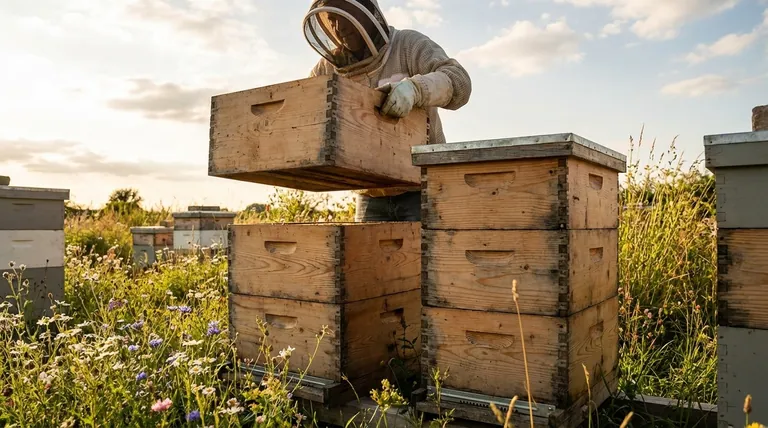
The Illusion of the Simple Number
In beekeeping, as in many complex systems, we often gravitate toward simple metrics. We ask, "Which hive produces more honey: the 8-frame or the 10-frame?"
On a spreadsheet, the answer is obvious. A 10-frame box offers 25% more volume than an 8-frame box. More space means more bees, more brood, and more honey. The math is clean. The conclusion feels certain.
But the apiary is not a spreadsheet. The real world is governed by biology, physics, and human behavior. And this is where the simple math breaks down.
The Physics of the Beekeeper
Imagine it’s late July. The air is thick with humidity, and the nectar flow is peaking. A deep 10-frame honey super is now full, weighing a staggering 80 to 90 pounds. It needs to be inspected or harvested.
This single physical object represents the most overlooked variable in the honey production equation: the beekeeper’s physical limit.
A System Designed for Human Failure
When a task becomes physically prohibitive, we delay it. A beekeeper struggling with a 90-pound box is less likely to perform a timely hive inspection. They might put it off until tomorrow, or next weekend.
In that delay, a colony can begin swarm preparations. A disease could take hold. The very act of choosing equipment that pushes the boundary of human ergonomics creates a system ripe for failure. The heaviest box is often the one that goes uninspected, and an uninspected hive is where production collapses.
The Compounding Cost of Avoidance
The 8-frame deep box, weighing a more manageable 60-70 pounds, changes this psychological calculus. It lowers the barrier to action.
Lifting it is still work, but it’s achievable work. Inspections happen on schedule. Problems are caught early. The beekeeper becomes a more consistent, effective manager. The "loss" of two frames of potential is more than compensated for by the gain in proactive oversight.
The most productive hive isn't the one with the biggest theoretical capacity; it's the one that is managed best. And management is a human behavior, deeply influenced by physical and psychological friction.
Designing for the Bee, Not Just the Box
Beyond the human factor, there is the biology of the bee itself. A beehive is not just a container; it's a home, a nursery, and a fortress. Its internal architecture matters.
The Geometry of Survival
The narrower, more vertical column of a stacked 8-frame hive more closely mimics the hollow of a tree—the ancestral home of the honeybee.
This isn't just a romantic notion; it has profound thermodynamic consequences. During winter, the bee cluster must generate heat to survive. A smaller, more compact space is more efficient to warm, reducing the colony's energy expenditure and consumption of precious honey stores.
The cluster can also more easily maintain contact with its food stores as it moves upward through the winter, a critical factor in preventing starvation.
A Practical Guide to System Trade-offs
The choice is not about a "better" or "worse" piece of equipment. It is an engineering decision about designing a system that works for your specific goals, your body, and your bees.
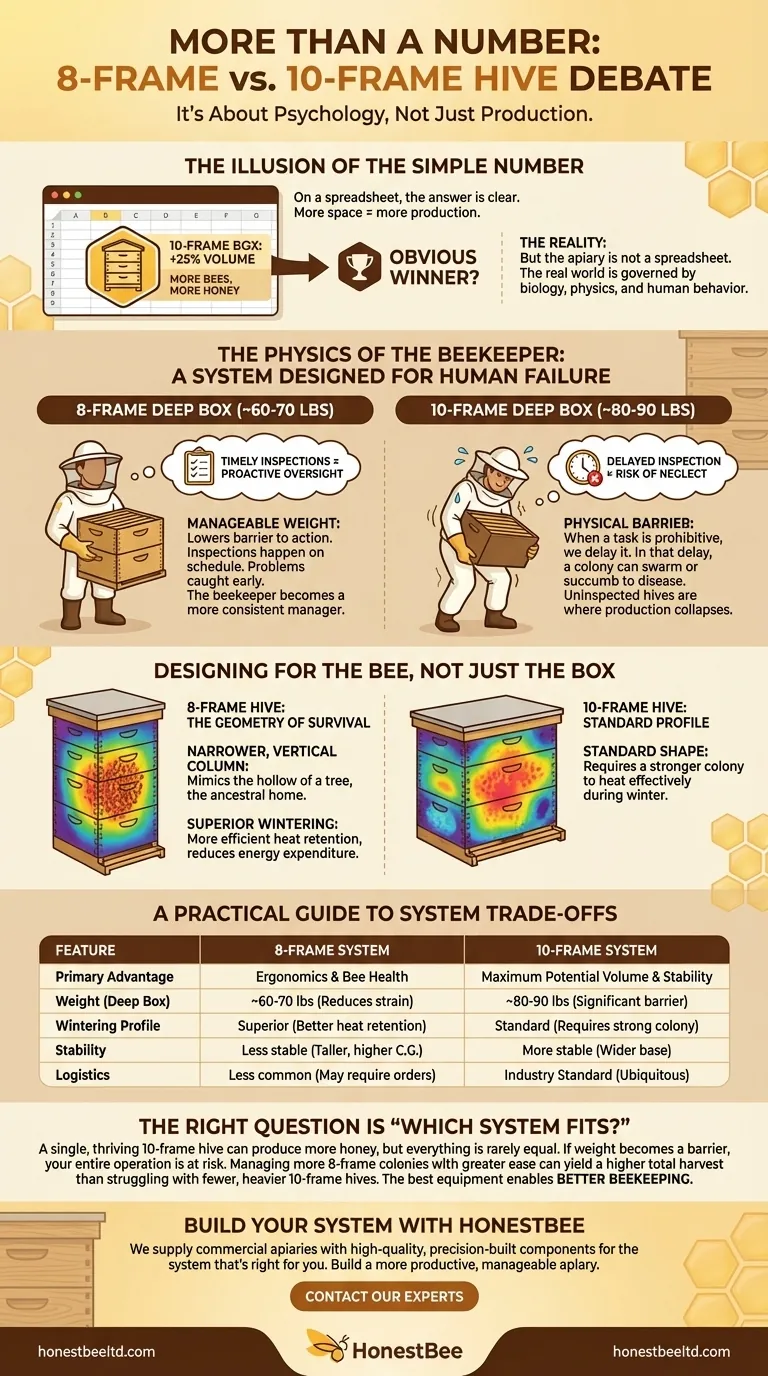
| Feature | 8-Frame Hive System | 10-Frame Hive System |
|---|---|---|
| Primary Advantage | Ergonomics & Bee Health | Maximum Potential Volume & Stability |
| Weight (Deep Box) | ~60-70 lbs (Reduces strain, encourages inspection) | ~80-90 lbs (A significant physical barrier) |
| Wintering Profile | Superior (Better heat retention, natural shape) | Standard (Requires a strong colony to heat) |
| Stability | Less stable (Taller for same volume, higher C.G.) | More stable (Wider base, better in high wind) |
| Logistics | Less common (May require special orders) | Industry Standard (Equipment is ubiquitous) |
The Right Question Is "Which System Fits?"
A single, thriving 10-frame hive will likely produce more honey than a single 8-frame hive, all else being equal.
But everything is rarely equal.
If you can no longer manage the weight of 10-frame boxes, your entire operation is at risk. If your goal is apiary-wide production, you may find that managing more 8-frame colonies with greater ease yields a higher total harvest than struggling with fewer, heavier 10-frame hives.
Ultimately, the best equipment doesn’t just hold bees; it enables better beekeeping. At HONESTBEE, we supply commercial apiaries and distributors with the high-quality, precision-built components needed to build the system that’s right for you, whether it’s 8-frame or 10-frame. We understand that success is built on a foundation of durable, reliable equipment that fits your operational philosophy.
To build an apiary that's more productive because it's more manageable, Contact Our Experts.
Visual Guide
Related Products
- Wholesales Dadant Size Wooden Bee Hives for Beekeeping
- Wooden Bee Hive Frames for Beekeeping and Wholesale
- Metal Bee Hive Stand Bee Box Stand for Beekeeping
- High-Performance Langstroth Bee Hives for Global Professional Beekeeping
- HONESTBEE Professional Hive Top Bee Feeder Feeding Solution
Related Articles
- Beyond the Bee Box: Why Your First Apiary Investment Determines Your Success
- The Silent Killer in the Hive: Why Moisture, Not Cold, Is Winter's Greatest Threat
- How to Assemble Wooden Beehives: A Beginner's Guide to Durable Joint Systems
- Why Wooden Beehives Outperform Modern Alternatives: A Science-Backed Guide for Beekeepers
- How Bee Space Dictates Hive Success: Science-Backed Management Strategies

















