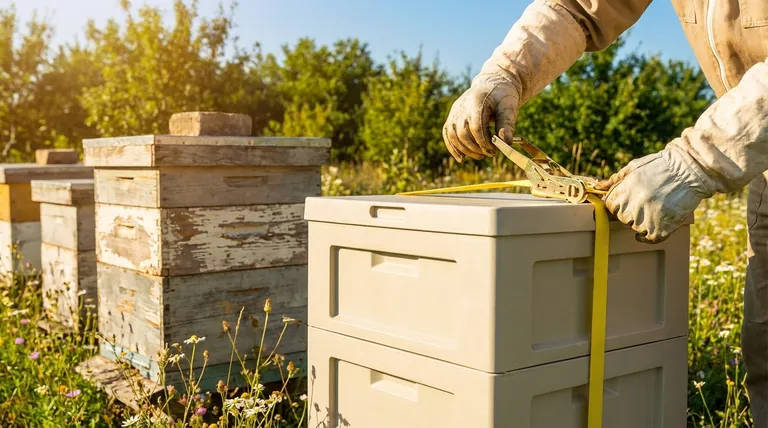
The Hidden Tax on Every Beekeeper
Imagine it’s early spring. You walk out to your apiary, ready for the first inspections of the season. But instead of focusing solely on your bees, you’re met with a familiar problem: a stack of wooden supers that didn't survive the winter. They are warped from moisture, the joints are splitting, and a few have clear signs of rot.
This isn't a catastrophe. It's just a predictable, recurring cost. It's the quiet, unseen tax that traditional materials levy on a beekeeper's most valuable assets: their time and attention.
Every hour spent scraping, sanding, painting, and repairing a wooden box is an hour not spent assessing colony health, managing swarms, or harvesting honey. At scale, this isn't just a chore; it's a systemic drag on the entire operation.
The Allure of Tradition, The Reality of Maintenance
For centuries, wood has been the default choice for beehives, and for good reason. It’s a natural, breathable material that helps manage the hive’s internal humidity—a critical factor for colony health, especially in damp climates. It feels right. It's classic.
But wood is an organic material in a constant battle with the elements. It absorbs water, it provides a home for pests like wax moths, and it degrades over time.
This creates a maintenance debt. The lower initial cost of wood is paid back slowly, season after season, through labor. For a hobbyist with two hives, this can be a romantic part of the craft. For a commercial apiary with two thousand, it's a crippling operational inefficiency.
A Shift in Mindset: From Craft to System
The choice to use plastic components isn't about abandoning tradition. It's about adopting an engineering mindset. It's about seeing the apiary not just as a collection of individual hives, but as an integrated system where the goal is to maximize resilience and minimize friction.
Plastic solves for the variable of decay.
Designing for Durability, Not Repair
High-quality plastic hive components are engineered for a single purpose: to endure. They are non-porous and dimensionally stable.
- They don’t warp, crack, or rot. This eliminates the primary failure mode of woodenware, drastically extending the equipment's service life.
- They are impervious to pests. Wax moths and other borers cannot gain a foothold in solid plastic, protecting your investment in frames and foundation.
- They withstand the extraction process. Plastic frames don’t break apart under the immense rotational forces of a commercial honey extractor.
This isn't just a material upgrade; it's a fundamental reduction of operational risk.
The Currency of Time
The most profound impact of this shift is the redefinition of "maintenance."
With wood, maintenance is a cycle of repair. With plastic, it's a simple act of cleaning. There’s no need to scrape embedded propolis from wood grain. A hive tool does most of the work, and for a deep clean, a power washer can reset the equipment to a near-new state in minutes.
This efficiency returns hundreds of hours to the beekeeper—hours that can be reinvested into the bees themselves.
Clarity in the Critical Moment
Good design reduces cognitive load. Many plastic foundations are black, which provides a high-contrast background against which a tiny, white, day-old queen egg stands out clearly.
Finding these eggs is one of the most critical tasks in beekeeping. It’s the definitive proof of a healthy, laying queen. Making that task faster and more certain isn't a small convenience; it’s a tool that enables better, faster decision-making about the health of your most valuable asset.
Understanding the System's Trade-Offs
No engineering choice is without compromise. A systems thinker understands the trade-offs and plans for them.
- Moisture Management: Because plastic is non-porous, it doesn't breathe like wood. This means condensation can form inside the hive in cold weather. This isn't a flaw; it's a known property that must be managed with proper ventilation.
- Thermal Properties: Plastic is a better insulator than wood. This is an advantage in cold climates, but can lead to overheating in hot climates if entrances and ventilation are not managed appropriately.
- Bee Acceptance: Bees will not draw comb on raw plastic. The components must be coated with a thin layer of beeswax. This is the essential interface between the natural and the manufactured—a simple, manageable step.
Make the Strategic Choice for Your Operation
The decision between wood and plastic is not sentimental. It is a strategic choice based on your primary goals and constraints.
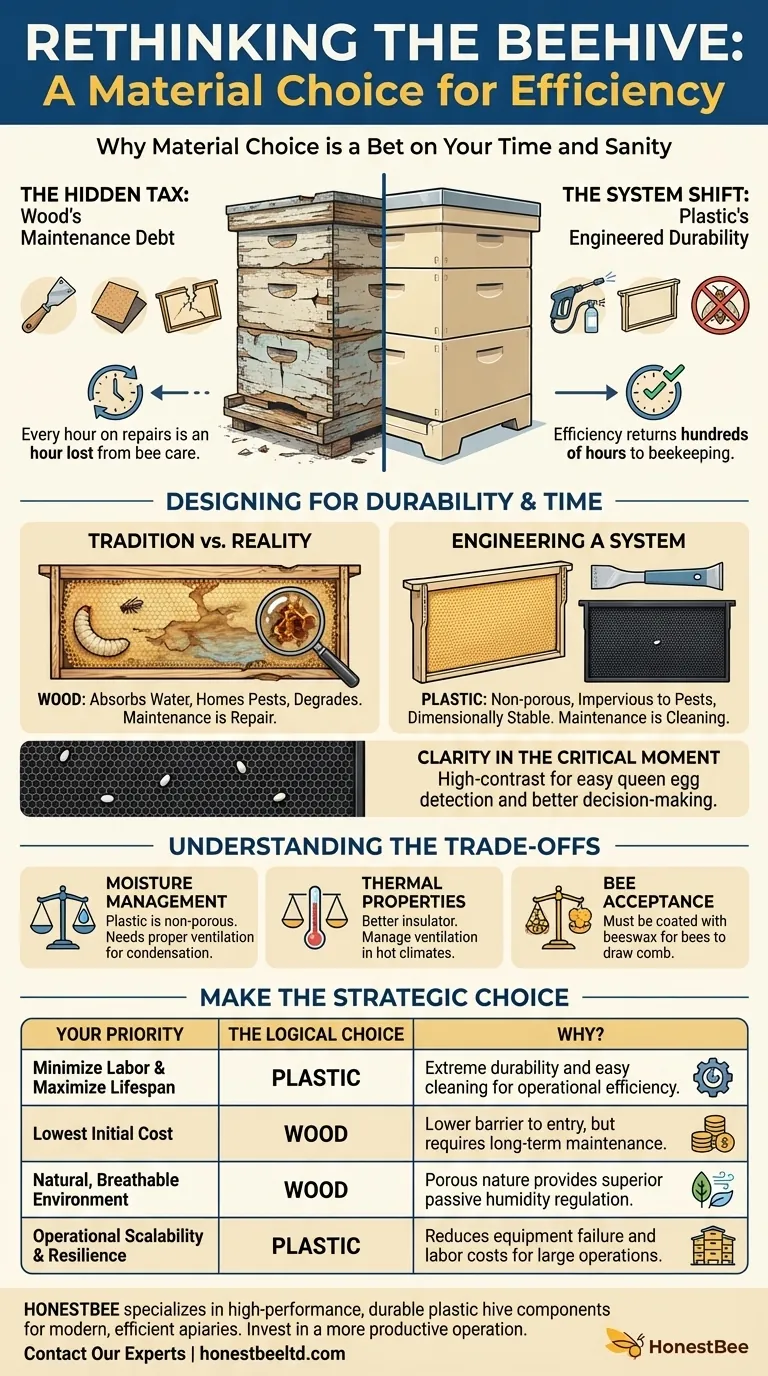
| Your Priority | The Logical Choice | Why? |
|---|---|---|
| Minimize Labor & Maximize Lifespan | Plastic | Extreme durability and ease of cleaning create a system built for operational efficiency. |
| Lowest Initial Cost | Wood | Offers a lower barrier to entry, but requires a long-term commitment to maintenance. |
| Natural, Breathable Environment | Wood | The porous nature of wood provides superior passive humidity regulation. |
| Operational Scalability & Resilience | Plastic | Reduces equipment failure and labor costs, which are the primary limiting factors in large apiaries. |
For commercial operations and wholesale distributors where every hour of labor and every piece of equipment is a critical part of a larger system, building for resilience is paramount. HONESTBEE specializes in providing the high-performance, durable plastic hive components that form the backbone of a modern, efficient apiary.
We understand that you're not just buying boxes; you're investing in a more productive and sustainable operation. Contact Our Experts
Visual Guide
Related Products
- Wholesales Dadant Size Wooden Bee Hives for Beekeeping
- Stainless Steel Round Beehive Air Vents for Ventilation
- Metal Bee Hive Stand Bee Box Stand for Beekeeping
- Durable Plastic Hive Number Set for Beekeeping
- Wooden Bee Hive Frames for Beekeeping and Wholesale
Related Articles
- The Silent Killer in the Hive: Why Moisture, Not Cold, Is Winter's Greatest Threat
- Beyond the Bee Box: Why Your First Apiary Investment Determines Your Success
- How to Assemble Wooden Beehives: A Beginner's Guide to Durable Joint Systems
- Why Wooden Beehives Outperform Modern Alternatives: A Science-Backed Guide for Beekeepers
- How Wooden Beehives Naturally Regulate Temperature for Healthier Honeybee Colonies


















