The Illusion of a Single Winter
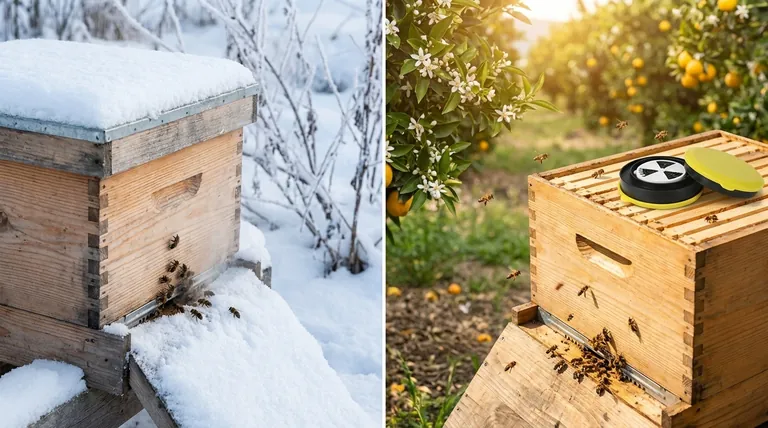
Imagine a commercial beekeeper moving their operation from the bitter plains of North Dakota to the humid groves of Florida. They might assume their toughest job—overwintering—just got easy.
This is a common, and dangerous, psychological trap. We project our human understanding of "winter" onto the hive. But a honey bee colony doesn't experience the calendar; it experiences environmental pressure.
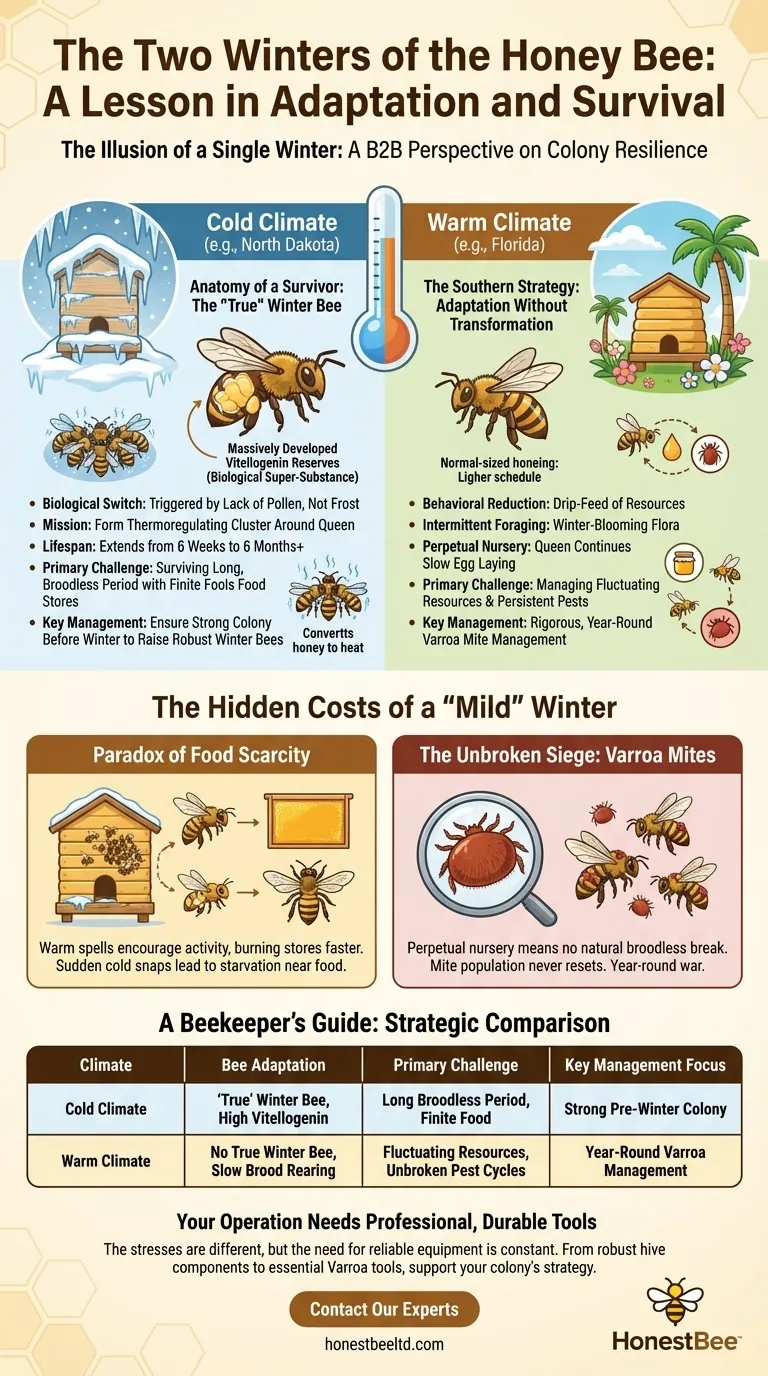
The fundamental truth is this: there is not one winter, but two. And the difference between them is not a matter of degrees on a thermometer, but a profound split in biological strategy. The question isn't if bees survive, but how.
The Anatomy of a Survivor: The "True" Winter Bee
In a cold climate, the colony's survival hinges on an engineering marvel: the creation of a physiologically distinct "winter bee."
This isn't just a summer bee born late in the season. It is a biological specialist, built for one purpose: endurance.
A Biological Switch, Not a Calendar Date
The trigger isn't the first frost, but the last pollen. As the flow of protein-rich pollen dwindles in autumn, the hive receives its cue. It's time to stop raising expendable workers and start raising survivors.
These bees are born with massively developed fat bodies, or vitellogenin reserves. Think of vitellogenin as a biological super-substance. It's a food source, an antioxidant, and the key that extends their lifespan from a frantic six weeks to a patient six months or more.
A Mission Redefined: From Worker to Living Furnace
The summer bee is a forager. A nurse. A builder. Its life is a blur of activity.
The winter bee has a single, solemn mission: to form a thermoregulating cluster around the queen. They are the living engine of the hive, shivering their flight muscles not to fly, but to convert honey into the precise amount of heat needed to keep the queen and the colony alive in the frozen dark.
The Southern Strategy: Adaptation Without Transformation
In a warmer climate, the environmental pressures that forge the winter bee simply don't exist. The colony's strategy shifts from long-term biological investment to short-term, flexible resource management.
The Drip-Feed of Resources
Winter in the south is not a monolithic block of cold. It's a series of cool periods punctuated by warm days. These days allow for cleansing flights and, crucially, for intermittent foraging on winter-blooming flora.
Because the resource tap never fully shuts off, the hive never flips the biological switch to create a specialized, long-lived generation.
The Perpetual Nursery
With nectar and pollen trickling in, the queen often continues laying eggs, albeit at a much slower pace. The hive doesn't need a single "hero generation" to carry it to spring because it is constantly, slowly, replenishing its population.
Bees born in a mild winter may live a few weeks longer than summer bees, but they do not undergo the radical physiological transformation of their northern cousins. They are simply workers on a lighter schedule.
The Hidden Costs of a "Mild" Winter
The absence of a true winter bee does not mean the absence of winter challenges. In fact, the challenges in warmer climates are often more complex and insidious.
The Paradox of Food Scarcity
A warm spell in January can be more dangerous than a blizzard. It encourages the bees to become more active, break cluster, and even attempt to raise more brood, burning through precious honey stores at an accelerated rate.
If a sudden cold snap follows, the smaller, more dispersed cluster can find itself stranded from its food, leading to starvation just inches from honey-filled frames.
The Unbroken Siege: Varroa Mites
This is the single greatest management challenge in warm-climate beekeeping.
In the north, the natural broodless period of deep winter is a beekeeper's greatest ally against the Varroa mite. With no young larvae to infest, the mite's reproductive cycle is broken.
In the south, the perpetual nursery becomes a perpetual breeding ground for Varroa. The pest population never faces a natural reset. It grows, and grows, and grows. This transforms mite management from a seasonal task into a relentless, year-round war.
A Tale of Two Winters: A Beekeeper's Guide
Your approach to beekeeping must be dictated by the biological reality your bees face. Understanding their adaptive strategy is the foundation of effective management.
| Climate Strategy | Cold Climate (e.g., North Dakota) | Warm Climate (e.g., Florida) |
|---|---|---|
| Bee Adaptation | Produces physiologically distinct 'winter bees' with high vitellogenin reserves for long-term survival. | Behavioral reduction in activity. No true winter bees; continuous but slowed brood rearing. |
| Primary Challenge | Surviving a long, broodless period with finite food stores. | Managing fluctuating resources and persistent, unbroken pest cycles. |
| Key Management Focus | Ensuring the colony is strong and healthy enough to raise a robust generation of winter bees before the first frost. | Implementing a rigorous, year-round Varroa mite management program to prevent population explosion. |
Whether your apiary is engineering a generation of true winter survivors or fighting a year-long battle against pests, the right equipment is non-negotiable. The stresses are different, but the need for professional, durable tools is constant. From robust hive components that withstand thermal stress to the essential tools for effective Varroa management, supporting your colony's unique strategy is paramount.
To ensure your operation is equipped for the winter your bees truly face, Contact Our Experts.
Visual Guide