The Slow Betrayal of the Body
Beekeeping is a practice of patience. We understand that a colony’s strength is built over months, not days. Yet, we rarely apply that same long-term perspective to our own bodies.
The physical demands of the job don't arrive like a sudden storm; they accumulate like grains of sand. Each lift from the ground, each prolonged bend over a brood box, is a small, almost unnoticeable deposit of strain on the spine and joints.
We ignore it because the cost isn't paid today. It's a debt that compounds silently over a decade, and the bill always comes due. The real threat to a beekeeper's career isn't a sudden catastrophe, but the slow, predictable failure of the body under preventable stress.
The Anatomy of a Career-Ending Lift
To understand the solution, we must first diagnose the problem with brutal honesty. Placing a hive directly on the ground creates a fundamentally flawed human-machine interface.
Bypassing the Body's Engine
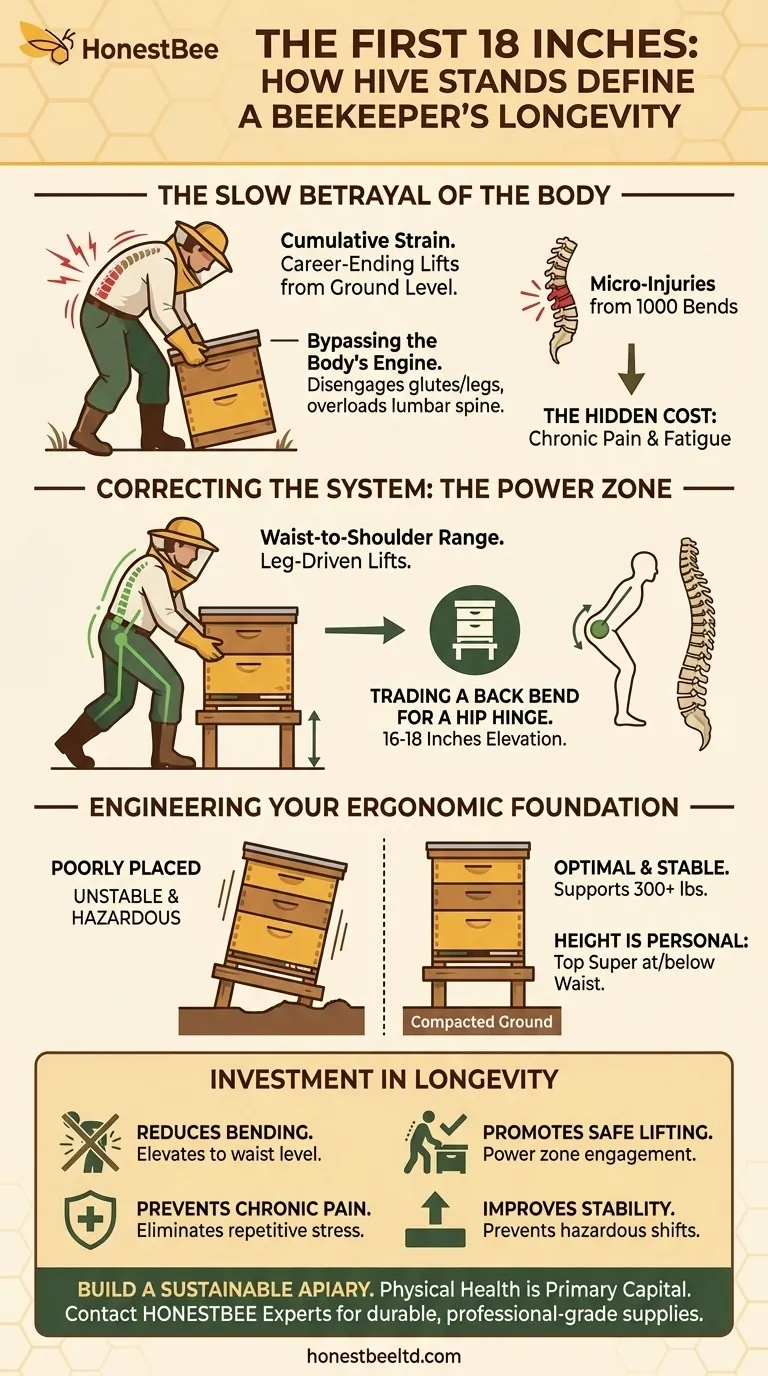
A deep super saturated with honey can weigh over 70 pounds. When you lift that mass from ground level, your body is forced into its most vulnerable position: a rounded lower back.
This posture switches off your body’s most powerful muscles—the glutes and legs—and transfers the entire load into the small, delicate muscles and ligaments of your lumbar spine. It’s the equivalent of trying to tow a car with a bicycle chain. The system is destined to fail.
The Hidden Cost of a Thousand Bends
The heavy lifts are only half the story. The daily work of beekeeping is a routine of inspection—a thousand small bends to check frames, monitor the queen, and assess colony health.
When the hive is on the ground, each of these movements is a micro-injury. It’s a repetitive, cumulative stress that leads to chronic inflammation, persistent pain, and the kind of fatigue that leaches the joy out of the work.
Correcting the System, Not the Symptom
A hive stand is not a luxury accessory. It is a piece of foundational engineering that corrects the entire ergonomic system of your apiary.
Entering the "Power Zone"
The safest and most powerful range of motion for the human body is the space between the waist and the shoulders. This is our "power zone," where our spine is neutral and our largest muscles can be properly engaged.
A hive stand simply elevates the work into this zone. The top boxes—the ones you interact with most frequently—are now positioned where your body is strongest. You are no longer fighting gravity; you are working with it.
Trading a Back Bend for a Hip Hinge
By raising the hive just 16 to 18 inches, the need for a deep squat or a dangerous back bend vanishes. Instead, you can adopt a slight knee bend and a "hip hinge."
This is the body’s natural and powerful bending pattern, the same one used by a weightlifter performing a deadlift. It keeps the spine straight and protected, letting the powerful engine of your hips and legs do the work.
Engineering Your Ergonomic Foundation
Implementing this system requires thoughtful design. A poorly chosen or placed stand can create new problems.
Height is Personal, Not Universal
The optimal hive stand height is determined by the beekeeper's body. The goal is to place the top of the highest super at or just below your waist. This allows for clear visibility during inspections without hunching and safe handholds for lifting.
Stability is a Prerequisite, Not a Feature
An unstable hive stand is an active hazard. It can shift during a heavy lift, leading to injury and a defensive, agitated colony. The foundation must be level, compacted, and built from materials that can support over 300 pounds without question. For commercial operations, stability means predictability and safety.
| Benefit | Ergonomic Impact |
|---|---|
| Reduces Bending | Elevates hive to waist level, minimizing strain on the lower back. |
| Promotes Safe Lifting | Brings heavy boxes into your 'power zone' for leg-driven lifts. |
| Prevents Chronic Pain | Eliminates repetitive deep bending during routine inspections. |
| Improves Stability | A sturdy platform prevents hazardous shifts while working. |
An Investment in Longevity
Viewing ergonomics as a luxury is a short-sighted calculation. For a commercial apiary or serious beekeeper, physical health is the primary capital asset. A single back injury can cost weeks of lost productivity, far exceeding the investment in proper equipment.
Building an ergonomic apiary is an investment in sustainability—for your body and your business. At HONESTBEE, we equip commercial apiaries and distributors with durable, stable hive stands and other professional-grade supplies designed for safety and efficiency at scale. Let us help you build an operation that will last as long as your passion.
To build a safer, more sustainable apiary, Contact Our Experts.
Visual Guide
Related Products
- Metal Hive Feet Bee Hive Stand for Ant Protection
- Plastic Bee Hive Stand for Beekeeping
- Metal Bee Hive Stand Bee Box Stand for Beekeeping
- Professional Ant-Proof Beehive Stand with Integrated Moat for Beekeeping
- Plastic Bee Frame Beekeeping Hive Frames for Wholesale
Related Articles
- How to Stabilize Beehive Stands in Wet Soil: Proven Techniques for Beekeepers
- Beyond the Box: How a Simple Stand Prevents Compounding Failures in Beekeeping
- The Unseen Foundation: Why a Beehive Stand Dictates Your Apiary's Success
- The Unseen Architecture of a Productive Apiary: Why Your Beehive Stand Height is a System Design Choice
- How to Choose and Install a Beehive Stand for Pest Control and Colony Health