The Sound of a Bad Day
Every experienced beekeeper knows the sound. It's not the gentle hum of a happy colony. It’s the sharp, cracking snap of a propolis seal breaking under the force of a hive tool, followed by a low, angry roar that builds from within.
This single, violent moment sends a shockwave through the entire colony. It’s an earthquake and a home invasion all at once. What should be a calm, methodical inspection has just begun with an act of war.
The root of this conflict isn't aggression. It's a fundamental misunderstanding between the beekeeper's goals and the bees' biology. The solution is a deceptively simple piece of equipment: the inner cover.
The Logic of "Bee Glue"
Bees are master architects and obsessive defenders of their home. They use a substance called propolis—a sticky, antimicrobial resin collected from plants—to seal every crack and seam in their hive.
This "bee glue" is a biological imperative. It keeps out drafts, repels water, prevents disease, and strengthens the hive's structure.
But when a beekeeper places a heavy, telescoping outer cover directly on the top hive body, the bees do what they are programmed to do. They weld it shut with propolis. In the heat of summer, this bond can become as strong as cement.
Prying it open requires force. Force creates vibration and noise. And that creates a defensive, stressed, and difficult-to-manage colony.
The Inner Cover as a System Interface
The inner cover is not just a second lid. It is an interface. It's a thin, lightweight barrier that completely changes the beekeeper's interaction with the hive.
Breaking the Seal, Not the Peace
Bees will still propolize the inner cover to the hive body below. But the seal is on a much smaller, lighter surface.
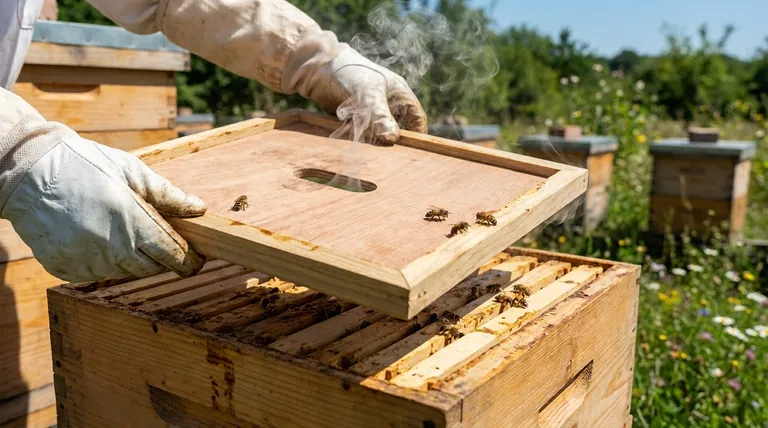
Breaking this seal requires a gentle nudge with the hive tool, not a jarring pry. The sound is a quiet pop, not a violent crack. The colony is barely disturbed. The beekeeper can proceed with a calm inspection, working with the bees, not against them.
A Tool for Communication
A calm inspection is a safe and productive inspection. The inner cover facilitates this with its central hole or notched rim.
Before removing the inner cover, a beekeeper can puff a small amount of smoke through this opening. It’s the equivalent of knocking on the door before entering. The smoke gently pacifies the guard bees, giving them a moment to prepare. When the inner cover is finally lifted, the colony is calm and receptive, not boiling out in a defensive rage.
An Elegant Solution to Multiple Problems
While managing propolis is its primary function, the inner cover's elegant design solves other critical hive management challenges. It turns the top of the hive into a multi-function control panel.
Regulating the Microclimate
The hole or notch isn't just for smoke; it's a crucial ventilation port. It allows excess moisture from the bees' respiration to escape. In winter, this is a life-saving feature. It prevents warm, moist air from condensing and dripping back down onto the cluster—a scenario that can be fatal.
A Platform for Provisioning
The central hole is perfectly sized to serve as a port for feeding. A jar of syrup can be placed directly over the opening, allowing the bees access to food with minimal exposure to the elements or robbers. The hive remains sealed and secure, and the feeding process is efficient and low-stress for the colony.
The Complete System: Two Covers, Two Jobs
The inner and outer covers are a system designed to work in tandem. Using only an outer cover is like using a hammer for every job in the toolbox.
| Component | Primary Function | Purpose |
|---|---|---|
| Inner Cover | Beekeeper Interface & Climate Control | Manages propolis, allows calm entry, provides ventilation, and supports feeding. |
| Outer Cover | External Weather Shield | Protects the entire hive and its wooden components from rain, sun, and snow. |
Ignoring the inner cover sacrifices control, creates stressful inspections, and compromises the hive's ability to manage its internal climate.
For commercial apiaries where efficiency and colony health are paramount, this system is not a luxury; it is the foundation of scalable, sustainable beekeeping. The integrity of that system relies on durable, precision-crafted components. At HONESTBEE, we supply the high-quality beekeeping equipment, including robust inner covers, that professional operations depend on to maintain calm and productive colonies season after season.
To ensure your hives are equipped with the best interface for effective management, Contact Our Experts
Visual Guide

Related Products
- Inner Beehive Cover for Beekeeping Bee Hive Inner Cover
- Professional Insulated Winter Hive Wrap for Beekeeping
- Telescopic Beehive Outer Cover Lid Roof with Galvanised Sheeting for Langstroth Hive and Beehive Outer Cover
- Professional Insulated Plastic Bee Hives
- Stainless Steel Round Beehive Air Vents for Ventilation
Related Articles
- How Beehive Inner Covers Protect Colonies and Simplify Beekeeping
- How to Secure Beehive Covers: Weatherproof Strategies for Every Hive Type
- How Inner Covers Optimize Hive Health Through Every Season
- Beyond Warmth: The Physics of Beehive Survival in Winter
- The Paradox of Warmth: Why a Beehive Must Breathe to Survive Winter