It’s a sight that makes every commercial beekeeper’s heart sink: a thick, buzzing cloud of bees—your bees—swirling into the air, preparing to leave. That isn't just a colony dividing; it’s the sound of your honey production, pollination contracts, and future profits taking flight.
Every spring, the same anxiety arrives. You watch your strongest, most promising hives—the very ones you count on for performance—become the most likely to swarm. Why does this happen, and why does it feel like you’re always one step behind?
The Spring Scramble: Why Common Fixes Fall Short
For commercial apiaries, swarming isn't a quaint natural event; it's a significant operational and financial problem. A single swarm represents:
- A Depleted Workforce: The departing bees take half the colony's population, crippling its ability to capitalize on the main nectar flow.
- Lost Production: The remaining colony must focus on raising a new queen and rebuilding, delaying honey production for weeks.
- Direct Replacement Costs: The lost bees and queen represent a tangible asset that must be replaced, costing time and money.
In response, many beekeepers find themselves in a reactive cycle. You might add honey supers, hoping to provide more room. You might perform emergency splits once you spot swarm cells, but by then, the impulse is already in motion. You feel like you're constantly playing defense, fighting against the bees' natural instincts.
These methods often fail because they are temporary patches on a much deeper issue. They address the symptoms—the swarm cells, the crowded hive—but not the fundamental trigger.
The Real Culprit: It’s Not an Urge, It’s an Eviction Notice
The primary driver behind swarming isn't a mysterious instinct to leave. It's a simple, predictable problem of logistics and real estate. To understand it, you have to think like a bee colony in early spring.
The Upward Winter March
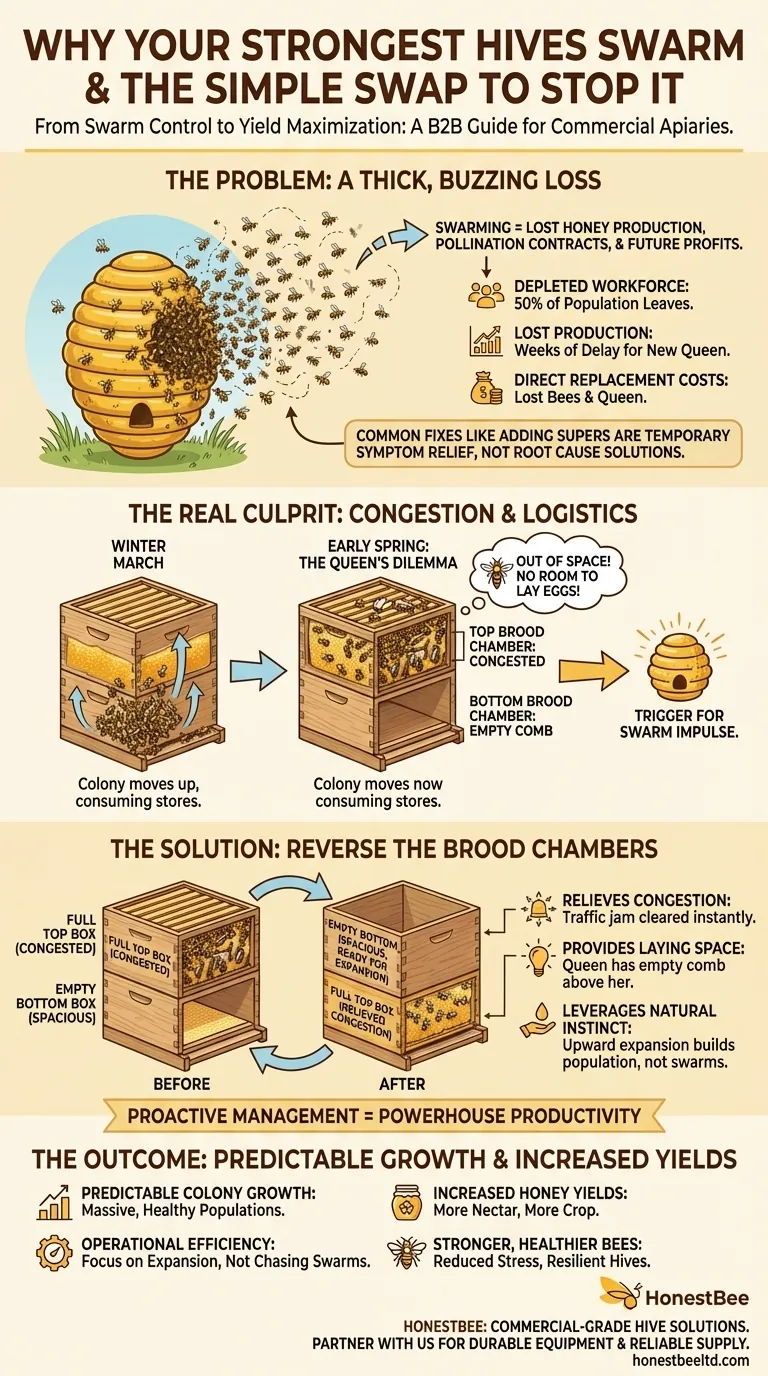
Throughout the winter, the colony consumes its honey stores, slowly and steadily moving upward through the hive. By the time warm weather arrives, the entire cluster, including the queen, is concentrated in the top brood chamber. This box is now packed with bees, the last of the winter stores, and the first rounds of new spring brood.
The Queen’s Dilemma
As the days get longer, the queen’s instinct is to ramp up egg-laying to build the workforce for the season. But where can she lay? The top box is congested. She becomes "honey bound" or "brood bound," with no empty cells available. Meanwhile, the bottom brood chamber, which the bees have vacated, is full of perfect, empty comb. The bees, however, are naturally driven to expand upward, not down.
From the colony's perspective, the message is clear: "We're out of space." This congestion is the single most powerful trigger for the swarm impulse. The colony decides its only option for survival and propagation is to divide.
This is why just adding a honey super on top often doesn't work. The problem isn't a lack of space in the hive; it's a lack of usable, adjacent space in the brood nest where the queen is active.
The Solution in Your Hands: Aligning with Bee Biology
Once you understand the root cause is an upward-moving colony running out of upward-moving space, the solution becomes incredibly logical. You don't need to fight the bees' instinct; you need to work with it.
The technique is called reversing the brood chambers.
By simply swapping the position of the two brood boxes, you move the congested top box to the bottom and place the spacious, empty bottom box on top. This single action accomplishes three things instantly:
- It relieves the congestion: The traffic jam in the brood nest is immediately cleared.
- It provides laying space: The queen has a whole box of empty comb right where she wants it—above her.
- It leverages natural instinct: The colony continues its natural upward expansion, channeling its energy into building population instead of preparing to swarm.
This proactive maneuver transforms a hive on the brink of swarming into a powerhouse of productivity. But to execute this strategy effectively across dozens or hundreds of hives, you need equipment built for the job. Frequent manipulation requires durable, precisely manufactured brood chambers that can withstand the rigors of commercial use, season after season. This is where having a reliable supply partner becomes critical. HONESTBEE specializes in providing commercial-grade hive bodies and components that are designed for exactly these kinds of essential management techniques.
From Swarm Control to Yield Maximization
When you shift from reactively catching swarms to proactively managing space, the entire dynamic of your operation changes. You are no longer a firefighter; you are an architect, guiding your colonies toward peak performance.
Resolving the swarm problem before it begins unlocks new potential for your business:
- Predictable Colony Growth: Build massive, healthy populations that are ready for the main nectar flow.
- Increased Honey Yields: Stronger colonies gather more nectar, directly boosting your honey crop per hive.
- Operational Efficiency: Your time is freed up from chasing swarms to focus on apiary expansion and other high-value tasks.
- Stronger, Healthier Bees: Proper space management reduces stress on the colony, leading to more resilient and productive hives.
Mastering techniques like hive reversal is a critical part of building a profitable and resilient commercial apiary. Equally important is having the reliable, high-quality equipment needed to implement these strategies at scale. By understanding the 'why' behind the bees' behavior, you can turn their powerful natural instincts into your greatest asset.
Our team understands the unique challenges and demands of commercial beekeeping, from swarm prevention to supply chain reliability. Let's discuss how our wholesale equipment supply can help you build a more productive and predictable operation. Contact Our Experts to explore solutions for your apiary.
Visual Guide
Related Products
- Durable Plastic Hive Number Set for Beekeeping
- Stainless Steel Round Beehive Air Vents for Ventilation
- HONESTBEE Professional Hive Top Bee Feeder Feeding Solution
- Professional Large-Format Hive Number Set for Beekeeping
- HONESTBEE Professional Long Handled Hive Tool with Precision Cutting Blade
Related Articles
- Hive Thermodynamics: The Unseen Clock Governing Winter Survival
- How Beekeepers Can Diagnose Queen Issues and Prevent Colony Collapse
- The Tipping Point: Managing the Psychology of a Beehive to Prevent Swarming
- The Material Calculus: A Beekeeper's Choice Between Nature and Durability
- Rethinking the Beehive: Why Material Choice is a Bet on Your Time and Sanity