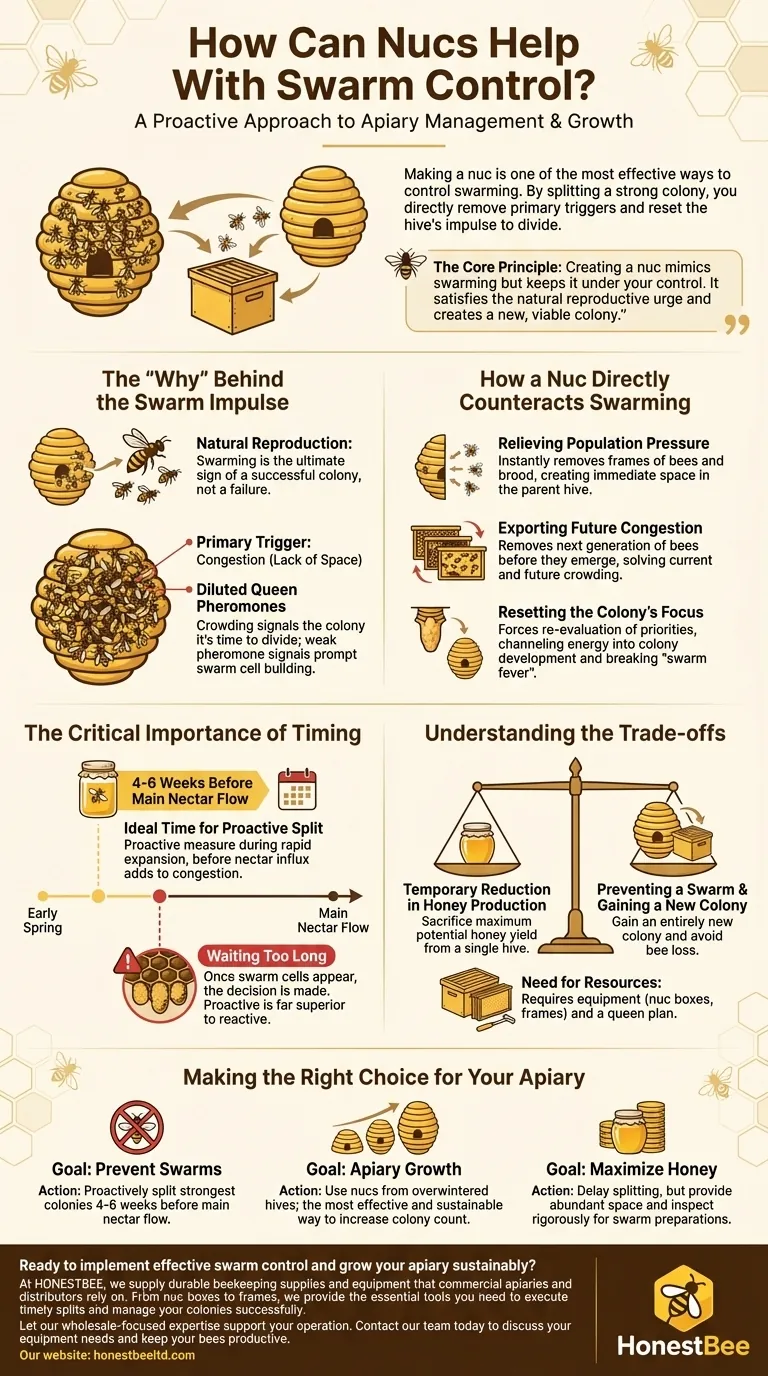
Making a nuc is one of the most effective ways to control swarming. By splitting a strong, congested colony into two separate units, you directly remove the primary triggers that cause bees to swarm. This proactive measure reduces the population density and creates more space, effectively resetting the colony's impulse to divide and leave the hive.
The core principle is simple: creating a nuc mimics the act of swarming but keeps it under your control. You satisfy the colony's natural reproductive urge to divide, preventing the loss of bees while simultaneously creating a new, viable colony.
The "Why" Behind the Swarm Impulse
Understanding Natural Reproduction
Swarming is not a sign of a failing colony; it is the ultimate sign of a successful one. It is the natural method by which honey bee colonies reproduce.
The old queen leaves with roughly half of the worker bees to establish a new home, while the original colony raises a new queen to continue its legacy.
The Primary Swarm Trigger: Congestion
The single greatest stimulus for swarming is nest congestion. When the hive becomes too crowded, several things happen.
The queen runs out of space to lay eggs, and workers run out of space to store nectar and pollen. This lack of room signals to the colony that it has reached its capacity and it is time to divide.
The Role of Queen Pheromones
A queen bee produces pheromones that signal her presence and vitality throughout the hive. In an overcrowded colony, these pheromones become diluted and cannot circulate effectively.
This weakened signal tells the worker bees that the colony is large enough to support a second queen, prompting them to begin building swarm cells to raise a new one.
How a Nuc Directly Counteracts Swarming
Relieving Population Pressure
The most direct benefit of creating a nuc is the immediate reduction in population. By removing several frames of bees and brood, you instantly create more space within the parent hive.
This alleviates the intense crowding that triggers the swarm impulse in the first place.
Exporting Future Congestion
When you pull frames for a nuc, you are not just removing adult bees; you are removing frames of capped brood.
These are the next generation of bees that would soon emerge and contribute to the hive's congestion. Removing them preemptively solves not only the current problem but the future one as well.
Resetting the Colony's Focus
By splitting the colony, you force it to re-evaluate its priorities. The parent hive may need to raise a new queen, and the new nuc is focused entirely on establishing itself.
This effectively breaks the "swarm fever" and channels the bees' energy back into colony development rather than reproduction.
The Critical Importance of Timing
Split Before the Nectar Flow
The references are clear: the ideal time to make a split for swarm control is four to six weeks before the main nectar flow.
This is the period when the colony's population is rapidly expanding but before the massive influx of nectar adds to the congestion problem. Acting during this window is proactive, not reactive.
The Danger of Waiting Too Long
If you wait until you see fully developed swarm cells, the colony's decision to swarm has likely already been made.
While a split can still prevent the loss of bees at this stage, it is far more effective to act before the impulse becomes irreversible. Proactive management is always superior to last-minute emergency measures.
Understanding the Trade-offs
A Temporary Reduction in Honey Production
Splitting your strongest colony right before the honey flow will reduce its foraging workforce. This is an unavoidable trade-off.
You are sacrificing the maximum potential honey yield from a single hive in exchange for preventing a swarm and gaining an entirely new colony.
The Need for Resources
Creating nucs isn't free. It requires additional equipment, including nuc boxes, frames, and a plan for ensuring the new unit has a queen.
Beekeepers must have these resources on hand to execute a split effectively when the time is right.
Making the Right Choice for Your Apiary
A well-timed split is a cornerstone of responsible and sustainable beekeeping. The decision of when and how to do it depends entirely on your goals.
- If your primary focus is preventing swarms: Proactively split your strongest colonies 4-6 weeks before the main nectar flow to relieve pressure.
- If your primary focus is apiary growth: Using nucs made from your own overwintered hives is the most effective and sustainable way to increase your colony count.
- If your primary focus is maximizing honey: You may choose to delay splitting, but you must provide colonies with abundant space and inspect them rigorously for swarm preparations.
Using a nuc for swarm control is the mark of a beekeeper who understands bee biology and works with it, not against it.
Summary Table:
| Key Benefit of Nucs for Swarm Control | How It Works |
|---|---|
| Relieves Population Pressure | Removes frames of bees and brood to instantly create more space in the parent hive. |
| Exports Future Congestion | Takes away capped brood, preventing the next generation of bees from causing overcrowding. |
| Resets Colony Focus | Splits the colony's energy away from swarming and back into development. |
| Ideal Timing | Most effective when done 4-6 weeks before the main nectar flow. |
Ready to implement effective swarm control and grow your apiary sustainably?
At HONESTBEE, we supply the durable beekeeping supplies and equipment that commercial apiaries and distributors rely on. From nuc boxes to frames, we provide the essential tools you need to execute timely splits and manage your colonies successfully.
Let our wholesale-focused expertise support your operation. Contact our team today to discuss your equipment needs and keep your bees productive.
Visual Guide
Related Products
- Automatic Heat Preservation 6 Frame Pro Nuc Box for Honey Bee Queen Mating
- Styrofoam Mini Mating Nuc Box with Frames Feeder Styrofoam Bee Hives 3 Frame Nuc Box
- 5 Frame Wooden Nuc Box for Beekeeping
- 5 Frame Langstroth Poly Nuc Corrugated Plastic Nuc Boxes
- Professional Grade Foldable Beehive Handles
People Also Ask
- What are the options for adding frames to a nuc after taking two frames from the parent colony?
- How are nuc boxes used in queen rearing? The Essential Tool for Reliable Queen Mating
- What steps are involved in transferring frames from the nuc box to the hive? A Guide for a Smooth, Low-Stress Colony Move
- What is the process for managing a new bee colony started in a nuc box? Expert Tips for Hive Success
- How long can bees be kept in a nuc box? Expert Timeline for Hive Transfer