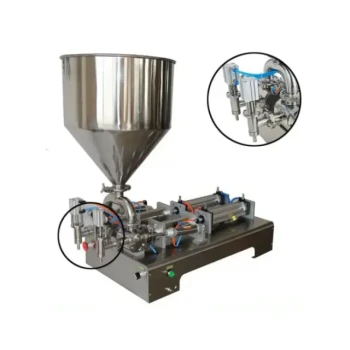
Automated filling production lines drive economic efficiency by transforming raw honey into high-value commercial goods through precise, hygienic packaging. These systems rely on accurate volume and weight controls to drastically minimize material loss while ensuring the sterility required for premium market positioning.
By replacing manual processes with closed-loop automation, producers transition from selling low-margin raw resources to high-margin branded products. The economic gain stems not just from speed, but from the elimination of waste and the guarantee of consistent, export-grade quality.
Transforming Raw Resources into Commercial Value
To understand the economic impact, you must look beyond simple speed. The primary value driver is the shift from bulk commodity handling to precision manufacturing.
Minimizing Material Loss through Precision
Manual packaging invariably leads to inconsistency—overfilling jars cuts into profit margins, while underfilling risks regulatory fines.
Automated systems utilize high-precision fluid control technology to enforce exact weight or volume limits. By eliminating spillage and overfills, you maximize the sellable units yielded from every batch of raw harvest.
Standardizing Product Consistency
Retail markets and large-scale distributors demand uniformity.
Automation ensures that every unit is identical in fill level and seal quality, creating a professional brand appearance. This consistency allows producers to move away from small-scale, irregular sales and enter larger, more lucrative retail supply chains.
Operational Efficiency and Scalability
Economic efficiency is also a function of throughput—how quickly you can convert raw inventory into cash.
Accelerating Market Turnover
Automated machinery facilitates the rapid conversion of bulk raw honey into retail-ready commodities.
This high-speed processing reduces the time inventory sits in storage. Faster production cycles improve cash flow by increasing market turnover efficiency for distributors and apiaries.
Reducing Reliance on Manual Labor
Traditional honey packaging is labor-intensive and slow.
By integrating extraction, filtration, and bottling into a single automated line, producers significantly reduce manual labor costs. This shifts operational interaction from manual handling to system monitoring, allowing for higher volume production without a linear increase in headcount.
Quality Control as an Economic Asset
In food production, hygiene is not just a safety requirement; it is an economic safeguard against product recall and spoilage.
Preventing Secondary Contamination
Manual packaging introduces significant risks of introducing bacteria or foreign particles.
Automated lines utilize closed-loop operations and hygienic-grade sealing to isolate the honey from the environment. This prevents secondary contamination, preserving the honey's nutritional integrity and flavor, which protects the brand's reputation and prevents costly wasted batches.
Accessing Export Markets
High-value international markets have strict hygiene regulations.
Industrial-grade automated systems provide the sterile environment necessary to comply with international standards. This hardware capability effectively unlocks new, higher-paying global revenue streams that are inaccessible to manual operations.
Understanding the Trade-offs
While automation drives efficiency, it introduces new complexities that must be managed to ensure a positive Return on Investment (ROI).
Capital Expenditure vs. Volume
Automation requires a significant upfront investment in hardware.
This expenditure is only economically viable if your production volume is high enough to lower the cost-per-unit over time. For very small batch producers, the depreciation of the machinery may outweigh the efficiency gains.
Technical Maintenance Requirements
Moving from manual to automated lines shifts the skill requirement of your workforce.
You reduce general labor but increase the need for technical maintenance. Downtime on an automated line halts all production, making preventative maintenance and technical expertise critical to sustaining economic efficiency.
Making the Right Choice for Your Goal
The level of automation you deploy should match your specific commercial objectives.
- If your primary focus is Maximizing Yield per Batch: Prioritize machines with high-precision metering and fluid control to eliminate "giveaway" weight and material waste.
- If your primary focus is Export and Large Retail: Invest in fully enclosed, closed-loop systems that guarantee the sterility and hygiene standards required for international compliance.
True economic efficiency in honey production is achieved when you stop treating packaging as a chore and start treating it as a precision manufacturing process.
Summary Table:
| Economic Driver | Manual Process | Automated Production Line | Impact on Efficiency |
|---|---|---|---|
| Material Loss | High (Overfills/Spills) | Minimal (High-Precision Control) | Increases units per batch |
| Hygiene & Safety | Risk of Contamination | Sterile Closed-Loop System | Access to export markets |
| Labor Costs | High per-unit labor | Low (System Monitoring) | Reduced operational overhead |
| Market Consistency | Irregular/Variable | Standardized Retail-Grade | Enhanced brand reputation |
| Throughput Speed | Slow & Capped | High-Speed Scalability | Faster cash flow turnover |
Scale Your Apiary Operations with HONESTBEE
Transition from bulk honey handling to a high-margin precision manufacturing powerhouse. HONESTBEE specializes in empowering commercial apiaries and global distributors with the industrial tools needed for market dominance.
Our comprehensive wholesale portfolio includes:
- Advanced Machinery: High-precision honey-filling machines and automated hive-making equipment.
- Full-Spectrum Supplies: Essential beekeeping tools, hardware, and industry consumables.
- Retail Growth: Professional packaging solutions and honey-themed cultural merchandise.
Whether you are looking to eliminate material waste or unlock lucrative export markets, our team provides the technical expertise and hardware to optimize your production line.
Contact HONESTBEE Today to discover how our specialized equipment can drive your business's economic efficiency.
References
- Agussalim Agussalim, I Gede Suparta Budisatria. The Type of Honeybees Forages in District of Pakem Sleman and Nglipar Gunungkidul Yogyakarta. DOI: 10.21059/buletinpeternak.v42i1.28294
This article is also based on technical information from HonestBee Knowledge Base .
Related Products
- Fully Automatic Honey Filling Packaging Machine for Processing Line
- Automatic Honey Filling and Filtering Machine for Beekeeping Bottle Filling
- Precision Automated Packaging Turntable Honey Spoon Filling Sealing Packing Machine
- Precision Durable Efficient HONESTBEE Rotary Honey Filling Machine
- Semi Automatic Small Honey Bottle Filling Machine Honey Filler
People Also Ask
- Why are fully automatic honey filling and packaging lines essential? Boost Your Honey's Market Value and Quality
- What is a fully-automatic honey filler? Streamline Your Production with High-Precision Automation
- How do automated honey filling and packaging machines affect profitability? Boost Margins with HONESTBEE Technology
- How do automated honey filling and packaging machines contribute to the market value of honey products? Maximize Your ROI
- How do industrial-grade automated honey filling and packaging machines mitigate the risk of physical contamination?