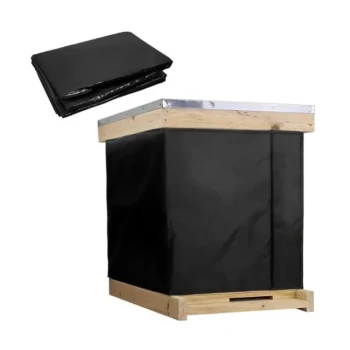
Beekeepers manage winter environments by systematically combining internal volume reduction with external thermal barriers. The primary method involves removing empty honey supers to minimize the dead air space the colony must manage, followed by installing protective hive covers once nighttime temperatures consistently drop below 50 degrees Fahrenheit (10 degrees Celsius). This dual approach allows the bees to cluster more efficiently, preserving heat and protecting the hive from harsh environmental conditions.
Winter management is fundamentally about energy conservation rather than heat generation. By reducing the physical space and applying materials with high thermal resistance, beekeepers stabilize the colony's core temperature, which directly lowers metabolic stress and food consumption.
Reducing Internal Volume
The first step in winter preparation focuses on the internal physics of the hive.
Minimizing Heat Loss
Beekeepers must remove empty honey supers before winter sets in.
This reduces the total internal volume of the hive. By eliminating this excess space, the colony does not waste energy attempting to manage a large, cold void.
Enhancing Cluster Efficiency
Bees survive winter by forming a tight cluster to generate warmth.
Reducing the hive volume assists this natural behavior. It allows the colony to focus their collective energy entirely on clustering for warmth rather than battling ambient air currents in a large box.
External Insulation and Protection
Once the internal volume is optimized, beekeepers apply external defenses to shield the colony.
The Timing of Installation
Insulation should not be applied arbitrarily.
Standard practice dictates installing hive covers when nighttime temperatures consistently fall below 50°F (10°C). This timing ensures protection arrives exactly when the colony's natural thermoregulation needs support.
Utilizing Thermal Resistance
Modern management often involves specialized winter insulation wraps.
These materials are selected for their high thermal resistance properties. They act as a barrier that significantly reduces heat loss from the beehive to the outside environment.
Stabilizing Core Temperature
In cold climates, external wraps help the colony maintain a stable core temperature.
This stability is critical for preventing rapid temperature fluctuations that can break the cluster or freeze the bees.
Biological Impacts and Benefits
The goal of insulation extends beyond simple warmth; it is a resource management strategy.
Lowering Food Consumption
A well-insulated hive requires less energy to stay warm.
Because the bees burn fewer calories generating heat, their food consumption drops. This preservation of food stores is often the deciding factor in preventing starvation during long winters.
Promoting Spring Recovery
Insulation sets the stage for the next season.
Colonies that are not stressed by extreme cold or starvation are healthier. They are better positioned to recover and expand quickly once spring arrives.
Understanding the Trade-offs
While insulation is vital, it must be applied correctly to be effective.
Volume vs. Insulation
Applying insulation without reducing the hive volume is inefficient.
External wraps cannot fully compensate for a hive that is too large for the cluster. The reduction of internal space is a prerequisite for the external insulation to work effectively.
Dependency on Stores
Insulation reduces consumption, but it does not eliminate the need for food.
A warm hive with no food will still starve. Beekeepers must view insulation as a tool to stretch food stores, not a replacement for ensuring the hive is adequately stocked with honey.
Making the Right Choice for Your Goal
Effective winter management requires aligning your strategy with the specific threats your colony faces.
- If your primary focus is preventing starvation: Prioritize volume reduction to minimize the energy expenditure required for the bees to maintain heat.
- If your primary focus is rapid spring growth: Invest in specialized high-resistance hive wraps to maintain a stable core temperature that preserves bee health and vitality.
Success in wintering bees lies in creating an environment where the colony spends its energy on survival, not on heating empty space.
Summary Table:
| Winter Management Strategy | Action Taken | Primary Benefit |
|---|---|---|
| Internal Volume Reduction | Removing empty honey supers | Minimizes dead air space and heat loss |
| External Insulation | Applying high-resistance wraps | Shields against wind and stabilizes core temperature |
| Strategic Timing | Install when nights < 50°F (10°C) | Ensures thermal support aligns with cluster formation |
| Resource Conservation | Maintaining stable temperatures | Lowers metabolic stress and food consumption |
| Spring Preparation | Reducing colony stress | Accelerates hive recovery and spring expansion |
Secure Your Apiary’s Success with HONESTBEE
Transitioning your colony through winter requires more than just technique—it requires professional-grade equipment. HONESTBEE provides commercial apiaries and distributors with high-performance beekeeping tools, specialized hive-making machinery, and essential consumables designed to withstand the harshest climates.
Whether you are looking for bulk wholesale supplies or advanced honey-processing equipment, we deliver the reliability your business needs to ensure rapid spring recovery and long-term vitality.
Ready to scale your production? Contact us today to explore our comprehensive hardware portfolio and industry-leading beekeeping solutions!
Related Products
- Telescopic Beehive Outer Cover Lid Roof with Galvanised Sheeting for Langstroth Hive and Beehive Outer Cover
- Professional Insulated Winter Hive Wrap for Beekeeping
- Inner Beehive Cover for Beekeeping Bee Hive Inner Cover
- Metal Bee Hive Stand Bee Box Stand for Beekeeping
- Metal Hive Feet Bee Hive Stand for Ant Protection
People Also Ask
- What is a telescoping outer cover and what are its advantages? Maximize Hive Protection in Harsh Climates
- What is the function of an outer telescoping cover on a beehive? Ultimate Weather Protection for Your Colony
- What is the purpose of the outer telescoping cover in a beehive? The Key to Weatherproofing Your Hive
- What are the benefits of the telescoping outer cover? Essential Protection for Hive Health & Longevity
- How should a telescoping outer cover be removed? Expert Techniques for Smooth Beekeeping Operations