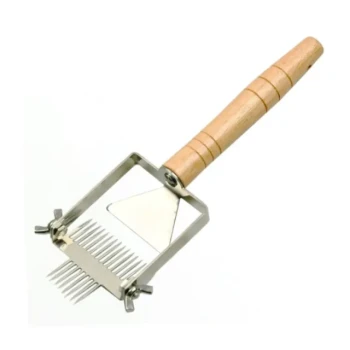
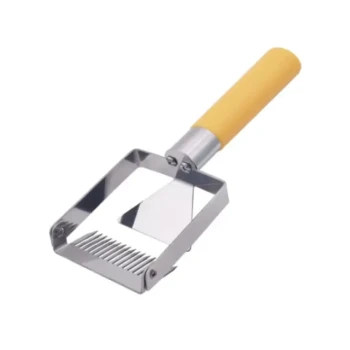
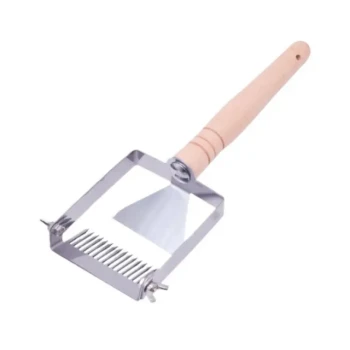
In traditional honey extraction, the synergy between mulberry wood pincers and cheesecloth creates a highly effective, low-tech system for separating liquid honey from solid wax. The process works by wrapping the honeycombs in cheesecloth and using the pincers to apply significant mechanical pressure; the pincers provide the force necessary to crush the comb, while the cheesecloth acts as a permeable barrier that allows the liquid to escape while retaining the solids.
The core principle of this method is the simultaneous application of compression and filtration. By combining the crushing force of the pincers with the sieving capability of the cloth, the harvester achieves immediate solid-liquid separation in a single step.
The Mechanics of Extraction
Applying Mechanical Pressure
The primary function of the mulberry wood pincers is to act as a lever for applying force.
Because honeycombs are structurally dense, they require significant pressure to release their contents. The pincers allow the operator to apply a squeezing action that physically collapses the comb structure.
Forcing Liquid Flow
This mechanical compression is what drives the movement of the fluid.
As the pincers squeeze the bundle, the internal pressure forces the viscous honey out of the crushed wax cells. The pincers effectively translate manual effort into hydraulic flow.
The Role of Filtration
Containing the Solids
Before any pressure is applied, the honeycombs are tightly wrapped in cheesecloth.
This fabric serves as a containment unit. It keeps the wax, propolis, and other solid debris confined within the bundle during the chaotic crushing process.
Facilitating Separation
The weave of the cheesecloth is critical to the process's efficiency.
It is porous enough to allow the liquid honey to pass through freely under the pressure of the pincers. However, it is tight enough to block the solid wax particles, resulting in a filtered product immediately upon extraction.
Understanding the Trade-offs
Simplicity vs. Automation
This method utilizes simple mechanical means rather than complex machinery.
The advantage is that it requires no electricity or advanced equipment. However, it relies entirely on the physical mechanics of the tools, meaning the efficiency of the extraction depends heavily on the proper application of force via the pincers.
Integrated Processing
A distinct benefit is that extraction and filtration happen at the exact same time.
However, this also means the two steps cannot be decoupled. You cannot squeeze the comb without the cloth, or the honey would be full of debris; the tools must always be used in tandem to be effective.
Making the Right Choice for Your Goal
This traditional technique represents a balance between mechanical force and material science.
- If your primary focus is low-tech efficiency: This method provides a reliable way to extract honey using only simple, durable tools without the need for power.
- If your primary focus is product clarity: The cheesecloth ensures that solid impurities are removed instantly as the honey is harvested, eliminating the need for a separate initial filtering stage.
This combination proves that efficient solid-liquid separation can be achieved through the intelligent application of basic mechanical principles.
Summary Table:
| Component | Primary Function | Mechanical Role |
|---|---|---|
| Mulberry Wood Pincers | Applying Mechanical Pressure | Acts as a lever to crush honeycomb and drive liquid flow. |
| Cheesecloth | Solid-Liquid Separation | Serves as a permeable barrier to retain wax while filtering honey. |
| Combined System | Integrated Extraction | Simultaneous compression and sieving for immediate debris-free honey. |
Elevate Your Honey Production with HONESTBEE
Whether you are preserving traditional techniques or scaling up with modern automation, HONESTBEE is your dedicated partner in beekeeping excellence. We empower commercial apiaries and distributors worldwide with a robust wholesale portfolio including:
- Precision Machinery: Hive-making equipment and professional honey-filling machines.
- Essential Hardware: A full spectrum of durable beekeeping tools and extraction gear.
- Industry Consumables: Every essential item needed to maintain a thriving apiary.
- Cultural Merchandise: Unique honey-themed products to diversify your brand.
Ready to enhance your efficiency and product quality? Contact us today to discover how our comprehensive equipment solutions can grow your beekeeping business!
References
- Gene Kritsky. Beekeeping on the Island of Andros: An Ethnographic Approach George Speis. DOI: 10.1093/ae/tmx006
This article is also based on technical information from HonestBee Knowledge Base .
Related Products
- Professional Stainless Steel Pry-Bar Hive Tool
- HONESTBEE 2 Frame Manual Acrylic Honey Extractor Beekeeping Equipment
- Stainless Steel 3 Frame Manual Honey Extractor Spinner for Bee Honey Extraction
- Plastic Hand Crank 2 Frame Honey Extractor Low Price
- HONESTBEE 3-Frame Manual Acrylic Honey Extractor
People Also Ask
- What is the function of a professional stainless steel hive tool in IFB? Optimize Your Colony Strength Assessment
- Which technical challenges in hive maintenance are addressed by using a professional stainless steel hive tool?
- What are the primary functions of a stainless steel hive tool? Essential Equipment for Professional Beekeeping
- What are the primary functions of a stainless steel hive tool? Essential Tips for Efficient Apiary Maintenance
- What is the role of professional hive tools in routine apiary maintenance? Expert Tips for Hive Health and Longevity