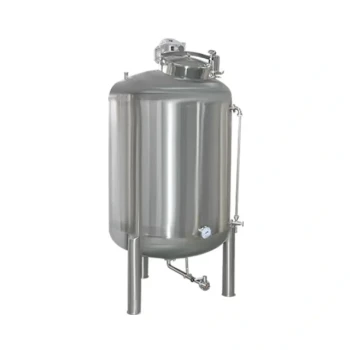
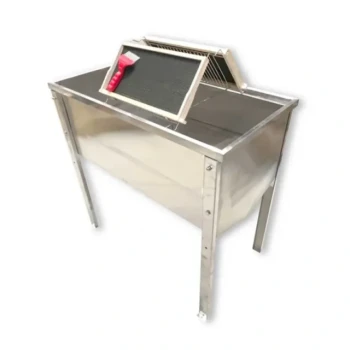
Gravity-driven stratification and mechanical filtration are the two primary mechanisms used to separate honey from beeswax. Settling tanks exploit the fact that beeswax is naturally less dense than honey, causing it to float to the surface for removal, while filtration sieves serve as a final physical barrier to trap remaining fine particles and impurities.
Core Takeaway To achieve commercial-grade clarity, producers rely on a two-step purification process: allowing the raw mixture to rest in settling tanks so wax separates via buoyancy, and subsequently passing the liquid through sieves to mechanically scour fine debris.
The Mechanics of Settling Tanks
Utilizing Density Differences
The fundamental principle behind the settling tank is relative density.
Because beeswax is significantly lighter (less dense) than liquid honey, it naturally rises when the mixture is left undisturbed.
When crushed honeycomb material is placed in these tanks, the wax floats to the top, creating a distinct layer that can be physically skimmed off.
The Importance of Standing Time
Settling is a static process that requires patience to be effective.
Tanks provide the necessary "standing time" for clarification, which can last approximately two weeks depending on the volume and viscosity.
During this period, not only does wax rise, but air bubbles escape to the surface, and heavier impurities may settle at the bottom.
The Role of Filtration Sieves
Mechanical Removal of Debris
While settling removes the bulk of the wax, it often leaves behind microscopic fragments.
Filtration sieves act as a physical barrier to capture these smaller contaminants.
Passing the honey through fine mesh removes residual wax bits, larval debris, and other particulate matter that gravity failed to separate.
Dual-Purpose Iron Sieves
In some processing workflows, iron sieve basins serve a double function.
They are used to filter crude liquid honey to remove honeycomb residues.
Additionally, they can be used during beeswax refining as a heating vessel, allowing pure melted wax to drip through while retaining larger solid impurities.
Understanding the Trade-offs
Time Investment vs. Throughput
The primary trade-off in using settling tanks is speed.
Achieving high clarity through gravity sedimentation is slow, often requiring weeks of static time, which creates a bottleneck in production throughput.
Maintenance and Clogging
Filtration sieves offer faster separation but are prone to mechanical obstruction.
Without prior settling to remove large wax particles, fine sieves will clog rapidly, requiring frequent cleaning and halting the flow of operations.
Making the Right Choice for Your Goal
To select the right separation method, you must balance your need for production speed against your requirements for product clarity.
- If your primary focus is Maximum Clarity: Prioritize a long residence time in settling tanks followed by fine filtration to ensure all air bubbles and micro-wax are removed.
- If your primary focus is Wax Refining: Utilize iron sieve basins in conjunction with a heat source to melt and filter the wax separately from the honey processing line.
By combining the passive power of gravity with the precision of active filtration, you ensure a pure, high-value final product.
Summary Table:
| Mechanism | Primary Tool | Key Process | Main Benefit |
|---|---|---|---|
| Buoyancy | Settling Tank | Density-based stratification (2 weeks) | Removes bulk wax & air bubbles |
| Mechanical | Filtration Sieve | Physical mesh barrier | Captures micro-debris & larval bits |
| Thermal | Iron Sieve Basin | Heating & melting vessel | Refines pure wax from solids |
Elevate Your Apiary Production with HONESTBEE
To achieve premium honey clarity and high-purity beeswax, your operation needs more than just basic tools—it requires professional-grade equipment engineered for efficiency. HONESTBEE specializes in supporting commercial apiaries and distributors with a comprehensive wholesale range of beekeeping machinery.
From industrial-scale settling tanks and clog-resistant filtration systems to specialized honey-filling machines and hive-making hardware, we provide the full spectrum of equipment and consumables needed to scale your business.
Partner with HONESTBEE to streamline your honey processing. Contact our expert team today to discuss your wholesale needs and discover how our specialized machinery can maximize your production value.
References
- Elliud Muli, S. K. Raina. Quality of Honey Harvested and Processed Using Traditional Methods in Rural Areas of Kenya. DOI: 10.2754/avb200776020315
This article is also based on technical information from HonestBee Knowledge Base .
Related Products
- Stainless Steel Honey Storage and Settling Tank with Double Strainer
- Heavy Duty Stainless Steel Honey Processing Machine Decrystallizing Tank
- Stainless Steel Honey Storage Tank with Lid for Honey
- Professional Honey Storage Tank with Agitation System
- Stainless Steel Uncapping Tank with Stand and Strainer
People Also Ask
- What economic role do honey storage tanks play? Boost Your Revenue Through Strategic Inventory Management
- What roles do industrial honey storage tanks and filtration meshes play in processing? Ensure Purity & Consistency
- What is the purpose of a honey storage tank? Streamline Your Honey Processing for Quality & Efficiency
- What role do settling tanks play in honey production? Achieve Pure, High-Clarity Honey Naturally
- Why are large settling tanks used in the honey clarification process? Achieve Natural Purity & Batch Consistency