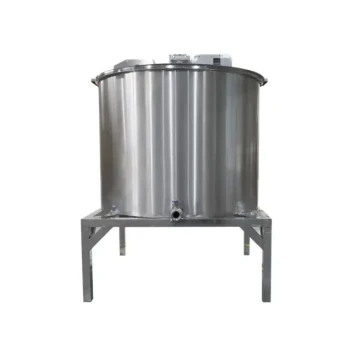
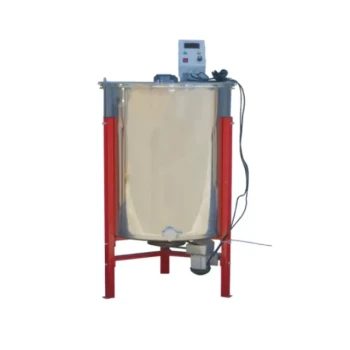
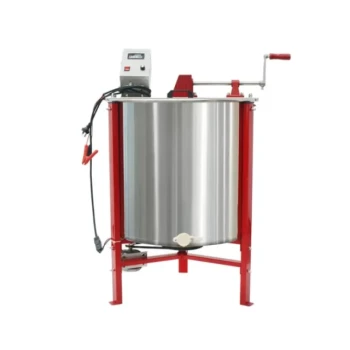
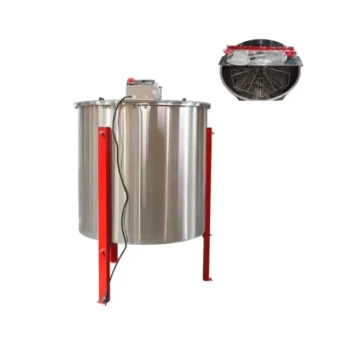
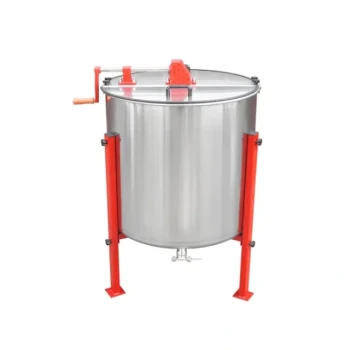
For commercial apiaries, centrifugal honey extractors are the primary harvesting equipment, while solar extractors serve mainly as auxiliary wax-processing tools. Centrifugal machines remove honey from decapped frames by spinning them, preserving the comb so frames can be returned to the hive and reused. Solar extractors use heat to melt honey, wax, and cappings, but their small-batch operation and destruction of comb structure make them unsuitable as the main system for large-volume harvesting.
The practical distinction is capacity versus recovery: centrifugal extraction is designed for fast, repeatable honey production with reusable comb, while solar extraction is best suited to recovering residual honey and wax from cappings or damaged comb.
How the Two Systems Work
Centrifugal Extraction Preserves Frames
A centrifugal extractor places decapped frames in a rotating basket. High-speed rotation forces liquid honey out of the cells while leaving the wax foundation substantially intact.
The extracted frames can then be returned to the colony. Bees do not need to rebuild the entire comb structure, which reduces wax-production demands and helps shorten the interval between harvests.
Solar Extraction Uses Heat
A solar extractor uses sunlight and heat to melt wax combs, cappings, and residual honey. The process separates liquid honey from wax after the comb structure has been broken down.
This makes solar equipment useful for cappings recovery, comb-scrap recycling, and wax collection, but it is not equivalent to a production-scale frame extractor.
Commercial Harvesting Performance
Throughput Favors Centrifugal Equipment
Commercial apiaries often process large numbers of frames within a limited harvest window. Centrifugal extractors are built for repeated loading, spinning, unloading, and integration with other processing steps.
Solar units operate in relatively small batch cycles and depend on available sunlight and sufficient heat. Those constraints make them difficult to use as the primary harvesting system when rapid order fulfillment and predictable production output matter.
Comb Reuse Improves Apiary Productivity
The main operational advantage of centrifugal extraction is not only speed. Preserving comb saves the colony time and energy, because bees can refill existing cells instead of secreting wax and rebuilding the foundation.
That reuse can support more consistent annual production and faster turnover between harvesting cycles. By contrast, solar melting destroys the comb, so the frames cannot be immediately returned to the hive in their original condition.
Solar Processing Adds Recovery Value
Solar equipment still has a valuable place in a commercial apiary. It can recover useful wax and residual honey from cappings, broken comb, and processing scraps that are unsuitable for normal centrifugal extraction.
This makes the solar extractor a complementary unit within a broader operation rather than a replacement for the main extraction line.
Product Quality and Process Control
Centrifugal Extraction Supports Standardization
Centrifugal harvesting provides a repeatable mechanical process. When used with properly prepared, decapped frames and appropriate filtering and settling equipment, it supports consistent production of extracted honey.
The process also reduces unnecessary manual handling compared with squeezing or crush-and-strain methods. Less handling can help reduce contamination risks and improve operational consistency.
Intact Comb Reduces Waste
Because centrifugal extraction separates liquid honey from the comb without intentionally destroying the foundation, the apiary retains the value of its comb assets. This is particularly important for commercial operators managing high frame counts and recurring harvests.
Solar melting converts the comb into separated wax and honey streams. That can be useful for recovery, but it eliminates the option of immediately reusing the comb as a production asset.
Moisture and Filtration Still Require Management
Neither equipment type alone guarantees final honey quality. Moisture content depends on factors such as harvest timing, frame ripeness, storage, and processing conditions.
Commercial operations should therefore pair centrifugal extraction with suitable uncapping, filtration, settling, storage, and quality-control procedures. Solar recovery streams may also require careful separation and handling before they are suitable for sale or further processing.
Equipment Fit for Commercial Apiaries
Centrifugal Extractors Are the Core System
For a commercial harvesting line, the extractor should be selected around expected frame volume, peak-season throughput, labor availability, and future expansion. Radial or tangential configurations, manual or automatic controls, basket capacity, and cleaning requirements all affect operational performance.
A properly sized centrifugal extractor becomes the central link between uncapping and downstream honey handling. Choosing too small a unit can create a bottleneck during the harvest window, while excessive capacity may increase capital and space requirements without immediate benefit.
Solar Extractors Are Supporting Equipment
A solar extractor is most appropriate where the apiary wants to recover wax and residual honey using low purchased energy. It can reduce waste and add value to cappings and damaged comb.
Its role should be planned as part of a full-spectrum processing setup: centrifugal equipment handles saleable honey extraction, while solar equipment supports wax recovery and by-product utilization.
Service and Supply Reliability Matter
For distributors, wholesalers, and B2B resellers, the comparison is also a sourcing decision. Commercial buyers may need extractors, uncapping equipment, filters, settling tanks, pumps, replacement parts, and related processing accessories from one dependable supplier.
Technical product matching, rapid response, reliable order fulfillment, and after-sales support can be as important as the machine’s headline capacity. A supplier that understands the entire workflow can help prevent compatibility problems and reduce downtime during the harvest season.
Understanding the Trade-offs
Centrifugal Equipment Requires Greater Investment
Commercial centrifugal extractors generally involve higher initial costs, more installation space, and more maintenance than simple solar units. Operators must also account for power requirements, cleaning procedures, moving components, and staff training.
These costs are justified when the apiary has enough harvest volume to benefit from faster processing and reusable comb. For small operations with limited production, the return on investment may take longer.
Solar Equipment Has Limited Harvest Capacity
Solar extractors are energy-efficient, but their output is constrained by sunlight, heat availability, chamber size, and batch duration. They are not well suited to processing the full volume of intact honey frames from a commercial harvest.
Treating a solar wax melter as a substitute for a centrifugal extractor can create serious throughput constraints and delay honey processing.
Comb Destruction Has a Long-Term Cost
Solar melting and crush-based methods recover honey and wax, but they sacrifice reusable comb. Bees must then spend additional time and energy producing new wax before the frames can support another full production cycle.
That cost may be acceptable for damaged comb or cappings. It is generally inefficient when applied to sound, reusable honeycomb at commercial scale.
Equipment Must Match the Workflow
A centrifugal extractor can also become a bottleneck if its capacity does not match the uncapping station, labor team, pumps, filters, or storage tanks. Purchasing the largest available unit is not automatically the best decision.
The correct system balances throughput, frame format, automation level, maintenance access, hygiene requirements, and projected growth.
Making the Right Choice for Your Goal
The appropriate choice depends on whether the priority is primary honey extraction, wax recovery, or a complete commercial processing line.
- If your primary focus is high-volume honey harvesting: Choose a properly sized centrifugal honey extractor that preserves comb and supports repeatable processing throughput.
- If your primary focus is wax and cappings recovery: Add a solar extractor to process comb scraps and residual honey with low purchased-energy requirements.
- If your primary focus is maximum annual apiary productivity: Prioritize centrifugal extraction so empty frames can return quickly to the hives for reuse.
- If your primary focus is one-stop commercial sourcing: Work with a supplier that can coordinate extraction, uncapping, filtration, storage, replacement parts, technical support, and rapid order fulfillment.
For commercial apiaries, the strongest setup uses centrifugal extraction for production capacity and solar processing for efficient wax and cappings recovery.
Summary Table:
| Feature | Centrifugal Honey Extractor | Solar Honey Extractor |
|---|---|---|
| Primary Role | Main harvesting equipment for honey extraction | Auxiliary tool for wax and cappings recovery |
| Comb Preservation | Preserves comb for reuse, saving bee energy | Destroys comb structure, no immediate reuse |
| Throughput | High, designed for large volumes | Low, batch-based, weather-dependent |
| Energy Source | Electricity/manual | Solar heat |
| Operational Cost | Higher initial investment, lower per-batch cost | Low energy cost, but limited capacity |
| Best For | Commercial apiaries with high frame volume | Recovering residual honey and wax from scraps |
| Product Quality | Supports standardized, consistent honey production | Requires additional separation and handling for quality |
Ready to optimize your commercial honey harvesting?
At HONESTBEE, we supply a comprehensive range of centrifugal and solar extractors, along with uncapping machines, filters, settling tanks, and all your processing essentials. Whether you're a distributor looking for reliable wholesale supply, a wholesaler needing one-stop sourcing, or a beekeeper seeking to scale up, our team provides rapid response, expert guidance, and ultra-fast delivery to keep your operation running smoothly. Contact us today for tailored solutions and competitive wholesale pricing!
Related Products
- HONESTBEE 72 Frame Industrial Electric Honey Extractor for Beekeeping
- Electric 8 Frame Honey Spinner Extractor Equipment for Beekeeping
- 32 Frame Commercial Electric Honey Extractor for Beekeeping and Honey Production
- Electric 4 Frame Tangential Honey Extractor
- HONESTBEE 6 Frame Self Reversing Electric Honey Extractor for Beekeeping
People Also Ask
- What is the importance of balancing honeycomb frames within a honey extractor? Ensure Stability and Protect Machinery
- How is honey separated from the frames after they are uncapped? Efficient Extraction Methods for High Yields
- What are the main benefits of using a honey extractor? Maximize Yields and Protect Your Honeycomb
- What are the recommended methods for removing honey from the honeycomb? Top Extraction Techniques for Maximum Efficiency
- How do manual honey extractors compare to electric honey extractors? Choosing the Right Tool for Your Apiary Growth