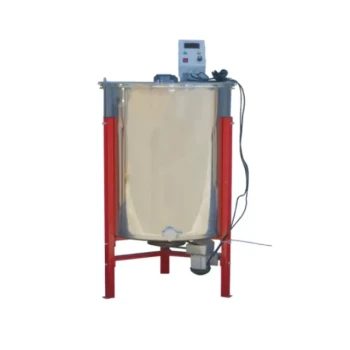
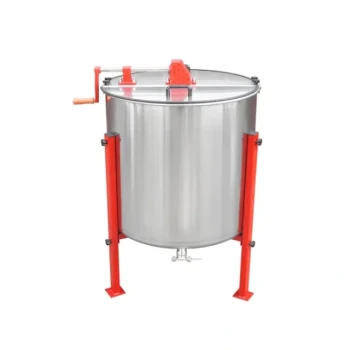
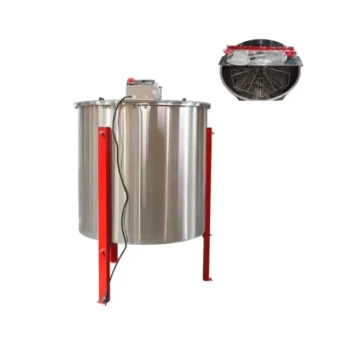
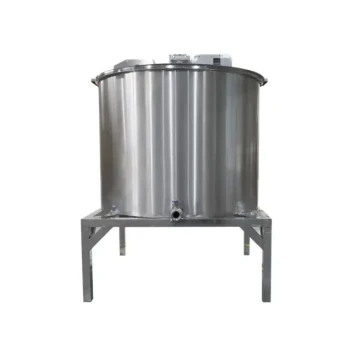
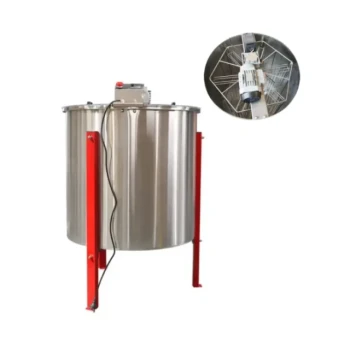
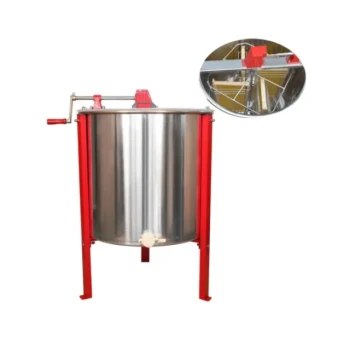
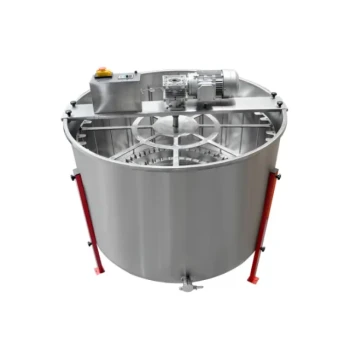
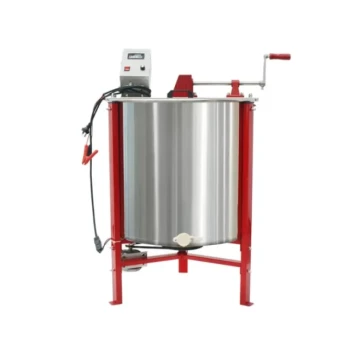
A centrifugal honey extractor operates by spinning beekeeping frames at high speeds within a cylindrical drum to separate liquid honey from the wax comb. By utilizing centrifugal force, the device pulls the honey out of uncapped cells and projects it against the inner walls of the barrel. Once the honey hits the wall, gravity causes it to drain to the bottom of the unit for collection through a tap or valve.
The definitive advantage of this method is comb preservation. Unlike crushing methods that destroy the wax, a centrifugal extractor leaves the honeycomb structure intact, allowing beekeepers to return the frames to the hive for immediate reuse by the bees.
The Mechanics of Extraction
The Central Components
The core of the extractor involves a cylindrical drum containing a central rotating fitting, often a metal mesh basket or barrel. This basket is designed to hold standard beekeeping frames securely in place during operation.
Generating Centrifugal Force
Whether powered by a manual hand crank or an electric motor, the central basket rotates at high velocity. This rotation generates significant centrifugal force, which is the physical principle responsible for dislodging the honey.
The Flow Path
As the basket spins, the force acts on the liquid honey, pulling it outward from the comb. The honey flies out of the cells, impacts the stationary inner wall of the drum, and flows downward to the base, maintaining hygiene and efficiency.
The Operational Process
Essential Preparation: Uncapping
Before a frame can be placed in the extractor, the wax cappings sealing the honey cells must be removed or punctured. The extractor cannot pull honey through sealed wax; the cells must be open for the force to be effective.
Loading and Balancing
Frames are placed into the wire baskets within the drum. It is critical to balance the load by placing frames of similar weight opposite each other. An unbalanced load will cause the machine to vibrate excessively or "walk" during the spin cycle.
The Spin Cycle
Once loaded, the operator activates the spin mechanism. For manual models, this involves cranking a handle for roughly 20 to 60 seconds per side. Electric models perform this automatically at consistent speeds.
Handling Frame Orientation
In many standard extractors (tangential style), honey is only extracted from the side of the frame facing the wall. Once the first side is empty, the operator must stop the machine and flip the frames to extract the second side. Some models require removing the frames entirely to reinsert them facing the opposite direction.
Understanding the Trade-offs
Mechanical Vibration
The efficiency of the extractor is heavily dependent on load distribution. If frames are not balanced precisely, the centrifugal force creates violent vibrations that can make the device difficult to control or potentially damage the mechanism.
Frame Manipulation
While efficient, the process often requires manual intervention. Unless using a radial extractor (where both sides empty simultaneously), the user must manually stop the process to flip the frames, which adds time to the workflow.
Making the Right Choice for Your Goal
To select the right extraction approach, consider your volume and resources:
- If your primary focus is preserving resources: Prioritize this method over crushing, as saving the drawn comb saves the bees significant energy in rebuilding wax.
- If your primary focus is processing speed: Choose an electric extractor to eliminate the physical labor of cranking and ensure consistent RPMs for faster separation.
- If your primary focus is equipment longevity: Ensure you meticulously balance every load to prevent vibration wear on the central bearings and motor.
Properly utilized, a centrifugal extractor is the most efficient tool for harvesting honey while sustaining the health and productivity of the hive.
Summary Table:
| Feature | Manual Extractor | Electric Extractor |
|---|---|---|
| Power Source | Hand Crank | Electric Motor |
| Extraction Speed | Variable (Operator-led) | Consistent High RPM |
| Labor Intensity | High physical effort | Minimal monitoring |
| Best For | Small-scale / Hobbyists | Commercial Apiaries |
| Key Benefit | Low cost & portable | Fast processing & high efficiency |
Scale Your Honey Production with HONESTBEE
Maximize your harvest efficiency while protecting your valuable wax combs. HONESTBEE provides commercial apiaries and distributors with premium-grade centrifugal honey extractors, honey-filling machinery, and a full spectrum of beekeeping equipment designed for longevity and performance.
Whether you are upgrading your facility with high-speed machinery or stocking essential industry consumables for distribution, our comprehensive wholesale solutions are tailored to your growth.
Ready to streamline your apiary operations?
Contact Us Today to Discuss Wholesale Opportunities
Related Products
- electric honey extractor honey centrifuge 3 frame honey extractor stainless steel honey frame extractor
- Manual Hand Crank 4 Frame Honey Extractor Centrifuge for Beekeeping
- Professional 4 Frame Self Reversing Electric Honey Extractor for Beekeeping
- 24 Frame Honey Extractor Commercial Radial Honey Frame Extraction Machine
- Electric 4 Frame Tangential Honey Extractor
People Also Ask
- What are the characteristics of electric honey extractors? Boost Your Apiary Efficiency with Automated Technology
- What are the disadvantages of using an electric honey extractor? Weighing Cost, Power, and Comb Safety
- What are the advantages of an electric honey extractor? Boost Efficiency and Scale Your Honey Production
- What are the technical advantages of electric honey extractors? Maximize Yield and Protect Your Bee Colony
- How does an electric honey extractor affect the quality of honey? Preserve Flavor & Purity with Precision Extraction