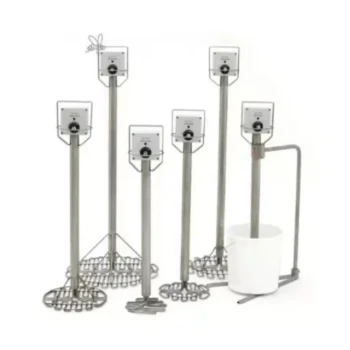
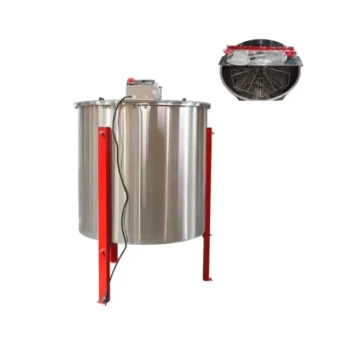
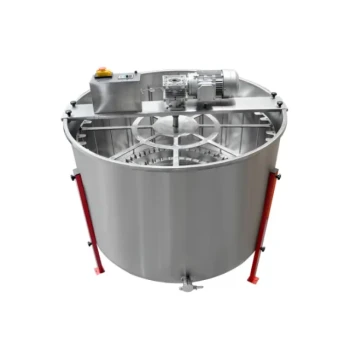
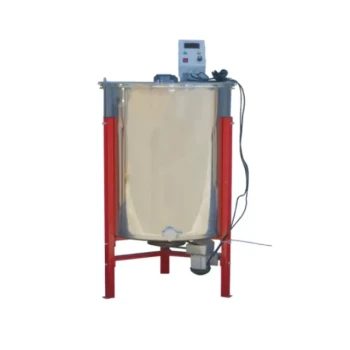
A high-torque mechanical stirrer facilitates nucleation by generating controlled mechanical shear force. By operating at adjustable rotation speeds, typically between 180 and 540 rpm, the stirrer inputs mechanical energy that simulates industrial mixing processes. This physical agitation accelerates the mass transfer of solute molecules, which is the fundamental driver for creating stable crystal nuclei in the honey.
The application of mechanical shear is the defining factor in controlling the nucleation rate. By increasing stirring intensity, you effectively raise the nucleation rate, forcing the honey to develop smaller, more uniform crystals rather than large, gritty structures.
The Mechanics of Induced Nucleation
Generating Mechanical Shear
The primary function of the stirrer is not simply to move the honey, but to apply mechanical shear force. Honey is a supersaturated sugar solution, and the physical force of the blades cuts through the viscous liquid. This energy input forces sugar molecules into alignment, lowering the energy barrier required for crystals to begin forming.
Accelerating Mass Transfer
Nucleation relies on the movement of molecules. High-torque stirring significantly accelerates mass transfer, ensuring that solute molecules collide and aggregate more frequently. Without this active agitation, the movement of molecules in viscous honey would be too slow to support a rapid or controlled crystallization process.
Controlling Crystal Size
There is a direct correlation between stirring intensity and crystal morphology. The mechanical input promotes a higher density of nuclei. When more nuclei form simultaneously, the available sugar distributes across many sites, resulting in smaller and more uniform crystals, which is the hallmark of a smooth, creamed texture.
The Critical Role of Thermal Balance
Overcoming High Viscosity
Honey acts as a thermal insulator due to its high viscosity and poor heat conduction efficiency. Without agitation, heat applied to the vessel walls fails to penetrate the center of the mass. The mechanical stirrer forces convective heat transfer, moving heated honey away from the walls and mixing it with the cooler center.
Ensuring Temperature Uniformity
Effective nucleation occurs only within specific temperature ranges. The stirrer eliminates internal temperature gradients, ensuring the entire batch remains at the target temperature for crystallization. This uniformity is essential for consistent results; otherwise, different parts of the batch would crystallize at different rates.
Understanding the Trade-offs
Managing Heat Sensitivity
While mechanical input is necessary for nucleation, it must be balanced against honey's sensitivity to heat. The friction from high-speed stirring can generate its own heat. Furthermore, poor stirring that leaves honey stagnant near heating elements can cause localized overheating, leading to enzyme loss or the formation of hydroxymethylfurfural (HMF), a marker of heat damage.
Equipment Requirements
Standard mixing equipment often fails under the load of honey. The term "high-torque" is critical here; the equipment must maintain consistent RPM ranges (180–540) against the substantial resistance of the viscous fluid. Inadequate torque results in speed fluctuations that yield inconsistent crystal sizes.
Making the Right Choice for Your Goal
To optimize your honey processing, you must adjust the stirring parameters based on your desired end product.
- If your primary focus is Texture (Creamed Honey): Prioritize higher rotation speeds (closer to 540 rpm) to maximize shear force, ensuring the smallest possible crystals for a smooth mouthfeel.
- If your primary focus is Quality Preservation: Ensure the stirrer is active during any heating phase to prevent localized hotspots that degrade enzymes and increase HMF levels.
Mastering the balance of mechanical shear and thermal uniformity is the key to producing premium crystallized honey.
Summary Table:
| Parameter | Influence on Nucleation | Benefit for Honey Quality |
|---|---|---|
| Mechanical Shear | Lowers energy barrier for molecular alignment | Encourages rapid, dense nuclei formation |
| Rotation Speed | 180 - 540 rpm (Adjustable) | Controls crystal size for smooth texture |
| Mass Transfer | Accelerates molecular collision rate | Ensures fast and stable crystallization |
| Thermal Uniformity | Eliminates internal temperature gradients | Prevents heat damage and enzyme loss |
| High Torque | Maintains constant RPM against viscosity | Guarantees consistent batch results |
Elevate Your Honey Processing with HONESTBEE Professional Equipment
Achieving the perfect creamed honey texture requires the right balance of mechanical power and thermal control. HONESTBEE specializes in serving commercial apiaries and distributors with high-performance wholesale solutions. From high-torque honey-making machinery and precision honey-filling machines to a full spectrum of beekeeping tools and industry consumables, we provide the hardware you need to scale your production.
Ready to enhance your product quality and operational efficiency? Partner with HONESTBEE for professional-grade equipment tailored to your apiary's needs.
References
- Lucília Carolina Vardenski Costa, Leda Battestin Quast. Influence of temperature and homogenization on honey crystallization. DOI: 10.1590/1981-6723.7314
This article is also based on technical information from HonestBee Knowledge Base .
Related Products
- Modern Stainless Steel Honey Dipper Stirrer
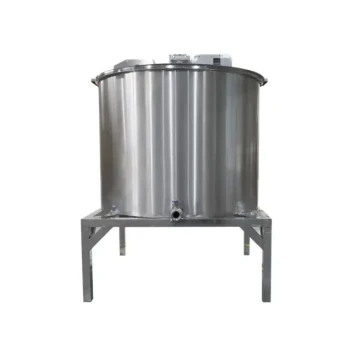
- Double Wall Honey Heating Stirring Homogenizer Mixing Machine with Various Capacity
- Professional Plastic Honey Dipper for Easy Honey Drizzling
- Modern Honeycomb Pattern Wooden Honey Dipper for Stirring and Drizzling
- Commercial Rotary Honey Filling Machine for Production
People Also Ask
- What is a honey dipper? Master the Art of the Perfect Drizzle with This Essential Tool
- How do you clean and store a honey dipper? Simple Steps for Long-Lasting Performance
- What is a honey taking spoon called? Discover the Tool for a Perfect, Mess-Free Drizzle
- What is a honey dipper and what is it used for? A Guide to Mess-Free Drizzling
- What is the proper method for cleaning a honey dipper? Maintain Pure Flavor with These Easy Pro Tips