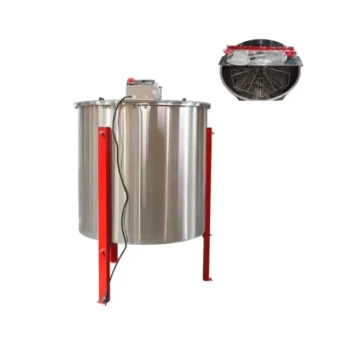
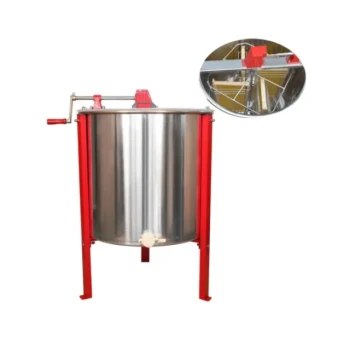
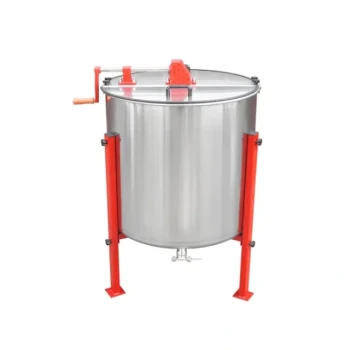
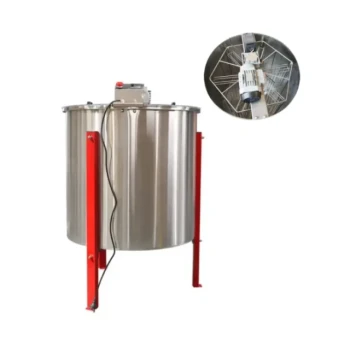
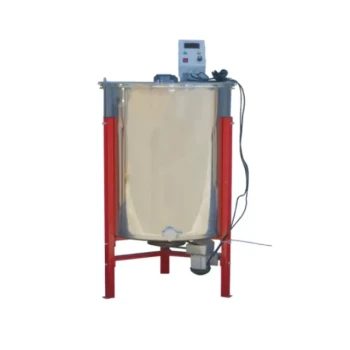
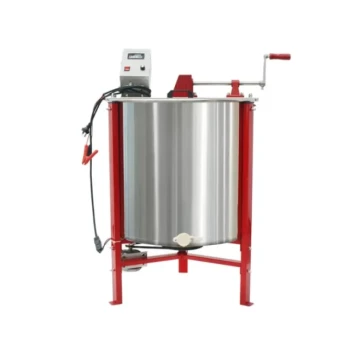
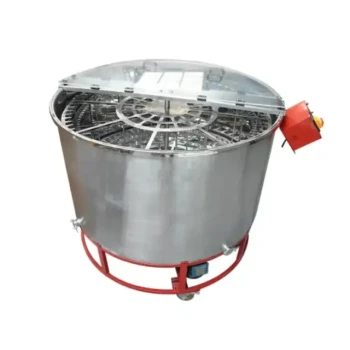
A mechanical brake unit serves as a critical control mechanism that manages the transition from high-speed extraction to a complete stop. By applying friction through rubber-coated semi-circular rings, it counteracts the significant inertia of the rotating basket, allowing operators to halt the machine safely without waiting for it to coast to a stop naturally.
While the honey extractor relies on centrifugal force to operate, the remaining rotational energy after power is cut can create hazardous conditions. A mechanical brake converts this kinetic energy into heat via friction, providing a controlled method to stop the basket and preventing the instability caused by sudden halts.
The Physics of Controlled Stops
Counteracting Rotational Inertia
Honey extractors operate by spinning frames at high speeds to generate centrifugal force. This force is necessary to pull honey from the comb without damaging the wax structure.
However, once the motor is cut, the heavy basket continues to spin due to inertia. Without intervention, a fully loaded extractor can take a significant amount of time to drift to a stop on its own.
The Friction Mechanism
To combat this inertia, the mechanical brake unit utilizes rubber-coated semi-circular rings.
These rings are designed to create resistance against the moving parts of the extractor. By pressing these rubber elements against the assembly, the operator generates friction that steadily bleeds off the rotational energy.
Operational Safety and Stability
Preventing Dangerous Vibrations
Stopping a heavy, spinning load incorrectly can be dangerous. An uncontrolled or sudden stop often results in violent equipment vibration.
The mechanical brake allows the operator to modulate the stopping force. This prevents the jarring motion that can damage the extractor's bearings, the tank, or the delicate wax frames inside.
Enhancing Operator Safety
The primary goal of the brake is to mitigate operational safety risks.
Waiting for a basket to stop naturally creates a temptation for operators to reach in prematurely. A brake ensures the equipment is fully stationary and safe before the operator opens the unit to swap frames.
Understanding the Trade-offs
Wear and Tear Components
Because the system relies on friction, the rubber coating on the rings is a wear item. Over time, the heat and abrasion generated during braking will degrade the rubber, requiring inspection and eventual replacement to maintain safety standards.
The Risk of Over-Braking
While the brake prevents vibrations from "free-wheeling," applying the mechanical brake too aggressively can still cause instability.
Effective use requires a gradual application of force. "Slamming" the brake can replicate the very shock loads and vibration issues the device is designed to prevent.
Making the Right Choice for Your Goal
Mechanical brakes are not just about stopping; they are about workflow and longevity.
- If your primary focus is Efficiency: You need a mechanical brake to reduce "coast-down" time, allowing you to unload and reload frames significantly faster between cycles.
- If your primary focus is Equipment Longevity: You should prioritize a brake unit to prevent the structural stress and bearing damage caused by unchecked vibrations during shutdown.
A well-maintained mechanical brake transforms a honey extractor from a simple spinning tool into a controlled, professional-grade instrument.
Summary Table:
| Feature | Function & Benefit |
|---|---|
| Mechanism | Rubber-coated semi-circular rings creating friction against the basket assembly. |
| Inertia Control | Rapidly bleeds off rotational energy, reducing downtime between extraction cycles. |
| Safety Benefit | Prevents premature access to spinning parts and reduces risk of injury. |
| Stability | Minimizes violent vibrations that can damage bearings, tanks, and wax frames. |
| Maintenance | Requires periodic inspection of rubber coatings to ensure consistent braking force. |
Elevate Your Beekeeping Operation with HONESTBEE
At HONESTBEE, we understand that efficiency and safety are paramount for commercial apiaries and distributors. Our professional-grade honey extractors are equipped with precision mechanical brake units to ensure your workflow remains fast and your equipment lasts longer.
As a comprehensive wholesale supplier, we provide everything from honey-filling machines and hive-making equipment to the essential beekeeping tools and consumables your business relies on. Whether you are scaling your extraction facility or stocking your distribution center, we offer the technical expertise and high-quality machinery needed to succeed.
Ready to optimize your production? Contact us today to discuss our wholesale offerings and discover how our specialized beekeeping solutions can benefit your business!
References
- M. A. Al-Rajhi, A. El-Sheikha. DEVELOPMENT AND EVALUATION OF A TANGENTIAL HONEY - EXTRACTOR. DOI: 10.21608/mjae.2014.98404
This article is also based on technical information from HonestBee Knowledge Base .
Related Products
- Spare Crank Gear Drivetrain Assembly for Manual 4 Frame Honey Extractor
- Stainless Steel 3 Frame Manual Honey Extractor Spinner for Bee Honey Extraction
- Manual Hand Crank 4 Frame Honey Extractor Centrifuge for Beekeeping
- Vertical Motor Kits for 2 3 4 Frame Electric Honey Extractors
- Stainless Steel Manual Honey Press with Guard for Pressing Honey and Wax
People Also Ask
- What is the function of geared motors in honey extractors? Automate Extraction for Maximum Efficiency and Volume
- Are manual honey extractors effective at extracting honey? Master Small-Scale Harvesting with Precision Control
- What are the physical demands of a manual honey extractor? A Guide to Effort vs. Reward
- Who typically uses manual honey extractors? Ideal for Small-Scale & Hobbyist Beekeepers
- What are the advantages of a manual honey extractor? Control, Cost, and Independence