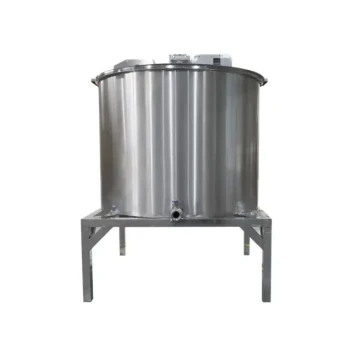
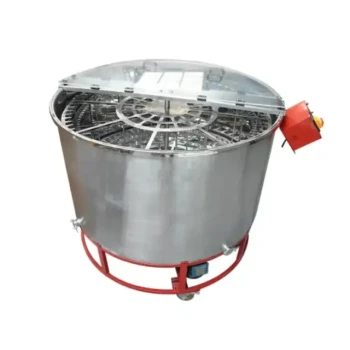
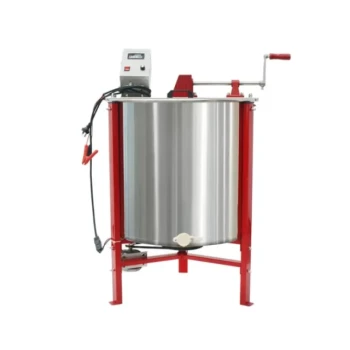
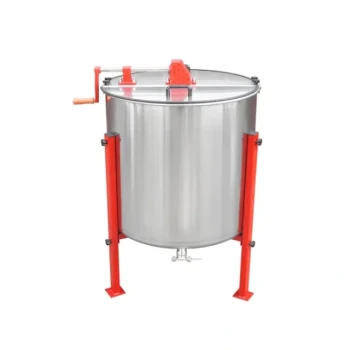
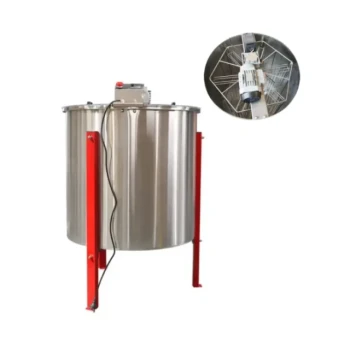
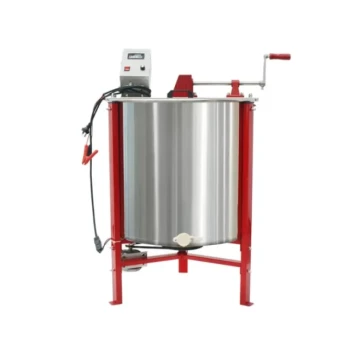
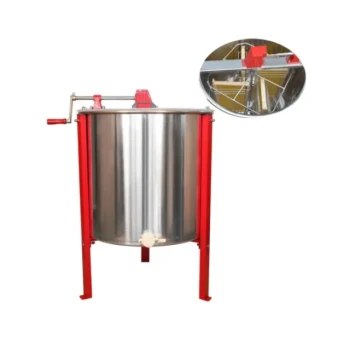
A multi-functional honey extractor facilitates the collection of honey during specific urban flowering periods by utilizing adjustable centrifugal force to separate honey from the comb. Its variable speed settings allow beekeepers to extract honey from fragile, newly built combs without causing damage, enabling the precise segregation of harvests based on distinct botanical sources.
The core value of a multi-functional extractor lies in its ability to perform "fine separation" of honey batches. By adjusting extraction speeds to suit the comb's fragility, beekeepers can isolate specific varietals, preserving the unique flavor profiles and chemical integrity of honey produced during different seasonal blooms.
The Mechanics of Precision Extraction
Utilizing Centrifugal Force
The extractor operates by spinning beehive frames, using centrifugal force to pull liquid honey out of the wax cells.
This mechanical process separates the honey effectively while keeping the physical structure of the frame intact.
The Importance of Adjustable Speed
A critical feature of multi-functional extractors is the ability to control the rotation speed.
During specific flowering periods, bees often build fresh, fragile combs to store the influx of nectar.
High speeds can destroy these delicate wax structures. By lowering the speed, the extractor protects the comb while still removing the honey.
Capturing Distinct Botanical Profiles
Isolating Flowering Periods
Urban environments often have distinct micro-seasons where different plants bloom in succession.
The extractor's gentle handling capability allows beekeepers to harvest honey immediately after a specific bloom ends, rather than waiting for a full season.
This "fine separation" ensures that honey from one botanical source is not mixed with another, preserving distinct flavor profiles.
Preserving Phytochemical Integrity
Beyond flavor, the method of extraction impacts the chemical composition of the honey.
By minimizing mechanical disturbance and preventing excessive aeration, the extractor maintains the natural state of the honey.
This ensures the integrity of sensitive components like polyphenols and alkaloids, which are critical for high-quality or laboratory-grade analysis.
Understanding the Trade-offs
Efficiency vs. Preservation
While adjustable speeds protect fragile combs, using lower speeds extends the time required to fully extract the honey.
Beekeepers must balance the need for speed (throughput) against the risk of blowing out a comb and contaminating the honey with wax particles.
Complexity of Operation
Multi-functional extractors offer more control, but they require the operator to actively judge the stability of the comb.
Incorrectly gauging the speed settings can still result in comb failure or incomplete extraction, requiring a higher level of user attention than single-speed industrial models.
Making the Right Choice for Your Goal
To maximize the utility of a multi-functional extractor, align your usage with your specific objectives:
- If your primary focus is Flavor Purity: Harvest immediately after a specific bloom ends and use lower speeds to prevent wax contamination.
- If your primary focus is Comb Preservation: Prioritize the lowest effective speed setting to ensure reusable frames for the next flowering cycle.
- If your primary focus is Chemical Analysis: Minimize the duration of spinning to reduce aeration and preserve natural phytochemicals.
By leveraging adjustable speeds, you transform extraction from a bulk process into a precision tool for varietal preservation.
Summary Table:
| Feature | Benefit for Urban Beekeeping | Impact on Quality |
|---|---|---|
| Variable Speed | Protects fragile, newly built wax combs | Prevents wax contamination |
| Centrifugal Control | Enables extraction of small, seasonal batches | Preserves distinct flavor profiles |
| Gentle Handling | Reduces honey aeration during spinning | Maintains phytochemical integrity |
| Fine Separation | Isolates honey from specific botanical sources | Enhances varietal purity |
Elevate Your Honey Production with HONESTBEE
Are you looking to scale your apiary or upgrade your wholesale distribution? HONESTBEE provides the industry's most comprehensive range of beekeeping tools and machinery designed for precision and durability. From multi-functional honey extractors that preserve delicate varietals to high-capacity honey-filling machines and specialized hive-making equipment, we cater specifically to the needs of commercial apiaries and global distributors.
Our extensive portfolio also includes essential industry consumables and unique honey-themed cultural merchandise to help your brand stand out. Partner with a supplier that understands the technical demands of modern beekeeping.
Ready to optimize your harvest? Contact HONESTBEE today to discuss our wholesale solutions and expert equipment support!
References
- Jorge Godoy Román. EL ESPÍRITU DEL ZUMBIDO: ENTREVISTA CON ERIKA MAYR. DOI: 10.56255/ma.v1i21.505
This article is also based on technical information from HonestBee Knowledge Base .
Related Products
- 32 Frame Commercial Electric Honey Extractor for Beekeeping and Honey Production
- HONESTBEE 3-Frame Manual Acrylic Honey Extractor
- HONESTBEE 72 Frame Industrial Electric Honey Extractor for Beekeeping
- Commercial Electric 12 Frame Honey Extractor Spinner Motorized Honey Extractor
- Electric 4 Frame Tangential Honey Extractor
People Also Ask
- What are commercial honey extractors used for? Boost Your Apiary's Efficiency & Profitability
- What is a commercial honey extractor? The Essential High-Volume Solution for Large Apiaries
- Who are commercial honey extractors designed for? Scaling Your Industrial Beekeeping Success
- How is honey extracted commercially? Maximize Your Apiary's Efficiency and Honey Yield
- What are commercial honey extractors and for what scale of beekeeping are they intended? Scale Your 200+ Colony Apiary